
Spain debate: allowing dogs up to 40kg on trains
Forum discusses admitting dogs up to 40kg on Spain's Cercanías with muzzles, leashes, and time limits, plus a proposed pet-only carriage.
English · Original discussion in Spanish · Published
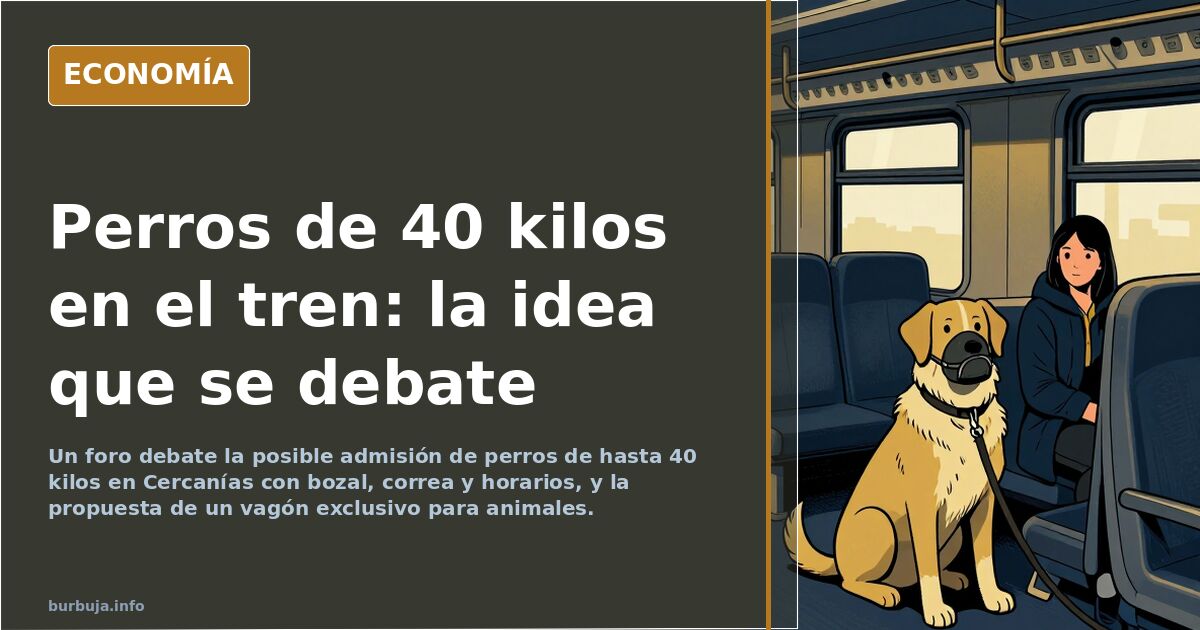
The debate on large dogs in trains: up to 40kg
Can a passenger board a Cercanías train (Spain's commuter rail) with a 40kg dog? The forum discusses this possibility, mixing hygiene, public space, and an uncomfortable question: who decides how we travel in a shared carriage? The proposal discussed comes with conditions — muzzle, leash, and schedules — and an idea hovering over the issue: enabling an exclusive carriage for animals. There is no official confirmation that this is a finalized measure; it is an open debate.
The starting point is well summarized by a recurring complaint: if the dog pays a ticket, why doesn't it also pay for the hygiene surcharge, the special seat fee, and care costs? The joke has substance. Cercanías already allows dogs with conditions for some time, according to the thread, so the novelty would not be the dog on the train, but its size. And that is where the trouble begins.
What changes with dogs up to 40kg
What is being debated is not whether a dog can travel, but how much it can weigh. The current rule in Cercanías admits animals with muzzles, on leashes, and during specific time slots, according to participants. Raising the limit to 40kg would open the door to breeds that no longer fit in a carrier and would occupy the aisle. That is the leap being debated.
Some argue that the measure is a concession to voters with pets, a growing demographic year after year. Against this weighs the argument of space: a Cercanías carriage at rush hour cannot accommodate a large dog without someone giving up their spot. The calculation thrown into the thread is that a 40kg dog takes up the space of two standing passengers.
The debate gets dirty quickly. Part of the messages devolves into insults against those defending the measure, and others respond in kind. In the middle remains what matters: whether a specific carriage is enabled, whether cleaning is reinforced, and who pays that extra cost.
Madrid Metro model as a mirror
Madrid's metro already reserves spaces and times for animals, as mentioned in the thread. This precedent is used as an argument in both directions: some say it works and Renfe is late; others respond that the conditions of the metro and Cercanías are not the same, because Cercanías covers long journeys with passengers seated for longer periods.
The comparison matters because it sets the bar. If the metro does it, Renfe can do it. If Cercanías has a different scale, the design must be distinct. No one has yet published the technical details: how many carriages, on which lines, with what cleaning frequency.
Allergies, hygiene, and the health argument
The health front is the most delicate. Allergy to dog and cat hair epithelium is mentioned, as well as Lyme disease. These are risks cited, but bounded: allergy affects those who have it, and ticks do not jump alone from the animal to the passenger. Still, the argument is used to demand that allergic people be banned from traveling, which gives the tone of the measure.
Hygiene is the other pillar. Urination, feces in the aisle, and barking appear in almost all critical messages. There are no public data on how many incidents of this type are currently recorded in Cercanías, leaving the debate in the realm of anecdote and impression.
The business behind the measure
There is a repeated economic reading: the free nature of some services and the opening to pets would seek to overload the system to later justify privatization. It is a hypothesis, not a fact, and circulates as such. What is mentioned is the context: Renfe operates with public subsidies and faces pressure to increase revenue.
Pet tourism moves money. Dog-friendly beaches, pet-friendly hotels, and trains that accept them would form a package. Renfe would not want to be left out. The question is whether the passenger without a dog pays for the party in the form of a half-empty reserved carriage.
What will happen in September
The date appearing in the messages is September, when the free nature of some routes and the possible entry of large dogs would coincide. The most repeated prediction is chaos: full trains, 40kg animals, and insufficient staff to control muzzles and schedules.
There is no official confirmation of the calendar. The measure remains in the study phase, and the result depends on whether Renfe publishes a specific rule or leaves the matter in the air. With what is on the table, the scenario presented is a trial period with strict conditions and complaints in both directions.
In the end, the question is not whether a dog fits in a train. It is whether the passenger who pays their ticket has the right to choose who they share a carriage with. And that, with or without a dog, still has no answer.
Also available in: Deutsch
Summary of a discussion on Burbuja.info - Foro de economía, actualidad y política., translated from Spanish and reviewed before publication. Read the full discussion (109 replies).
More summaries
-
Street vending in Madrid metro fuels informal economy debate
Street vending in the Madrid metro sparks debate on the causes of Spain's informal economy and labor precarity.
-
Madrid Metro Safety Crisis: Incidents Become Normalized
A recent altercation in Madrid's metro reignites debate on public transport safety, highlighting institutional passivity and growing user frustration.
-
Video Shows Fight on Madrid Metro Line 10
Unverified video captures a brawl on Madrid's Metro Line 10, reigniting debate over public transport safety.
-
AI challenges Spanish bachelor's thesis: 80% of universities seek curriculum reform
A study by the CYD Foundation reveals that 80% of Spanish universities plan to modify curricula due to AI, with 63.9% prioritizing assessment changes.
-
Australia pauses working holiday visas for Spain
Australia has paused Spain's working holiday visa after the annual quota was filled. Japan has already done the same, and one school of analysis argues the Spanish passport is losing value.
-
AfD, energy and Russia dependence spark heated debate in Germany
A forum discusses alleged Russian funding of Germany's AfD and the country's energy future, amid accusations of propaganda and disinformation.