
Madrid Metro Safety Crisis: Incidents Become Normalized
A recent altercation in Madrid's metro reignites debate on public transport safety, highlighting institutional passivity and growing user frustration.
English · Original discussion in Spanish · Published
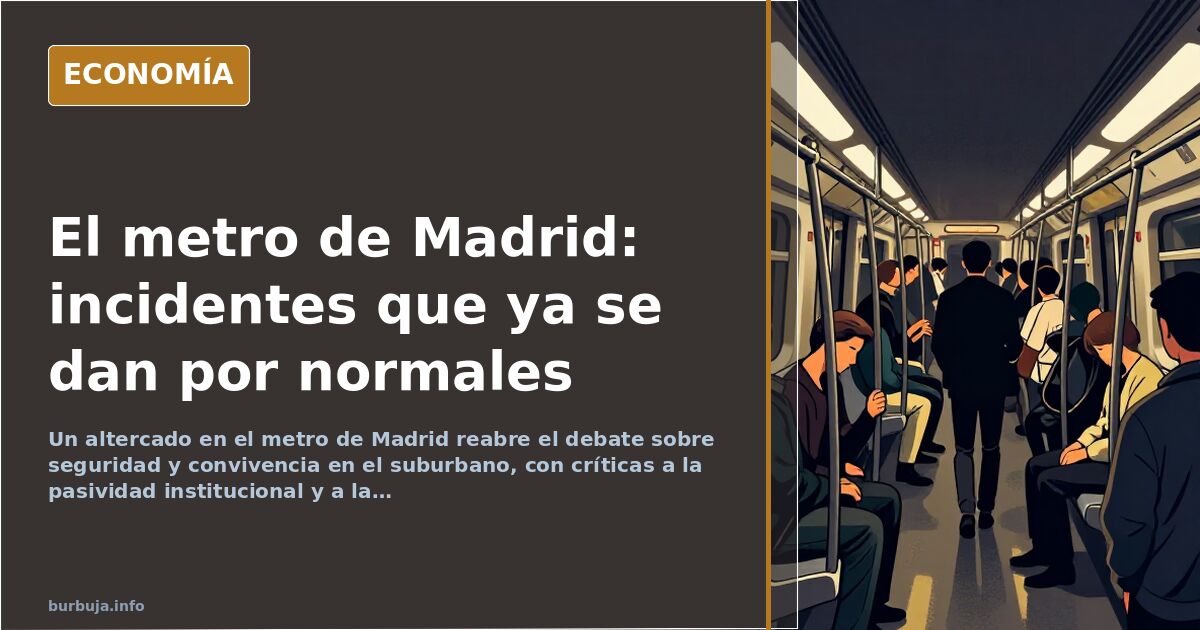
Madrid Metro and the Normalization of Insecurity
A video of an altercation in a Madrid metro car —a heated argument between passengers, a perfume bottle thrown to the floor, and escalating tension— has prompted hundreds to share what no longer surprises them: the underground system has become a space where incidents are increasingly accepted as part of the daily landscape. According to commenters, this scene, widely shared on social media, is not isolated but the tip of broader discontent regarding coexistence, safety, and institutional neglect in the capital.
What the Video Shows and What It Doesn't
The footage captures a confrontation between two men in a carriage. One appears to speak Spanish without a marked foreign accent, leading some to speculate he may be second-generation. The other, wearing a white shirt, picks up a bottle from the floor and throws it dismissively at the first man’s feet. There is no consensus on what triggered the dispute or who is responsible. What is clear is that no one intervened, while several passengers filmed with their phones.
This passivity is precisely the core of the dissatisfaction. Some argue that any attempt to mediate or reprimand the agitator becomes a bigger problem: carriage cameras, assault reports, accusations of racism online, and crowds of witnesses recording. The cold calculation is that the cost of intervening outweighs any benefit. This mindset repeats itself car after car.
Unacknowledged Institutional Neglect
The most repeated diagnosis does not point to the disruptive passenger, but to those who should prevent such behavior. Critics cite dereliction of duty by the metro operator and relevant administrations. The specific complaint: if you try to solve a problem yourself, the full weight of the law falls on you; if you ignore it, nothing happens. This asymmetry —infinite tolerance for incivility, zero tolerance for self-defense— has, according to this analysis, turned the metro into a space where looking away is the norm.
Criticism extends to the political class. The President of the Community of Madrid and the Mayor of the capital are cited as ultimately responsible for a policy that, according to this view, prioritizes the image of an open city over users' real safety. The accusation is not of incompetence, but of ideological complicity with a model that produces these episodes.
The Metro as a Social Thermometer
Beyond the specific incident, the issue has allowed many users to share their daily experiences. Some use the metro out of necessity, describing pogre deterioration: situations that would have been scandalous twenty-five years ago are now accepted with resignation. For some, remote work has been the only escape. For others, the solution lies in leaving Madrid.
The debate drifts toward immigration, but with nuances worth separating. Some participants distinguish between migrants who work and respect rules —who also suffer from the stigma generated by uncivil behavior— and a minority they claim is making coexistence in public transport unbearable. Generalization, however, is an error the material itself avoids in several points.
Is There a Solution or Just Damage Control?
Proposals circulating are few and modest. They include increased police presence, private security in cars, and stricter consequences for disrupting order. But none address the root problem: the perception that the state protects offenders and abandons citizens. As long as this perception persists, any measure will be cosmetic.
Ultimately, the video matters less than what it reveals: a society that has internalized that public space no longer belongs to everyone, but to whoever shouts loudest. And a public transport system that, once a symbol of modernity, has become a thermometer of deeper malaise. How many more incidents are needed before someone decides enough is enough?
A video of an altercation in a Madrid metro car —a heated argument between passengers, a perfume bottle thrown to the floor, and escalating tension— has prompted hundreds to share what no longer surprises them: the underground system has become a space where incidents are increasingly accepted as part of the daily landscape. According to commenters, this scene, widely shared on social media, is not isolated but the tip of broader discontent regarding coexistence, safety, and institutional neglect in the capital.
What the Video Shows and What It Doesn't
The footage captures a confrontation between two men in a carriage. One appears to speak Spanish without a marked foreign accent, leading some to speculate he may be second-generation. The other, wearing a white shirt, picks up a bottle from the floor and throws it dismissively at the first man’s feet. There is no consensus on what triggered the dispute or who is responsible. What is clear is that no one intervened, while several passengers filmed with their phones.
This passivity is precisely the core of the dissatisfaction. Some argue that any attempt to mediate or reprimand the agitator becomes a bigger problem: carriage cameras, assault reports, accusations of racism online, and crowds of witnesses recording. The cold calculation is that the cost of intervening outweighs any benefit. This mindset repeats itself car after car.
Unacknowledged Institutional Neglect
The most repeated diagnosis does not point to the disruptive passenger, but to those who should prevent such behavior. Critics cite dereliction of duty by the metro operator and relevant administrations. The specific complaint: if you try to solve a problem yourself, the full weight of the law falls on you; if you ignore it, nothing happens. This asymmetry —infinite tolerance for incivility, zero tolerance for self-defense— has, according to this analysis, turned the metro into a space where looking away is the norm.
Criticism extends to the political class. The President of the Community of Madrid and the Mayor of the capital are cited as ultimately responsible for a policy that, according to this view, prioritizes the image of an open city over users' real safety. The accusation is not of incompetence, but of ideological complicity with a model that produces these episodes.
The Metro as a Social Thermometer
Beyond the specific incident, the issue has allowed many users to share their daily experiences. Some use the metro out of necessity, describing pogre deterioration: situations that would have been scandalous twenty-five years ago are now accepted with resignation. For some, remote work has been the only escape. For others, the solution lies in leaving Madrid.
The debate drifts toward immigration, but with nuances worth separating. Some participants distinguish between migrants who work and respect rules —who also suffer from the stigma generated by uncivil behavior— and a minority they claim is making coexistence in public transport unbearable. Generalization, however, is an error the material itself avoids in several points.
Is There a Solution or Just Damage Control?
Proposals circulating are few and modest. They include increased police presence, private security in cars, and stricter consequences for disrupting order. But none address the root problem: the perception that the state protects offenders and abandons citizens. As long as this perception persists, any measure will be cosmetic.
Ultimately, the video matters less than what it reveals: a society that has internalized that public space no longer belongs to everyone, but to whoever shouts loudest. And a public transport system that, once a symbol of modernity, has become a thermometer of deeper malaise. How many more incidents are needed before someone decides enough is enough?
Summary of a discussion on Burbuja.info - Foro de economía, actualidad y política., translated from Spanish and reviewed before publication. Read the full discussion (140 replies).
More summaries
-
Vox’s Pension Plan: The Electoral Cost of Spain’s Reform
Vox proposes a mixed pension system: 50% pay-as-you-go and 50% individual capitalization. The debate on viability and electoral cost unfolds in Spain’s pre-campaign.
-
Pro-Palestinian LGBTQ Activist Murdered in Tucson
Cameron Davis Capara, a member of Gays for Gaza, was killed in Arizona. Police are investigating whether the attack was a hate crime.
-
Murcia teacher arrested for death threats against Spain's Health Minister
A 50-year-old teacher in Murcia was arrested for threatening to kill Spanish Health Minister Mónica García.
-
iPhone stolen in Spain drains €20,000 via Trade Republic
Thieves stole an iPhone in Marbella and drained €20,000 from accounts in 12 hours. Analysis of security flaws in neobanks like Trade Republic.
-
Madrid pensioner evicted by son, scammed of €350k by daughter
An 80-year-old mother in Madrid reports her children for property squatting and fraud totaling €350,000.
-
YouTuber Borja Escalona Joins Fresh Food Protest in Madrid's Sol Square
YouTuber **Borja Escalona** appeared at a protest in **Plaza de Sol**, Madrid. We analyze the economic context of such events.