
Spain cuts Christmas lights as household spending rises
Spanish cities reduce public holiday lighting while private consumption starts early. Debate grows on the future of traditional Christmas celebrations.
English · Original discussion in Spanish · Published
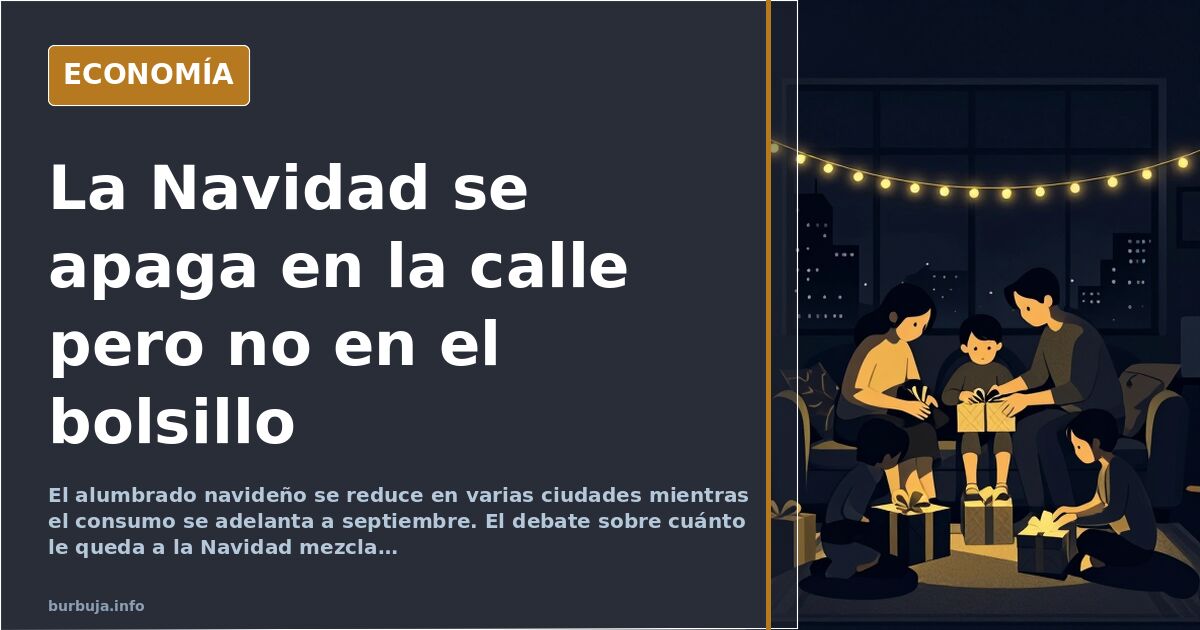
Christmas lights fade in Spanish streets while home spending heats up
A familiar scene is repeating across many cities this season: main avenues without lights, squares with minimal decorations, and residents wondering if their town hall has decided to save money or simply stopped believing in Christmas. In an economics forum, one participant put it bluntly: "On one of the city's main streets there are practically no lights; we are moving from neutral lighting to having almost none." The complaint was not just aesthetic. Behind it lies a question many are asking: how much life is left in the Christmas we knew?
The answer emerging from the debate is not unanimous. Some argue that political decisions are emptying the festival, others point to consumption as the only engine keeping it alive, and some defend that as long as families and memories exist, Christmas will continue even if the municipality turns off the lights. What trinc is a review of the arguments, data, and predictions exchanged in the discussion.
Public lighting as a thermometer for Christmas
The first alarm signal came from the lights. Several participants agreed that municipal lighting has been reduced or has completely disappeared in some areas. One claimed that in his neighborhood "lights have always been put up early" but this year, so far, there is nothing. Another responded with skepticism: "Do you live in a desert? Because in Spain there are lights even underwater." The discrepancy is real: it depends on the city and the neighborhood.
The debate quickly shifted to political management. A tweet comparing Barcelona's lighting to "a bar menu" was cited, attributing the decision to "PSC-PSOE and ERC antics." Irony about the supposed identity value of escudella (Catalan stew) and cannelloni served to illustrate a broader thesis: that administrations are replacing traditional symbols with more neutral ones or simply cutting costs. There are no official figures in the discussion, but there is a perception that municipal economic effort has fallen.
Against this interpretation, some participants defended savings: "Anything that avoids wasting public money seems fine to me." Therefore, the discussion is not only cultural; it is also about budgetary priorities.
Consumption as the sole support of the festival
If public lights go out, private ones remain on. Several messages noted that supermarkets and shopping centers began putting up Christmas decorations "at the end of September." That is, the private sector has not abandoned Christmas; it has moved it forward and turned it into a longer shopping season. One participant summarized it with sarcasm: "We will stop celebrating Christmas but not Black Friday... that won't happen."
Criticism of consumerism was widespread. Christmas was described as "an irrational consumer orgy" that loses meaning in an increasingly secular society. Another added that the festival has been reduced to "giving gifts, eating, drinking, seeing people who don't matter..." The paradox is evident: the more it is emptied of religious content, the more it depends on spending to justify itself.
This dependence has a clear economic consequence. If consumption is the engine, Christmas will last as long as there is spending capacity. Hence a participant's prediction: "Christmases will disappear when the extra salary disappears." The phrase, half-joking, points to a real link between the festival and the Spanish salary structure.
The thesis of cultural replacement and its limits
Part of the debate focused on the idea that Christmas is being replaced by other celebrations. Halloween, Black Friday, and the "Thanksgiving dinner" were mentioned as examples of imported festivals gaining ground. Someone predicted that the word Christmas will disappear and people will speak of "winter holidays," disconnected from December 24 and 25.
In this vein, several messages linked the alleged loss of Christmas with the presence of Muslim populations in Europe. Tweets about attacks on Christmas trees in Istanbul and the closure of Christmas markets in Germany due to attack risks were cited. It is important to note that these claims are not verified in the material and are presented as opinions or third-party denunciations. The debate itself included counterarguments: a Muslim participant explained that in Sarracin the main celebration is Ramadan and Eid, and that many Jovenlandeses in Europe participate lightly in Christmas, as a family gathering. Another added that Christmas is also celebrated in majority-Muslim countries like Syria or Egypt.
The discussion devolved into accusations about who is abandoning faith. One participant pointed out that "even those who call themselves Catholics do not go to mass," while another attributed the decline to "the childish and effeminate air of today's church." Overall, the thesis of cultural replacement remains a debated hypothesis, not a proven fact.
Christmas as family memory against the official calendar
Against the pessimists, several participants defended that Christmas does not depend on lights or town halls. One of the most valued messages expressed it forcefully: "It will last, at least as long as I live with consciousness and the ability to celebrate it. [...] Take away my Christmas and you take away some of the most cherished memories of my life." In this reading, the festival is a private matter, of ethos and family DNA, not an administrative concession.
Others provided concrete examples of traditions that remain alive. Ferrol was mentioned, where the nativity scene tradition inherited from ships arriving in Naples is maintained with dozens of belenes (nativity scenes) in downtown venues, some nearly 80 years old. Individual practices were also described: sending cards, setting up the Nativity scene, lighting the Advent candle, attending Midnight Mass. "Is it a grain of sand? Yes," admitted the person listing them.
The conclusion drawn from this part of the debate is that Christmas has two speeds: the public one, which fades or transforms, and the private one, which resists as long as there are families willing to sustain it. The question is how long the second can maintain itself without the first.
How much life is left in Christmas? It depends on who you ask. For some, two news broadcasts. For others, a whole life. The only thing clear is that the debate is no longer about lights, but about what we are willing to pay—in money and attention—for a festival that is no longer mandatory.
A familiar scene is repeating across many cities this season: main avenues without lights, squares with minimal decorations, and residents wondering if their town hall has decided to save money or simply stopped believing in Christmas. In an economics forum, one participant put it bluntly: "On one of the city's main streets there are practically no lights; we are moving from neutral lighting to having almost none." The complaint was not just aesthetic. Behind it lies a question many are asking: how much life is left in the Christmas we knew?
The answer emerging from the debate is not unanimous. Some argue that political decisions are emptying the festival, others point to consumption as the only engine keeping it alive, and some defend that as long as families and memories exist, Christmas will continue even if the municipality turns off the lights. What trinc is a review of the arguments, data, and predictions exchanged in the discussion.
Public lighting as a thermometer for Christmas
The first alarm signal came from the lights. Several participants agreed that municipal lighting has been reduced or has completely disappeared in some areas. One claimed that in his neighborhood "lights have always been put up early" but this year, so far, there is nothing. Another responded with skepticism: "Do you live in a desert? Because in Spain there are lights even underwater." The discrepancy is real: it depends on the city and the neighborhood.
The debate quickly shifted to political management. A tweet comparing Barcelona's lighting to "a bar menu" was cited, attributing the decision to "PSC-PSOE and ERC antics." Irony about the supposed identity value of escudella (Catalan stew) and cannelloni served to illustrate a broader thesis: that administrations are replacing traditional symbols with more neutral ones or simply cutting costs. There are no official figures in the discussion, but there is a perception that municipal economic effort has fallen.
Against this interpretation, some participants defended savings: "Anything that avoids wasting public money seems fine to me." Therefore, the discussion is not only cultural; it is also about budgetary priorities.
Consumption as the sole support of the festival
If public lights go out, private ones remain on. Several messages noted that supermarkets and shopping centers began putting up Christmas decorations "at the end of September." That is, the private sector has not abandoned Christmas; it has moved it forward and turned it into a longer shopping season. One participant summarized it with sarcasm: "We will stop celebrating Christmas but not Black Friday... that won't happen."
Criticism of consumerism was widespread. Christmas was described as "an irrational consumer orgy" that loses meaning in an increasingly secular society. Another added that the festival has been reduced to "giving gifts, eating, drinking, seeing people who don't matter..." The paradox is evident: the more it is emptied of religious content, the more it depends on spending to justify itself.
This dependence has a clear economic consequence. If consumption is the engine, Christmas will last as long as there is spending capacity. Hence a participant's prediction: "Christmases will disappear when the extra salary disappears." The phrase, half-joking, points to a real link between the festival and the Spanish salary structure.
The thesis of cultural replacement and its limits
Part of the debate focused on the idea that Christmas is being replaced by other celebrations. Halloween, Black Friday, and the "Thanksgiving dinner" were mentioned as examples of imported festivals gaining ground. Someone predicted that the word Christmas will disappear and people will speak of "winter holidays," disconnected from December 24 and 25.
In this vein, several messages linked the alleged loss of Christmas with the presence of Muslim populations in Europe. Tweets about attacks on Christmas trees in Istanbul and the closure of Christmas markets in Germany due to attack risks were cited. It is important to note that these claims are not verified in the material and are presented as opinions or third-party denunciations. The debate itself included counterarguments: a Muslim participant explained that in Sarracin the main celebration is Ramadan and Eid, and that many Jovenlandeses in Europe participate lightly in Christmas, as a family gathering. Another added that Christmas is also celebrated in majority-Muslim countries like Syria or Egypt.
The discussion devolved into accusations about who is abandoning faith. One participant pointed out that "even those who call themselves Catholics do not go to mass," while another attributed the decline to "the childish and effeminate air of today's church." Overall, the thesis of cultural replacement remains a debated hypothesis, not a proven fact.
Christmas as family memory against the official calendar
Against the pessimists, several participants defended that Christmas does not depend on lights or town halls. One of the most valued messages expressed it forcefully: "It will last, at least as long as I live with consciousness and the ability to celebrate it. [...] Take away my Christmas and you take away some of the most cherished memories of my life." In this reading, the festival is a private matter, of ethos and family DNA, not an administrative concession.
Others provided concrete examples of traditions that remain alive. Ferrol was mentioned, where the nativity scene tradition inherited from ships arriving in Naples is maintained with dozens of belenes (nativity scenes) in downtown venues, some nearly 80 years old. Individual practices were also described: sending cards, setting up the Nativity scene, lighting the Advent candle, attending Midnight Mass. "Is it a grain of sand? Yes," admitted the person listing them.
The conclusion drawn from this part of the debate is that Christmas has two speeds: the public one, which fades or transforms, and the private one, which resists as long as there are families willing to sustain it. The question is how long the second can maintain itself without the first.
How much life is left in Christmas? It depends on who you ask. For some, two news broadcasts. For others, a whole life. The only thing clear is that the debate is no longer about lights, but about what we are willing to pay—in money and attention—for a festival that is no longer mandatory.
Also available in: Deutsch
Summary of a discussion on Burbuja.info - Foro de economía, actualidad y política., translated from Spanish and reviewed before publication. Read the full discussion (115 replies).
More summaries
-
Website Crash Before Black Friday Sparks Office Work Debate
A technical failure at an online store before Black Friday triggers debate on office roles and missing contingency plans.
-
Black Friday 2023: Unsold stock and trivial discounts
Trivial discounts, unsold inventory, and fake reference prices marked down: Black Friday 2023 ended without real deals, impacting local commerce.
-
Spain's IMV to top €1,600 in 2027: how it compares to working
Spain's IMV to top €1,600 for the first time in 2027, reaching over 893,000 households: how it compares to a job
-
Spain's PSOE rally flop: rooftop video sparks debate
A rooftop video showing few attendees at a Pedro Sánchez support rally in Madrid fuels controversy over turnout and timing.
-
Spain to mandate digital ID for age verification online
Spain will implement an internet age verification system this summer using electronic IDs or digital certificates. The access logs spark debate...
-
OKdiario Accuses Police of Negligence in Ferraz Protests
OKdiario alleges UIP negligence at Ferraz, citing a document that reveals political criteria for the use of force. The debate on police conduct...