
Spain: Cat lover adopts two tabbies instead of buying breeds
A user in Spain sought a British or Bengal cat for outdoor life but adopted two common tabbies. The post discusses breed costs, health risks, and the adoption debate.
English · Original discussion in Spanish · Published
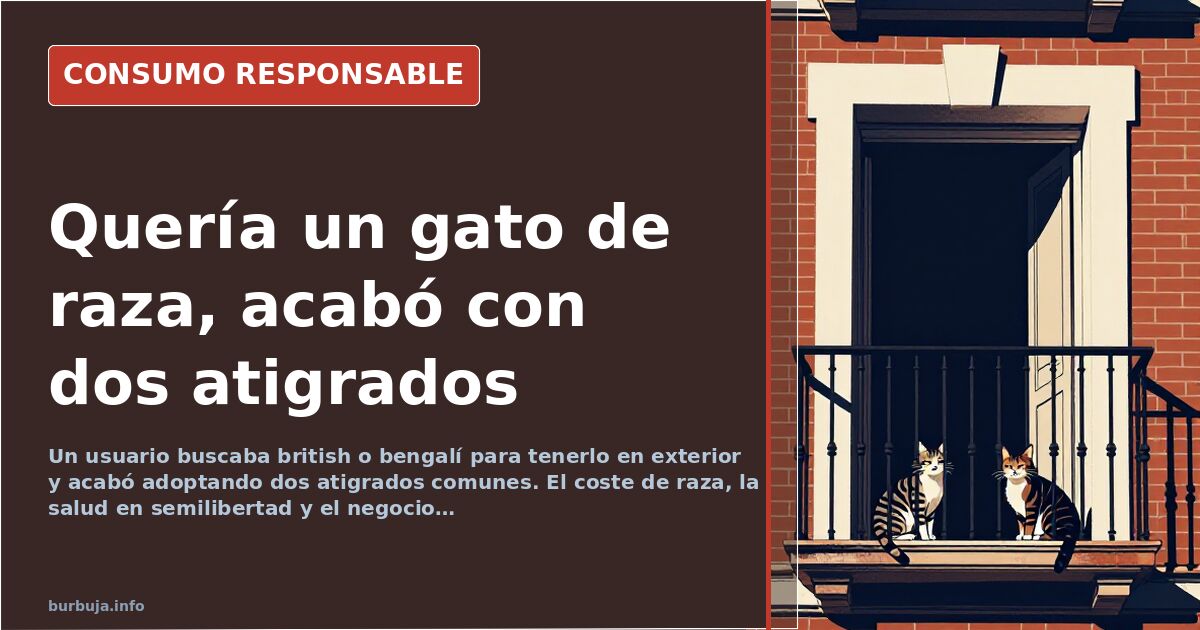
Wanted to buy a British or Bengal cat but ended up adopting two tabbies
Is it worth paying for a pedigree cat when the streets are full of them? This question was raised by someone looking for a feline "more athletic," capable of defending itself against neighbor cats and living outdoors, who dismissed the British Shorthair for being too common. The Bengal seemed like "a regular cat with a tiger pattern." Ultimately, the purchase fell through, leading to a different outcome: two common tabby cats, born on the street and abandoned by their mother, who survived "miraculously just days after birth."
This twist is not anecdotal. It summarizes the clash between two ways of understanding pet ownership: one that buys a pedigreed breed and another that argues lives should not be bought. In between, there are many practical data points about health, freedom to go outside, and prices that are worth considering before deciding.
Which breed handles street life better?
The starting point was physical resilience. The Bengal was perceived as a cat "powerful in feline terms," a good hunter, climber, and fighter, while the British Shorthair was seen as more domesticated and less suitable for the outdoors. The underlying recommendation was clear: if it will go out alone, better to have two so they aren't lonely and share the wear and tear.
Accumulated experience points in another direction. A loose cat "will definitely get into fights," and doesn't start winning them until three years old. Breed matters less than individual character and environment. In fact, the best cat described by a participant was a 12-kilo spotted stray, tame at home and "a killer" outside, capable of jumping over a fence with a duck in its mouth.
The real cost: €1,500 for genetic defects
The discussion quickly shifted to price. The figure mentioned in the conversation is €1,500 for a cat with endogamous genetic defects, compared to a free stray with its predatory instinct intact. Added to this is the health argument: exotic breeds are more prone to problems, and the Scottish Fold, with its ear mutation, is banned in some countries.
The most repeated answer was the same: adopt. Some argue that buying encourages a breeding business with malformations and that private sales are prohibited. The counter-argument from the other side is simple: everyone does what they want with their money, and a pedigree cat has a predictable standard.
Health: FIV, parasites, and a bit of luck
In semi-free range, diseases arrive. One participant claims that a cat with outdoor access "has a 99% chance of catching Feline Immunodeficiency Bicho (FIV)," although it is not always fatal. Other parasites are controlled with spot-on treatments, pills, and collars. The recurring health recommendation is to consult a veterinarian and accept that freedom has a cost.
The other cost is the risk of not returning. Accidents with automatic doors, hit-and-runs, and poisonings appear in the conversation. Those who let their cats go out accept this. Those who don't want to take the risk build an outdoor catio: an enclosed structure where the animal goes out without exposure.
The outcome: Two tabbies and a catio
The final decision was to adopt two common tabby cats, with an outdoor catio so they could go out without the risk of not coming back. The grey tabby coat is celebrated as one of the most beautiful, and a health argument is added: mixed-breed cats "tend to be healthier." The male weighed almost two kilos at two and a half months.
The chosen diet was chicken-based dry food and wet cans, combining brands and looking for prices in online stores. The story ends with a phrase summarizing the adopted stance: "Don't buy, adopt. If there is no demand, there is no business." With two cats rescued from the street, the business, at least in this case, lost a customer.
Is it worth paying for a pedigree cat when the streets are full of them? This question was raised by someone looking for a feline "more athletic," capable of defending itself against neighbor cats and living outdoors, who dismissed the British Shorthair for being too common. The Bengal seemed like "a regular cat with a tiger pattern." Ultimately, the purchase fell through, leading to a different outcome: two common tabby cats, born on the street and abandoned by their mother, who survived "miraculously just days after birth."
This twist is not anecdotal. It summarizes the clash between two ways of understanding pet ownership: one that buys a pedigreed breed and another that argues lives should not be bought. In between, there are many practical data points about health, freedom to go outside, and prices that are worth considering before deciding.
Which breed handles street life better?
The starting point was physical resilience. The Bengal was perceived as a cat "powerful in feline terms," a good hunter, climber, and fighter, while the British Shorthair was seen as more domesticated and less suitable for the outdoors. The underlying recommendation was clear: if it will go out alone, better to have two so they aren't lonely and share the wear and tear.
Accumulated experience points in another direction. A loose cat "will definitely get into fights," and doesn't start winning them until three years old. Breed matters less than individual character and environment. In fact, the best cat described by a participant was a 12-kilo spotted stray, tame at home and "a killer" outside, capable of jumping over a fence with a duck in its mouth.
The real cost: €1,500 for genetic defects
The discussion quickly shifted to price. The figure mentioned in the conversation is €1,500 for a cat with endogamous genetic defects, compared to a free stray with its predatory instinct intact. Added to this is the health argument: exotic breeds are more prone to problems, and the Scottish Fold, with its ear mutation, is banned in some countries.
The most repeated answer was the same: adopt. Some argue that buying encourages a breeding business with malformations and that private sales are prohibited. The counter-argument from the other side is simple: everyone does what they want with their money, and a pedigree cat has a predictable standard.
Health: FIV, parasites, and a bit of luck
In semi-free range, diseases arrive. One participant claims that a cat with outdoor access "has a 99% chance of catching Feline Immunodeficiency Bicho (FIV)," although it is not always fatal. Other parasites are controlled with spot-on treatments, pills, and collars. The recurring health recommendation is to consult a veterinarian and accept that freedom has a cost.
The other cost is the risk of not returning. Accidents with automatic doors, hit-and-runs, and poisonings appear in the conversation. Those who let their cats go out accept this. Those who don't want to take the risk build an outdoor catio: an enclosed structure where the animal goes out without exposure.
The outcome: Two tabbies and a catio
The final decision was to adopt two common tabby cats, with an outdoor catio so they could go out without the risk of not coming back. The grey tabby coat is celebrated as one of the most beautiful, and a health argument is added: mixed-breed cats "tend to be healthier." The male weighed almost two kilos at two and a half months.
The chosen diet was chicken-based dry food and wet cans, combining brands and looking for prices in online stores. The story ends with a phrase summarizing the adopted stance: "Don't buy, adopt. If there is no demand, there is no business." With two cats rescued from the street, the business, at least in this case, lost a customer.
Also available in: Deutsch
Summary of a discussion on Burbuja.info - Foro de economía, actualidad y política., translated from Spanish and reviewed before publication. Read the full discussion (118 replies).
More summaries
-
White-label vs. name-brand air conditioners: which should you buy?
Is it worth paying double for a Mitsubishi or Daikin? 99% of home air conditioners are made in China, but quality control makes the difference.
-
The €3.61 Fee Killing AliExpress Purchases
The €3.61 per-category tariff has inflated AliExpress purchases by up to 80%. Consumers are stopping buys, and revenue is falling. Does it actually protect...
-
How to Choose a Microwave: Size, Dial vs Digital, and Reliable Brands
Liter size is misleading—check the turntable diameter. A €49 microwave can last for years. A buying guide with real consumer data.
-
Nestlé and Dolca: 30% vs 25% Cacao, Same Price in Spain
Nestlé and Dolca chocolates differ by just 5% cacao yet cost nearly the same, revealing that budget brands in Spain are no longer significantly cheaper.
-
Paleo diet debate: hunters versus gatherers evidence
The paleolithic diet controversy: from fire control to daily mussel counts. What fossil evidence reveals about ancestral diets.
-
Briefcases fade as backpacks dominate men's fashion
Forum debate on briefcase replacement by backpacks and crossbody bags, focusing on comfort, hands-free convenience, and shifts in male accessories.