
Spain: Boss scolds worker for refusing unpaid Saturday shift
A hospitality employer in Spain criticizes an employee for not working a Saturday without pay, reigniting debate on overtime and rest days.
English · Original discussion in Spanish · Published
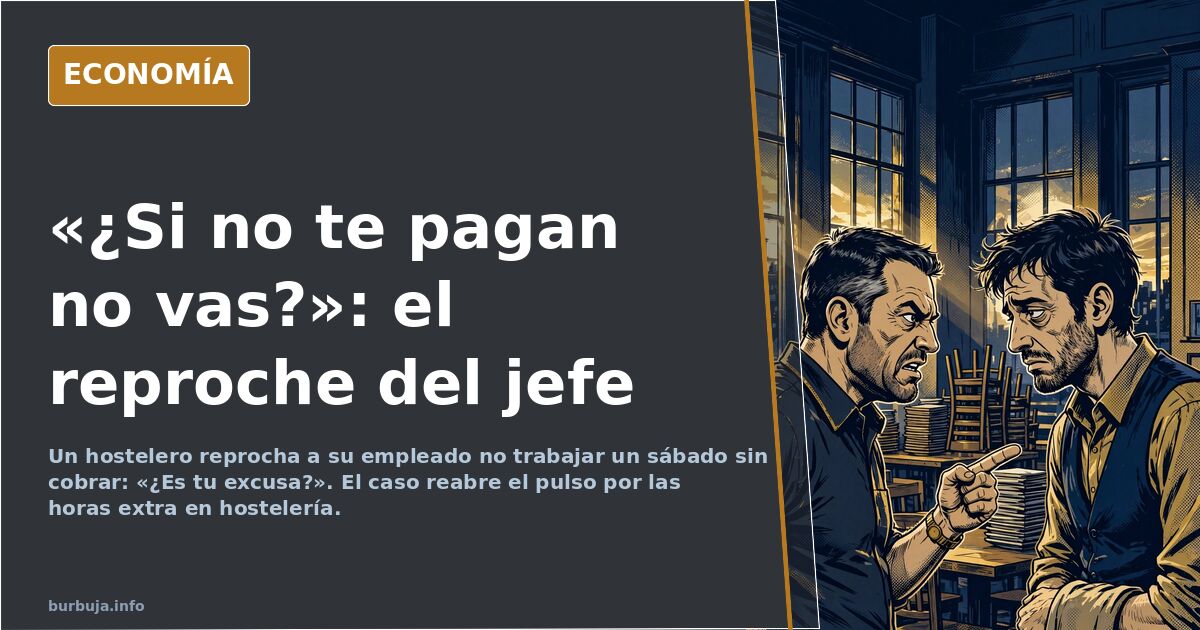
The unpaid Saturday the hospitality boss demanded from his worker
A hospitality employee refuses to work a Saturday without pay, and his boss blames him. It is not a covert strike or a whim: he was off duty that day and would not be compensated. The employer's response, reported by El Confidencial, has gone viral: "So, if you're not paid, you won't come? Is that your excuse?" Before this, the worker had stated plainly: "I rest on Saturdays, sir, and there was no extra payment."
The scene is minimal and precisely for that reason it works as an X-ray. The boss does not dispute the right to rest; he disputes the logic. If Saturday costs nothing, there is no reason to miss it. This starts an old struggle between the business's cash flow and the schedule of those who serve it.
What is a compensatory day off and why did the boss see it as an excuse?
A compensatory day off (libranza) is the rest due within the weekly schedule. It is not paid separately because it is not extra: it is part of the ordinary cycle. The employee explained it exactly as such, and that was the misunderstanding. For the hospitality owner, that uncovered Saturday leaves the venue crippled and equals an absence; for the worker, it is a day that is not theirs because no one will remunerate it.
The boss's reasoning, that "if they don't pay you, you won't go," shifts the burden of proof. It turns rest into something that must be justified and payroll into a favor. Underneath lies a widespread idea in small businesses: that the employee is always available and that it is the company that decides when to exchange that time.
A Saturday is paid double, not with another loose day
Here enters the technical part, usually missing in the argument. Holidays are paid at double rates in most collective agreements: two days with money, not with rest. Paying it with vacation seems equivalent but is not. If the worked Saturday is exchanged for a low-traffic Wednesday, the employer sends the employee home on the quiet day and saves the premium. The worker ends up covering when there is work and resting when there isn't, never collecting the bonus.
Hence the advice repeated by those who know the sector: overtime yes, but with money; weekends according to the agreement and at double rate. The theory is simple. Practice depends on how much hurry the boss has to close the month.
The manual of the "bulletproof" employee who conquers the world
Also circulating with irony was the portrait of the ideal worker: arriving at 5:00 AM, sweeping the warehouse, unloading a whole truck in front of the boss, offering to do more hours without being asked, and giving 200% to show willingness. "Let them see willingness," summarizes the motto. The caricature is exaggerated and has some mirror-like quality.
The real discourse it parodies is known: unlimited availability as merit, loyalty as a substitute for the salary slip. Its practical translation is an elastic workday and a rigid salary, with promotion as a carrot on the horizon. Whoever drops out for just one Saturday becomes the one who doesn't pull their weight.
Twelve hours, eighty overtime, and a thousand euros expectation
The cases accompanying the episode are more eloquent than the episode itself. According to testimony circulated alongside the matter, in a ham shop the manager warns that there are many customers and that no one leaves for lunch that day. A colleague is reproached for lowering the shutter to go to the bathroom, arguing that everyone holds it there. Another accumulated 80 overtime hours during the Christmas campaign expecting to earn around 1,000 euros. Twelve-hour shifts in the background.
These are not figures from the agreement, but stories of people who work. That is why they matter. When the premium never arrives and rest is negotiated every week, payroll stops being a contract and becomes a conversation.
The asymmetry that explains why this keeps happening
The most repeated argument is not sarracena, but about power. An employee can be sanctioned and fired; an employee cannot sanction or fire a boss. The relationship is asymmetric from top to bottom. Add the cost detail: keeping the troublemaker and distributing their work among the rest is cheaper than paying severance.
Whoever claims their leaving time already knows how the story ends. And that is why many don't even ask.
The free Saturday is not paid and not worked, and the tug-of-war continues. In a Christmas campaign, the expectation for eighty extra hours was a thousand euros. With those accounts, the hospitality boss's question answers itself.
Also available in: Deutsch
Summary of a discussion on Burbuja.info - Foro de economía, actualidad y política., translated from Spanish and reviewed before publication. Read the full discussion (182 replies).
More summaries
-
Forum Claims UCO Places Sánchez in Mask Contract
A forum alleges the UCO links Sánchez to a 20 million euro mask contract and connects Begoña Gómez with AirEuropa.
-
Spain's Koldo Case: The 'Explosive' Scoop That Never Came
El Confidencial announced an explosive scoop on Spain's Koldo case, but no major revelation followed. The investigation remains open amid leaks.
-
El Confidencial: CERA Vote Residency Was Not Verified
Report published by El Confidencial: Consulates requested residency papers very recently and described no material proof of connection.
-
Vox cuts €161,000 in LGTBI aid in Spain's Aragon region
The regional government of Aragon has redirected €161,000 from LGTBI support to disability programs, reducing the total budget by 15.5%.
-
The price of affection: the money thresholds Spanish men set for finding a Latina partner
From threshold ages (25, 88, 100) to the price of affection: the economic dilemma facing older single Spanish men when it comes to relationships with Latin American women.
-
Natives first: the policy splitting Spain down the middle
The new PP-Vox deal in Castilla y León introduces 'national priority' in public services. Discrimination or common sense? The economic debate dividing Spain.