
Spain Bolsters Logistics Hubs Against Farmer Blockades
Interior Ministry deploys riot police and issues mass fines to secure logistics centers against over 30 tractoradas across Spain.
English · Original discussion in Spanish · Published
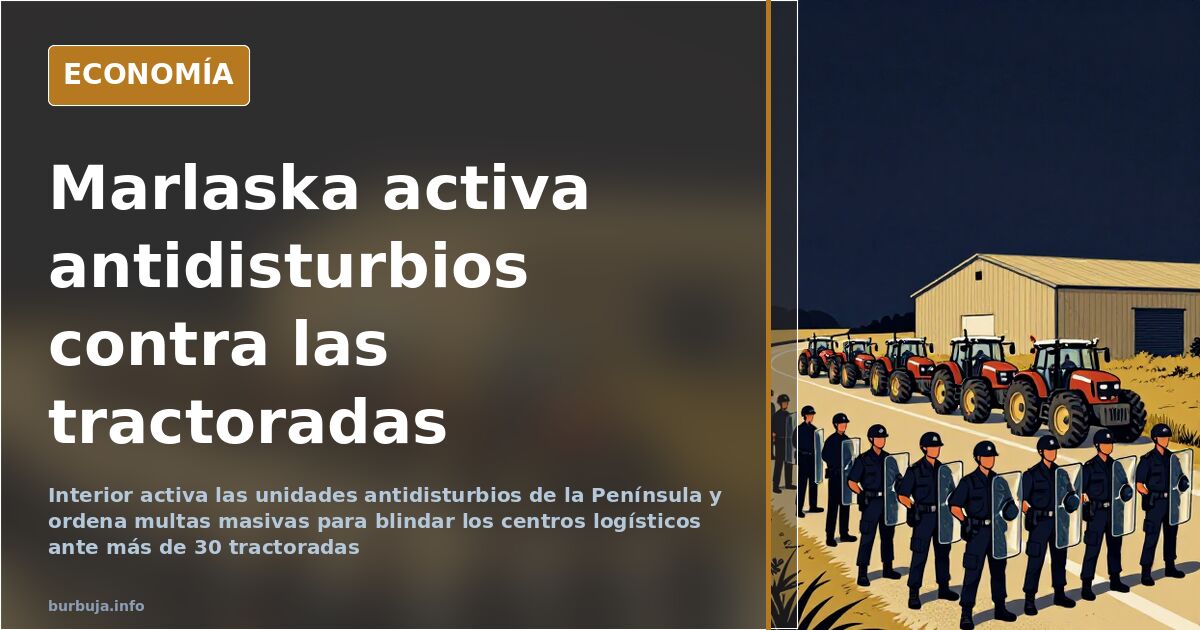
Interior orders 'decisive action' against tractorada blockades
A cordon of riot police around MercaMadrid. That was the image with which the Ministry of the Interior responded to the tractoradas crossing Spain in early February 2024. The instruction sent to provincial police stations and chief offices orders to secure the "main logistics and supply centers," clear roadblocks, and identify mobilized farmers. The key term appears twice in the document signed by the State Secretariat for Security: decisive action.
"They must be considered executive and applied with due force," the text reads. Translated: zero tolerance for blockades and any attempt to reach major cities. The order comes after a high-level meeting at Interior, with Minister Fernando Grande-Marlaska present, and in light of the protest not subsiding.
What police deployment has been activated against the tractorada
All UIP, USECIC, and GRS units of the Civil Guard on the Peninsula are activated. The Canary Islands, Ceuta, and Melilla are excluded. Staff leave has been suspended. The operation is based on preventive pre-positioning: placing units in the most conflictive points to guarantee the freedom of movement of people and vehicles, with special attention to access to distribution centers and what the document calls critical infrastructure.
To the use of force inherent in these devices is added administrative punishment. Government delegations order identifying participants, opening reports for future complaints, and imposing economic sanctions. Thousands of fines have already been processed, in addition to complaints regarding public security and road safety. The declared objective: to prevent blockades from recurring and, above all, from persisting over time.
The logic of the device is simple: a timely deactivated cost is less than one consolidated over days. What is not so clear is the other account, the political one. Each sanction adds to the next call someone who until now only had a tractor and a grievance.
Why did the Government go from denying shortages to securing logistics centers?
In the early hours of the protest, the Executive maintained that the calls were minor and that they would "in no way" affect the supply of food or fuel. The securing of access to supply centers says otherwise. The change in tone is read as an implicit acknowledgment that the message from the countryside has resonated more than calculated.
The farmers' battle cry —without us, you don't eat— has stopped sounding like a minority slogan. And the antiestéticar that now runs through offices is not the protest itself, but that the supply chain ends up feeling it if the mobilization escalates in the coming days.
The focus: blocking Mercadona or cutting the port of Algeciras?
Here the conversation splits in two. One current defends action on food distribution platforms for their advertising value: the message reaches public opinion immediately. Another argues that the effective blow is at the ports, cutting the entry of products imported from third countries —Segarro among them— because there one touches the origin point of the problem they denounce.
The connection between distribution and prices has its own chapter. According to a message circulated on social media, in March 2023 Juan Roig stated, commenting on 2022 results, that the company had "raised prices by a lot." To that phrase clings the argument that circulates most, according to that same source: 600 million euros distributed in bonuses to staff, 50% more than the previous year. One can debate whether one explains the other. What is not debated is the effect it had on the protest narrative.
Tear gas in Antequera and the comparison with France
According to a message circulated on social media, tear gas was used against farmers blocking access at the Antequera logistics platform. The scene is the most circulated and the one that has peine the comparison with the treatment received by French farmers during their own mobilizations. The most repeated version holds that even across the Pyrenees, they would not have reached that point. It is an assertion that circulates, not a verified fact: it should be treated as such.
The role of the police, in question
The deployment has peine a secondary front, that of the agents themselves. Some argue that the bodies do not apply the law, but obey orders, while others recall that riot police work with suspended leave and under direct instruction. The criticism, insisted upon in several analyses, is not against the street agent but against the chain of command that sets the intensity of the response. In the air remains another circumstance: the police corps carries its own unresolved salary claims.
The calendar explaining Interior's urgency
The dates are tight. From the day after the announcement, the major farm associations —COAG, Asaja, and UPA— join the conflict, with over 30 tractoradas called across Spain until February 27. There is a call in Madrid on Monday the 12th. Hence the suspension of leave and the demand for decisiveness from all provincial police stations and chief offices.
The figure that orders the entire episode remains. Interior mobilizes riot police to protect the logistics centers threatened with blockade by the countryside and, at the same time, fines those who produce what goes inside. If the declared objective was to avoid shortages, the uncomfortable question is whom to protect from whom.
A cordon of riot police around MercaMadrid. That was the image with which the Ministry of the Interior responded to the tractoradas crossing Spain in early February 2024. The instruction sent to provincial police stations and chief offices orders to secure the "main logistics and supply centers," clear roadblocks, and identify mobilized farmers. The key term appears twice in the document signed by the State Secretariat for Security: decisive action.
"They must be considered executive and applied with due force," the text reads. Translated: zero tolerance for blockades and any attempt to reach major cities. The order comes after a high-level meeting at Interior, with Minister Fernando Grande-Marlaska present, and in light of the protest not subsiding.
What police deployment has been activated against the tractorada
All UIP, USECIC, and GRS units of the Civil Guard on the Peninsula are activated. The Canary Islands, Ceuta, and Melilla are excluded. Staff leave has been suspended. The operation is based on preventive pre-positioning: placing units in the most conflictive points to guarantee the freedom of movement of people and vehicles, with special attention to access to distribution centers and what the document calls critical infrastructure.
To the use of force inherent in these devices is added administrative punishment. Government delegations order identifying participants, opening reports for future complaints, and imposing economic sanctions. Thousands of fines have already been processed, in addition to complaints regarding public security and road safety. The declared objective: to prevent blockades from recurring and, above all, from persisting over time.
The logic of the device is simple: a timely deactivated cost is less than one consolidated over days. What is not so clear is the other account, the political one. Each sanction adds to the next call someone who until now only had a tractor and a grievance.
Why did the Government go from denying shortages to securing logistics centers?
In the early hours of the protest, the Executive maintained that the calls were minor and that they would "in no way" affect the supply of food or fuel. The securing of access to supply centers says otherwise. The change in tone is read as an implicit acknowledgment that the message from the countryside has resonated more than calculated.
The farmers' battle cry —without us, you don't eat— has stopped sounding like a minority slogan. And the antiestéticar that now runs through offices is not the protest itself, but that the supply chain ends up feeling it if the mobilization escalates in the coming days.
The focus: blocking Mercadona or cutting the port of Algeciras?
Here the conversation splits in two. One current defends action on food distribution platforms for their advertising value: the message reaches public opinion immediately. Another argues that the effective blow is at the ports, cutting the entry of products imported from third countries —Segarro among them— because there one touches the origin point of the problem they denounce.
The connection between distribution and prices has its own chapter. According to a message circulated on social media, in March 2023 Juan Roig stated, commenting on 2022 results, that the company had "raised prices by a lot." To that phrase clings the argument that circulates most, according to that same source: 600 million euros distributed in bonuses to staff, 50% more than the previous year. One can debate whether one explains the other. What is not debated is the effect it had on the protest narrative.
Tear gas in Antequera and the comparison with France
According to a message circulated on social media, tear gas was used against farmers blocking access at the Antequera logistics platform. The scene is the most circulated and the one that has peine the comparison with the treatment received by French farmers during their own mobilizations. The most repeated version holds that even across the Pyrenees, they would not have reached that point. It is an assertion that circulates, not a verified fact: it should be treated as such.
The role of the police, in question
The deployment has peine a secondary front, that of the agents themselves. Some argue that the bodies do not apply the law, but obey orders, while others recall that riot police work with suspended leave and under direct instruction. The criticism, insisted upon in several analyses, is not against the street agent but against the chain of command that sets the intensity of the response. In the air remains another circumstance: the police corps carries its own unresolved salary claims.
The calendar explaining Interior's urgency
The dates are tight. From the day after the announcement, the major farm associations —COAG, Asaja, and UPA— join the conflict, with over 30 tractoradas called across Spain until February 27. There is a call in Madrid on Monday the 12th. Hence the suspension of leave and the demand for decisiveness from all provincial police stations and chief offices.
The figure that orders the entire episode remains. Interior mobilizes riot police to protect the logistics centers threatened with blockade by the countryside and, at the same time, fines those who produce what goes inside. If the declared objective was to avoid shortages, the uncomfortable question is whom to protect from whom.
Also available in: Deutsch
Summary of a discussion on Burbuja.info - Foro de economía, actualidad y política., translated from Spanish and reviewed before publication. Read the full discussion (219 replies).
More summaries
-
Widow refuses Marlaska's medal in Barbate agent's funeral
A widow in Barbate rejects Interior Minister Marlaska's medal during her husband's funeral, sparking a standoff that highlights deep tensions within the Civil Guard.
-
Borrell challenges absentee voting with the grandchild law
Borrell opens the debate on non-resident voting with the grandchild law: those registered in the CERA already decide seats in general, European, and regional elections.
-
Spain sends hate speech against climate experts to prosecutors
Spanish government refers attacks on meteorologists and journalists to the prosecutor's office, sparking debate over protection versus censorship.
-
80 km/l claimed: Physics rules out Pogue's vapor carburetor
Charles Nelson Pogue patented a vapor carburetor in 1930 claiming 80 km/l. Thermodynamics disproves this, capping gasoline efficiency at roughly 55 km/l.
-
Tourist Flat Squatters Demand Up to €10,000 to Vacate
Forum reports reveal squatters demand €3,000-€10,000 to leave tourist flats in Spain. Overburdened courts and organized gangs worsen the crisis.
-
Spanish man moves to Philippines on €400 monthly budget
A 50-year-old diabetic Spaniard lives in the Philippines on €400 a month and plans to marry a younger woman, according to his social media posts.