
Spain: Bikini Ban at Supermarket Sparks Rights Debate
Security guards barred three women in bikinis from a Spanish supermarket, triggering a debate on dress codes versus individual freedom.
English · Original discussion in Spanish · Published
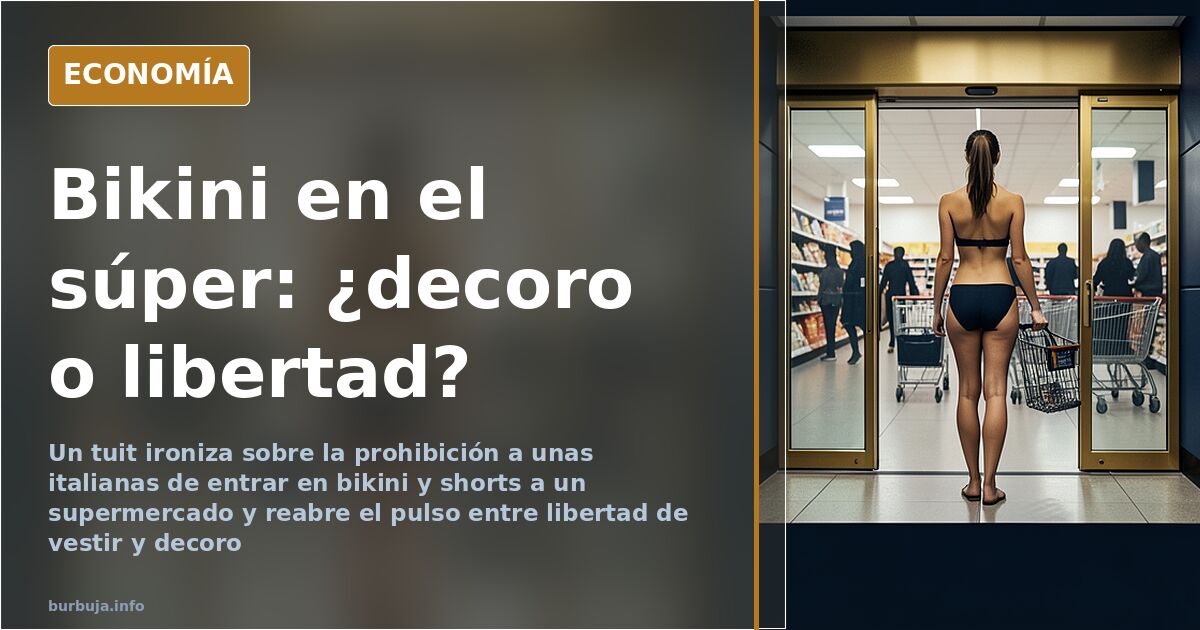
Bikini Ban in Spain: Decorum vs. Right of Admission
A security guard prevented three young women wearing bikinis and shorts from entering a supermarket. A customer, seen confronting them in the video, sparked the dispute: is it legitimate to ban specific clothing in a store, or does it infringe on personal liberty? The incident, recorded and shared on social media, has reignited the eternal clash between social etiquette and the law.
The scene is simple: three young girls, beachwear, a shopping cart. The security guard blocks their path. An older woman protests from inside. The video circulates, dividing public opinion between those who see disrespect and those who see overreaction. There is no state regulation governing attire in private establishments; the right of admission exists but is vague and rarely applied based on clothing.
Right of admission is not a blank check
Spanish legislation does not mandate a dress code for entering supermarkets. The right of admission allows owners to set conditions, provided they are non-discriminatory and clearly displayed. Without visible signage prohibiting swimwear or enforcing an etiquette standard, denying entry due to a bikini is legally vulnerable. Several analyses suggest the affected individuals could sue the store or the guard for abusa fundamental rights.
The nuance matters: an urban beach differs from a shopping center. The beach is a public space where bikinis are the norm; the supermarket is a private venue where social etiquette, not law, sets boundaries. This etiquette is increasingly blurred. Younger generations have normalized sports tops as daily wear; older generations view them as provocative.
The guard's role: between rules and common sense
The security guard enforces a rule that doesn't exist in writing. According to the video, his intervention occurred without formal complaints or instructions from the establishment. He is the weakest link in a chain starting with the protesting customer and ending with an improvised decision. Some argue he merely fulfilled what he believed was his duty; others see an unfounded overreach.
The confrontation adds layers of gender and class dynamics. The discussion shifts to generational reproach: an older woman criticizing young women's attire, while the latter defend individual freedom. The episode becomes a microcosm of the conflict between puritanism and exhibitionism.
Normalizing beachwear in everyday spaces
This incident is not isolated. In tourist areas, seeing swimsuits and shorts in local shops is common. Tolerance varies by context: in coastal towns, bikinis in bakeries don't scandalize; in city neighborhood supermarkets, they do. Custom, not law, draws the line between acceptable and indecorous.
The debate also reveals tensions regarding the female body. While discussing bikini appropriateness, judgments about age, physique, and intent creep in. The underlying question isn't just whether one can enter in a bikini, but who has the authority to define decency.
Conclusion: an unwritten rule
The law doesn't ban bikinis in supermarkets. Custom sometimes does. When custom imposes itself without written rules, conflict arises. The video captures this tension: three young people at the door, an uncomfortable guard, and an indignant customer. No one is entirely right. No one has the law fully on their side.
Also available in: Deutsch
Summary of a discussion on Burbuja.info - Foro de economía, actualidad y política., translated from Spanish and reviewed before publication. Read the full discussion (189 replies).
More summaries
-
Mercadona staff reprimands three customers for beachwear
A video shows a Mercadona employee criticizing three women's beach attire. The debate on dress codes and right of admission continues.
-
US retail theft: store closures and $100 billion in losses
Retail theft cost US stores nearly $88 billion in 2021, with 2022 projections nearing $100 billion. Physical retailers are fortifying operations.
-
EU bans fluorinated gases in fridges, hitting 80% of supermarkets
The EU Council prohibits fluorinated gases; 80% of supermarkets still use them, requiring costly renovations and closures.
-
Riots at Milan's Duomo: looting and rent protest
Riots broke out at Milan's Duomo: looting, stones thrown at the cathedral and a rent protest that Meloni's government is failing to address.
-
Spain's General Strike Echoes 1966: Cheap Housing, Single Income
General strike in Spain highlights the 1966 model of affordable housing and single-income households, sparking debate on historical context.
-
Viral Claim That Beavers Outsmart Africans Is False
A viral post falsely claims beavers have better geometric skills than average Africans. The assertion lacks evidence and conflates animal behavior with human prejudice.