
Spain bans terrace smoking without raising tobacco tax
Terrace smoking ban remains a draft bill in Spain, awaiting public consultation and parliamentary approval while tobacco sales continue.
English · Original discussion in Spanish · Published
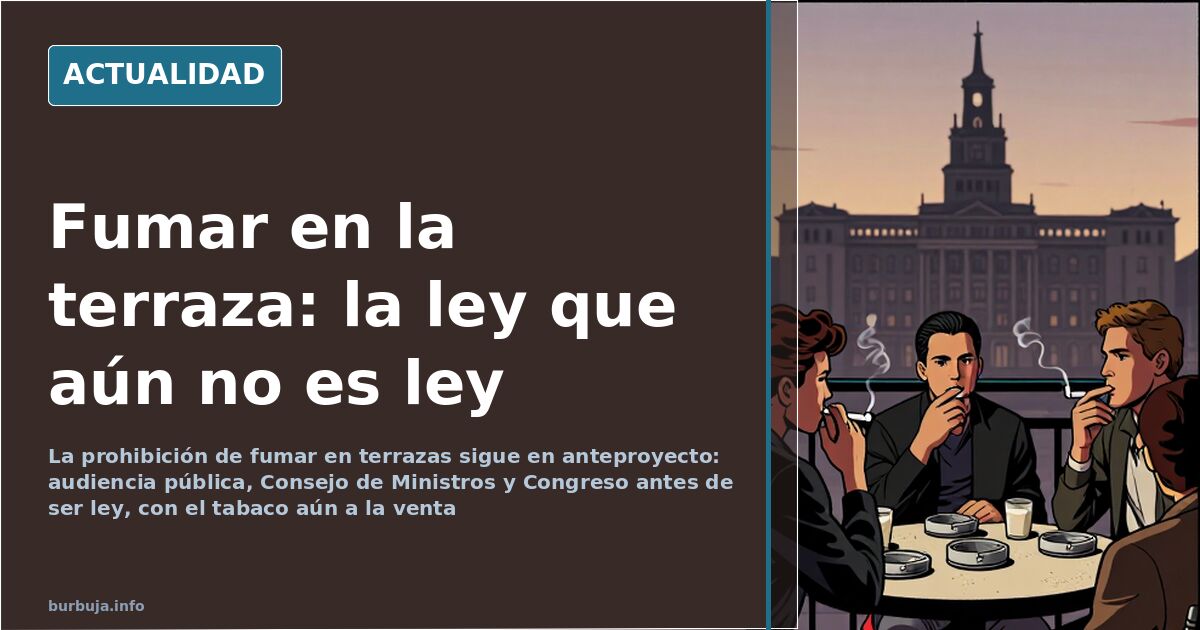
Terrace smoking banned: draft bill leaves tobacco tax untouched
Can you still smoke on a bar terrace? Yes, although the text aiming to ban it has already made significant pogre. The prohibition on smoking in all public spaces, including terraces, has been approved as a draft bill and has entered the cumbersome process separating an announcement from a law. While this is decided, the country debates two things at once: how much secondhand smoke we must tolerate and how far the administration can go in deciding for us. And almost no one focuses on where it hurts: that the same state that pursues the cigarette still sells it at the corner kiosk.
What is missing for the smoking ban to become law
The text is approved as a draft bill, not as a firm law. A public consultation period is now open, during which associations, businesses, autonomous communities, and citizens can submit objections. Afterwards, the Ministry of Health reviews the resulting text and returns it to the Council of Ministers. If it passes again, it goes to Congress and then the Senate. Only when it passes all these filters will it be applicable law.
Translated: there is no date, no certainty, and amendments are still possible. Anyone announcing that the ban arrives next month is selling smoke, and never more aptly. The objection phase is, moreover, the only time when hostel owners and smokers have something to say. When the text reaches the Official State Gazette (BOE), the matter will be closed.
Terraces and public space: the real battlefield
The dispute is not in the interiors—where the restriction has been established for years—but on the street. The terrace is the last stronghold, and according to part of the analysis, the only reasonable solution is separation: establishments for smokers and establishments for non-smokers, with the owner deciding the rules in their house. The argument has market logic: if there were supply for both, the customer would choose freely, and the conflict would die down.
On the other side is the passive smoker, who is no invention. Anyone walking down a sidewalk flanked by tables knows the feeling of passing through a curtain of smoke. However, some downplay the harm: in open spaces, it is argued, secondhand smoke weighs less in the air you breathe than everyday urban combustion—traffic, boilers, stoves—so the problem is more about annoyance than public health. It is an issue with data that no one finishes putting on the table with numbers.
Why the state doesn't ban tobacco if it cares so much
Here the narrative breaks. A product that creates addiction, fills oncology clinics, and takes lives daily is still sold in any kiosk. The circulating answer is simple: revenue. Tobacco pays for hospitals and schools, and a sales ban would dry up a source of income that no ministry wants to lose. Hence the suspicion that this crusade is not just about health, but about squeezing smokers through taxation while pointing fingers.
The paradox widens with the proposal that reappears every so often: banning purchases for those born less than 18 years ago, so that when they reach adulthood, they can no longer legally acquire it. It sounds decisive and is perfectly applicable. It is not done.
Children, alcohol, and the slippery slope
The conversation becomes toxic when someone asks why smoke is pursued with such ferocity but not alcohol. Some demand banning minors from venues serving drinks and moving nightlife bars to the outskirts, with a safety radius included. Others respond with the familiar domestic experience: parents who drank a glass of wine at lunch and never stumbled.
The relevant point is not who is right, but the pattern. Today it is tobacco; tomorrow, alcohol; after that, sugar, salt, wood stoves, or fireworks. Each restriction justifies itself, and none justifies itself in relation to the others. And the smoker who applauds today looks away, because it is never their vice that is in the crosshairs.
Secondhand smoke vs. city air
There remains an uncomfortable question: if the criterion is the air quality breathed by a non-smoker, the sidewalk of any avenue fails the test long before the neighboring table. No one proposes closing traffic in the city center for respiratory health. We start with what is cheap to ban, which is always the neighbor's vice.
With tobacco in kiosks, alcohol on bars, and the rule still in the objection phase, there is time to smoke on the terrace. Enjoy it while you can, as you will be notified soon.
Can you still smoke on a bar terrace? Yes, although the text aiming to ban it has already made significant pogre. The prohibition on smoking in all public spaces, including terraces, has been approved as a draft bill and has entered the cumbersome process separating an announcement from a law. While this is decided, the country debates two things at once: how much secondhand smoke we must tolerate and how far the administration can go in deciding for us. And almost no one focuses on where it hurts: that the same state that pursues the cigarette still sells it at the corner kiosk.
What is missing for the smoking ban to become law
The text is approved as a draft bill, not as a firm law. A public consultation period is now open, during which associations, businesses, autonomous communities, and citizens can submit objections. Afterwards, the Ministry of Health reviews the resulting text and returns it to the Council of Ministers. If it passes again, it goes to Congress and then the Senate. Only when it passes all these filters will it be applicable law.
Translated: there is no date, no certainty, and amendments are still possible. Anyone announcing that the ban arrives next month is selling smoke, and never more aptly. The objection phase is, moreover, the only time when hostel owners and smokers have something to say. When the text reaches the Official State Gazette (BOE), the matter will be closed.
Terraces and public space: the real battlefield
The dispute is not in the interiors—where the restriction has been established for years—but on the street. The terrace is the last stronghold, and according to part of the analysis, the only reasonable solution is separation: establishments for smokers and establishments for non-smokers, with the owner deciding the rules in their house. The argument has market logic: if there were supply for both, the customer would choose freely, and the conflict would die down.
On the other side is the passive smoker, who is no invention. Anyone walking down a sidewalk flanked by tables knows the feeling of passing through a curtain of smoke. However, some downplay the harm: in open spaces, it is argued, secondhand smoke weighs less in the air you breathe than everyday urban combustion—traffic, boilers, stoves—so the problem is more about annoyance than public health. It is an issue with data that no one finishes putting on the table with numbers.
Why the state doesn't ban tobacco if it cares so much
Here the narrative breaks. A product that creates addiction, fills oncology clinics, and takes lives daily is still sold in any kiosk. The circulating answer is simple: revenue. Tobacco pays for hospitals and schools, and a sales ban would dry up a source of income that no ministry wants to lose. Hence the suspicion that this crusade is not just about health, but about squeezing smokers through taxation while pointing fingers.
The paradox widens with the proposal that reappears every so often: banning purchases for those born less than 18 years ago, so that when they reach adulthood, they can no longer legally acquire it. It sounds decisive and is perfectly applicable. It is not done.
Children, alcohol, and the slippery slope
The conversation becomes toxic when someone asks why smoke is pursued with such ferocity but not alcohol. Some demand banning minors from venues serving drinks and moving nightlife bars to the outskirts, with a safety radius included. Others respond with the familiar domestic experience: parents who drank a glass of wine at lunch and never stumbled.
The relevant point is not who is right, but the pattern. Today it is tobacco; tomorrow, alcohol; after that, sugar, salt, wood stoves, or fireworks. Each restriction justifies itself, and none justifies itself in relation to the others. And the smoker who applauds today looks away, because it is never their vice that is in the crosshairs.
Secondhand smoke vs. city air
There remains an uncomfortable question: if the criterion is the air quality breathed by a non-smoker, the sidewalk of any avenue fails the test long before the neighboring table. No one proposes closing traffic in the city center for respiratory health. We start with what is cheap to ban, which is always the neighbor's vice.
With tobacco in kiosks, alcohol on bars, and the rule still in the objection phase, there is time to smoke on the terrace. Enjoy it while you can, as you will be notified soon.
Summary of a discussion on Burbuja.info - Foro de economía, actualidad y política., translated from Spanish and reviewed before publication. Read the full discussion (429 replies).
More summaries
-
Fernández de la Vega to leave Council of State for health reasons
María Teresa Fernández de la Vega reportedly resigns from the Council of State due to health. The replacement reopens debate on institutional spending.
-
Senator Warns of 'Furry' Pilots Amidst AI Flight Campaign
Senator Tommy Tuberville raises concerns about 'furry' pilots, crew, and air traffic controllers, sparking debate on aviation safety.
-
Moroccan dissident claims King Mohammed VI fainted and lost weight
A dissident claims that Mohammed VI "suffered a fainting spell and lost three kilos." His health has become the focus of debate over the succession.
-
Self-employed Fees Double in Spain: The Burden of Social Security
A lawyer's shock at 458 euros in social security fees sparks debate on forum Burbuja.info about survival in Spain's self-employed system.
-
North Carolina Murder Case Highlights US Judicial Flaws
Analysis of Iryna Zarutska's murder in Charlotte and the defendant's declared mental incompetence.
-
Down Syndrome Births Drop as Prenatal Screening Expands
Maternal age increases Down syndrome risk, yet fewer births occur. Prenatal screening and termination explain the decline in Spain.