
Spain Allocates €50M for Migrants in Canary Islands
Escrivá announces a €50 million grant to support migrants arriving in the Canary Islands, while La Palma volcano victims still await promised aid.
English · Original discussion in Spanish · Published
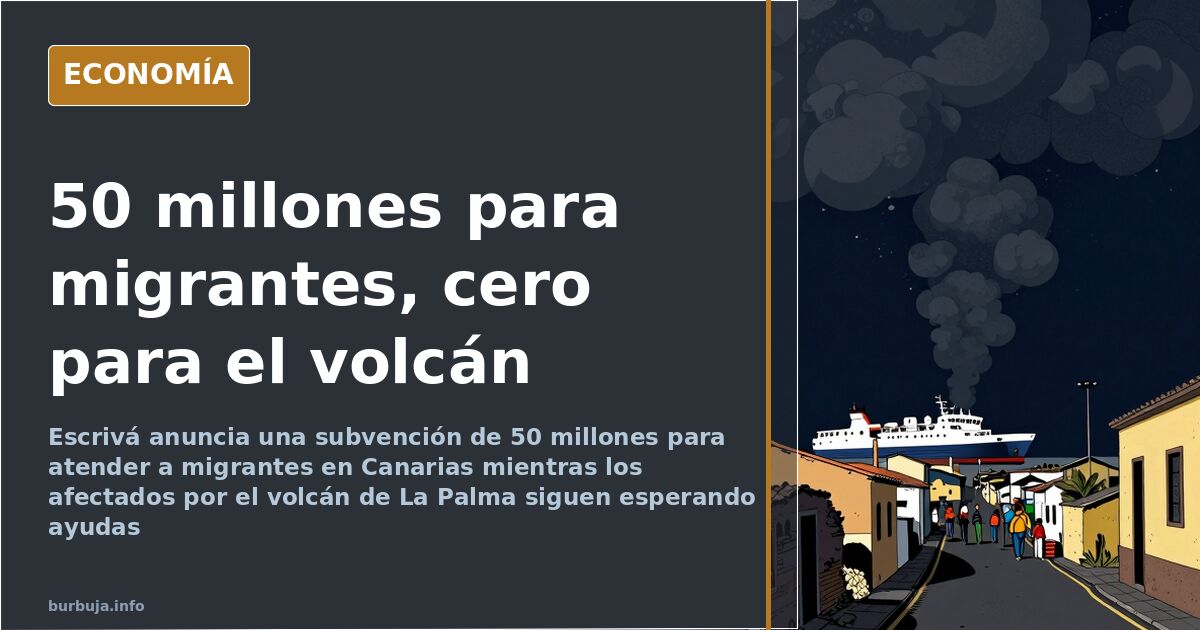
Escrivá Announces €50M for Migrants as La Palma Awaits Aid
The Ministry of Inclusion, Social Security and Migration has announced a €50 million grant to assist people arriving in the Canary Islands. This news coincides with another figure: by October 15, 23,537 people had reached the archipelago, a 79.4% increase compared to the same period last year. The timing alongside pending aid for those affected by the La Palma volcano —and later fires— has turned this sum into a trigger for discontent that goes far beyond the humanitarian emergency.
What the Announcement Says vs. What the Numbers Show
The grant is presented as an urgent response to growing migratory pressure. Official government data indicates a 79.4% year-on-year rise in arrivals to the islands. Funding is directed toward care for new arrivals: housing, food, and basic services. Meanwhile, comparisons with other emergency management have become inevitable. Those affected by the La Palma volcano have been waiting two years for committed aid that, according to reports, has yet to fully arrive. The coincidence is not just opinion; it is a sequence of facts made visible by the announcement itself.
Why Compare the Grant to Volcano Aid?
Because the contrast is quantifiable and palpable. Some analyses argue the State prioritizes irregular arrival support over rebuilding devastated areas. Others note these funds do not compete within the same budget or administration. However, the practical result seen by residents is hotels occupied by newcomers versus families still in tents or temporary housing. This comparison has become the emotional core of the issue, surpassing even the migration debate.
Opportunity Cost: 150,000 Self-Employed and Monthly Fees
A common calculation in economic analyses is simple: €50 million equals the monthly social security contributions of approximately 150,000 self-employed workers. This is not an official figure but an equivalence used to make the announcement tangible. The resulting question is not whether humanitarian aid is necessary—it is—but why urgency is activated so easily in one case and stalls in the other. Some argue the problem is not spending, but execution asymmetry: decrees exist for some funds, while administrative silence prevails for others.
Pressure on Public Services in the Canary Islands
The archipelago bears the bulk of both arrivals and care duties. Testimonies describe hotel and apartment occupancy rates reaching high-end establishments. Simultaneously, unemployment in the Canaries remains among the highest in Spain, with many locals working at minimum wage. The tension is not only economic but also social, fueled by perceptions of unfairness. Arguments about limited resources and proportional solidarity are increasingly heard, even among those who do not question the need to help those arriving.
Political Background: Immigration as State Policy
Beyond this specific case, the announcement fits a line the Government has defended before Brussels: immigration as a way to offset labor shortages. This framework explains why the response is financial rather than restrictive. It also explains why discontent targets not just Escrivá’s ministry, but the broader official narrative. Public debate mixes two distinct issues: managing a humanitarian emergency and structural migration policy. The grant addresses the former; the latter lacks serious parliamentary discussion.
The analysis consistently hits the same snag: no one disputes the need to help those arriving, but few explain why that urgency isn’t applied with equal estimulante ilegal to those already here when disaster struck. The €50 million is approved. As of this writing, aid for volcano victims remains pending.
The Ministry of Inclusion, Social Security and Migration has announced a €50 million grant to assist people arriving in the Canary Islands. This news coincides with another figure: by October 15, 23,537 people had reached the archipelago, a 79.4% increase compared to the same period last year. The timing alongside pending aid for those affected by the La Palma volcano —and later fires— has turned this sum into a trigger for discontent that goes far beyond the humanitarian emergency.
What the Announcement Says vs. What the Numbers Show
The grant is presented as an urgent response to growing migratory pressure. Official government data indicates a 79.4% year-on-year rise in arrivals to the islands. Funding is directed toward care for new arrivals: housing, food, and basic services. Meanwhile, comparisons with other emergency management have become inevitable. Those affected by the La Palma volcano have been waiting two years for committed aid that, according to reports, has yet to fully arrive. The coincidence is not just opinion; it is a sequence of facts made visible by the announcement itself.
Why Compare the Grant to Volcano Aid?
Because the contrast is quantifiable and palpable. Some analyses argue the State prioritizes irregular arrival support over rebuilding devastated areas. Others note these funds do not compete within the same budget or administration. However, the practical result seen by residents is hotels occupied by newcomers versus families still in tents or temporary housing. This comparison has become the emotional core of the issue, surpassing even the migration debate.
Opportunity Cost: 150,000 Self-Employed and Monthly Fees
A common calculation in economic analyses is simple: €50 million equals the monthly social security contributions of approximately 150,000 self-employed workers. This is not an official figure but an equivalence used to make the announcement tangible. The resulting question is not whether humanitarian aid is necessary—it is—but why urgency is activated so easily in one case and stalls in the other. Some argue the problem is not spending, but execution asymmetry: decrees exist for some funds, while administrative silence prevails for others.
Pressure on Public Services in the Canary Islands
The archipelago bears the bulk of both arrivals and care duties. Testimonies describe hotel and apartment occupancy rates reaching high-end establishments. Simultaneously, unemployment in the Canaries remains among the highest in Spain, with many locals working at minimum wage. The tension is not only economic but also social, fueled by perceptions of unfairness. Arguments about limited resources and proportional solidarity are increasingly heard, even among those who do not question the need to help those arriving.
Political Background: Immigration as State Policy
Beyond this specific case, the announcement fits a line the Government has defended before Brussels: immigration as a way to offset labor shortages. This framework explains why the response is financial rather than restrictive. It also explains why discontent targets not just Escrivá’s ministry, but the broader official narrative. Public debate mixes two distinct issues: managing a humanitarian emergency and structural migration policy. The grant addresses the former; the latter lacks serious parliamentary discussion.
The analysis consistently hits the same snag: no one disputes the need to help those arriving, but few explain why that urgency isn’t applied with equal estimulante ilegal to those already here when disaster struck. The €50 million is approved. As of this writing, aid for volcano victims remains pending.
Also available in: Deutsch
Summary of a discussion on Burbuja.info - Foro de economía, actualidad y política., translated from Spanish and reviewed before publication. Read the full discussion (151 replies).
More summaries
-
Union claims 70% of Spain's foreign residents don't contribute to social security
Solidaridad union reports only 30.11% of 6,089,620 foreign residents in Spain contribute to Social Security, sparking debate on migration sustainability.
-
Spain's Social Security covers only 70% of pension costs
Social Security income covers just 70% of pension spending, fueling debate on immigration's impact on the system.
-
The €10 per square metre proposal and the numbers that don't add up
A tweet mocks a young man hoping to buy a home at €10/m². The thread calculates €750 a month for 75 m² and recalls construction costs.
-
Spain Rental Stock Plummets on Idealista Forum
Forum tracks drop in Spain's rental listings from 80,364 to 71,965. Users blame housing laws and owner withdrawals.
-
Spanish influencer arrested for sexual assault on sleeping friend
Guardia Civil arrests content creator in Roquetas de Mar for allegedly sexually assaulting a sleeping friend and sharing the footage online.
-
Early retirement with minimum pension: forum user's calculation
Retiring early once minimum requirements are met yields better returns than working until ordinary age, according to a circulating calculation.