
Spain: 7 in 10 companies struggle to find staff amid 2.7 million unemployed
Seven out of ten Spanish companies can't find the workers they need, while 2.7 million people are unemployed. The labor market is failing on both ends.
English · Original discussion in Spanish · Published
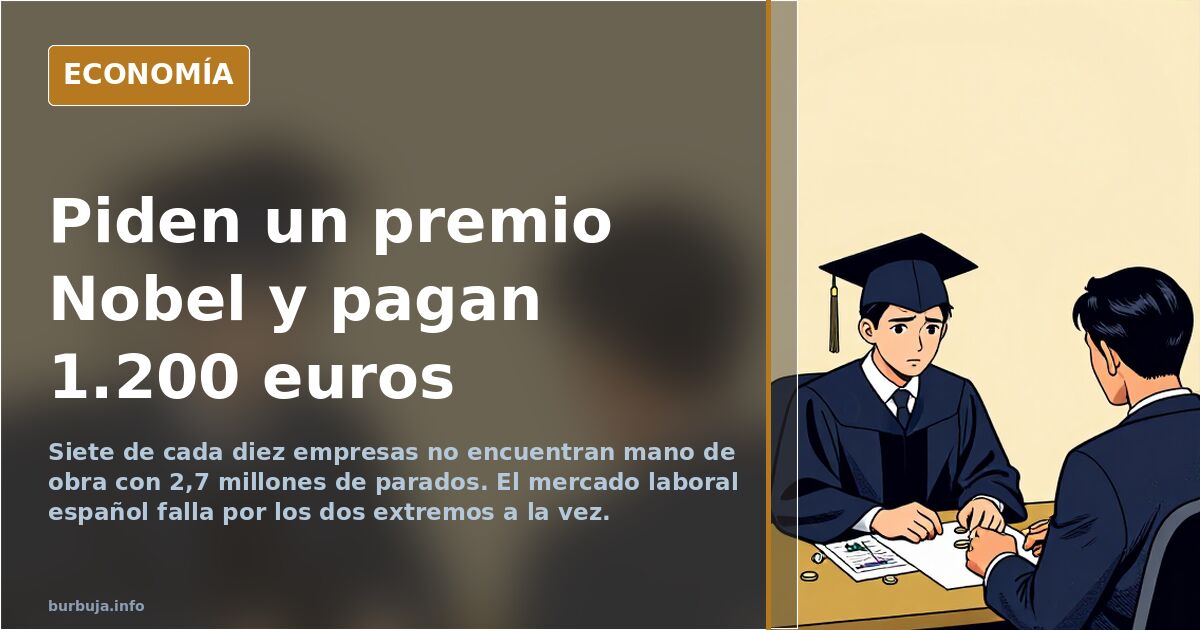
Worker Shortage, Surplus of Unemployed: The Paradox No One Solves
Spain doesn't have one employment problem. It has two, and they eye each other warily. Seven out of ten companies report they can't find the labor they're looking for, while the country has 2.7 million unemployed. Both figures coexist without apparent contradiction for employers and without convincing explanation for those who have spent months sending out resumes with no response.
This isn't a new picture. It's a struggle that has lasted far too long and serves as the best portrait of how the Spanish labor market is failing at both extremes simultaneously.
The Profile They Seek Doesn't Exist
The first official explanation is qualification. Lack of training, they say. The problem arises when you look at the details of the job offers. One recent advertisement sought a Business Administration degree or similar, five years of experience, SAP, Excel, Power BI, advanced English, French, and German, and willingness to travel. Offered: union-agreed salary and a split workday.
In the tech sector, the bar is raised to absurd levels. A systems administrator vacancy once demanded certifications in AWS, GCP, and Azure, mastery of Kubernetes and Docker, Terraform deployment, eight years of prior experience, agile methodologies, and being a scrum master on top of it all. Meeting all these requirements, according to those who recount it, is nearly impossible for 95% of professionals in the field.
And then there's the fine print of the hiring process: four-hour technical tests, uncompensated, that lead nowhere. Some people are now refusing to do them.
What's Paid When a Degree Isn't Needed
At the other extreme, offers drop below 1,200 euros for a split workday. Or 900 euros for contributing to social security for eight hours while working twelve. That's where the profit is, half of Spain seems to imply.
The calculation circulating among those who argue the problem isn't supply but price is uncomfortable: with a subsidy of 426 euros at stake, and after deducting travel, meals, and clothing expenses, accepting certain jobs leaves a margin of two or three hundred euros a month. With those numbers, the math is simple. Those who maintain this view attribute it to pure economic rationality, not laziness.
Soria: 100 Jobs in a Town of 1,700 Inhabitants
The case that breaks the narrative of absenteeism is in rural areas. In a municipality of 1,700 inhabitants, one hundred workers are needed. There are no people of working age because they have emigrated, and outsiders don't want to move there because there are no services. Santiago Aparicio, vice-president of Cepyme and president of CEOE Castilla y León, speaks of "absolute desperation."
The objection comes in the next sentence: where do a hundred families fit? What housing and services are offered in an inland area where winter temperatures drop below minus ten degrees Celsius? If the package doesn't include a house, school, and transportation, the position remains vacant, even if there are many people with driving licenses.
Those Who Are Rightfully Left Out
There remains the group that doesn't even get a look-in. Record levels of overqualification, companies that offer little training, and selection processes that are not transparent. There are people over 45 willing to accept the minimum wage, but their resumes go straight to the trash. The official narrative speaks of a lack of candidates; the real filter is different.
Added to this is the parallel route that many know by heart: access through recommendation, nepotism as a shortcut, and competitive public examinations as the only arena where everyone competes under the same rules.
The most reasonable prediction is not that the problem will be solved, but that it will become chronic. As long as the offered salary doesn't compete with the subsidy, the conditions don't allow for work-life balance, and rural areas don't offer more than just a salary, there will continue to be a shortage of waiters and a surplus of graduates. The paradox doesn't close. It settles in.
Spain doesn't have one employment problem. It has two, and they eye each other warily. Seven out of ten companies report they can't find the labor they're looking for, while the country has 2.7 million unemployed. Both figures coexist without apparent contradiction for employers and without convincing explanation for those who have spent months sending out resumes with no response.
This isn't a new picture. It's a struggle that has lasted far too long and serves as the best portrait of how the Spanish labor market is failing at both extremes simultaneously.
The Profile They Seek Doesn't Exist
The first official explanation is qualification. Lack of training, they say. The problem arises when you look at the details of the job offers. One recent advertisement sought a Business Administration degree or similar, five years of experience, SAP, Excel, Power BI, advanced English, French, and German, and willingness to travel. Offered: union-agreed salary and a split workday.
In the tech sector, the bar is raised to absurd levels. A systems administrator vacancy once demanded certifications in AWS, GCP, and Azure, mastery of Kubernetes and Docker, Terraform deployment, eight years of prior experience, agile methodologies, and being a scrum master on top of it all. Meeting all these requirements, according to those who recount it, is nearly impossible for 95% of professionals in the field.
And then there's the fine print of the hiring process: four-hour technical tests, uncompensated, that lead nowhere. Some people are now refusing to do them.
What's Paid When a Degree Isn't Needed
At the other extreme, offers drop below 1,200 euros for a split workday. Or 900 euros for contributing to social security for eight hours while working twelve. That's where the profit is, half of Spain seems to imply.
The calculation circulating among those who argue the problem isn't supply but price is uncomfortable: with a subsidy of 426 euros at stake, and after deducting travel, meals, and clothing expenses, accepting certain jobs leaves a margin of two or three hundred euros a month. With those numbers, the math is simple. Those who maintain this view attribute it to pure economic rationality, not laziness.
Soria: 100 Jobs in a Town of 1,700 Inhabitants
The case that breaks the narrative of absenteeism is in rural areas. In a municipality of 1,700 inhabitants, one hundred workers are needed. There are no people of working age because they have emigrated, and outsiders don't want to move there because there are no services. Santiago Aparicio, vice-president of Cepyme and president of CEOE Castilla y León, speaks of "absolute desperation."
The objection comes in the next sentence: where do a hundred families fit? What housing and services are offered in an inland area where winter temperatures drop below minus ten degrees Celsius? If the package doesn't include a house, school, and transportation, the position remains vacant, even if there are many people with driving licenses.
Those Who Are Rightfully Left Out
There remains the group that doesn't even get a look-in. Record levels of overqualification, companies that offer little training, and selection processes that are not transparent. There are people over 45 willing to accept the minimum wage, but their resumes go straight to the trash. The official narrative speaks of a lack of candidates; the real filter is different.
Added to this is the parallel route that many know by heart: access through recommendation, nepotism as a shortcut, and competitive public examinations as the only arena where everyone competes under the same rules.
The most reasonable prediction is not that the problem will be solved, but that it will become chronic. As long as the offered salary doesn't compete with the subsidy, the conditions don't allow for work-life balance, and rural areas don't offer more than just a salary, there will continue to be a shortage of waiters and a surplus of graduates. The paradox doesn't close. It settles in.
Summary of a discussion on Burbuja.info - Foro de economía, actualidad y política., translated from Spanish and reviewed before publication. Read the full discussion (397 replies).
More summaries
-
Spanish Minimum Income Benefit Exceeds Most Common Salary: Who Gets What
The Spanish Minimum Income Benefit (IMV) is 20% higher than the most common salary, but €1,195 is for a family of three, while €1,200 is for a single worker. Key details explained.
-
Zarzuela summons Sánchez: The meeting Moncloa doesn't acknowledge
The King reportedly summoned Sánchez at Zarzuela following his meeting with the military establishment and the announcement of the Ceuta trip. The official agenda makes no mention of the encounter, and...
-
Euthanasia in Old Age: Autonomy vs. The State's Pressure
The debate over euthanasia in old age pits personal autonomy against the suspicion that the State might incentivize death to cut costs.
-
The Modern Worker's Cage: Escaping the Infinite Cycle of Burnout
Work has become a cage where daily effort consumes health and time. Discover why we push ourselves so hard and how to break the cycle.
-
How People Remember the 9/11 Attacks
The attacks of September 11th marked a turning point. Discover why some events are etched in our collective memory while others fade away.
-
Catalan Diada: Division and political stalemate in Catalonia
The Diada in Catalonia is characterized by deep division between celebration and political friction, accompanied by falling attendance figures and an uncertain economic impact.