
Spain 10Y Bond Nears 4%, UK 30Y Hits 6% as European Stocks Slide 3-5%
Spain's 10-year bond yield approaches 4% while the UK 30-year reaches 6%. European stock markets fall 3% to 5% monthly as central banks face limits.
English · Original discussion in Spanish · Published
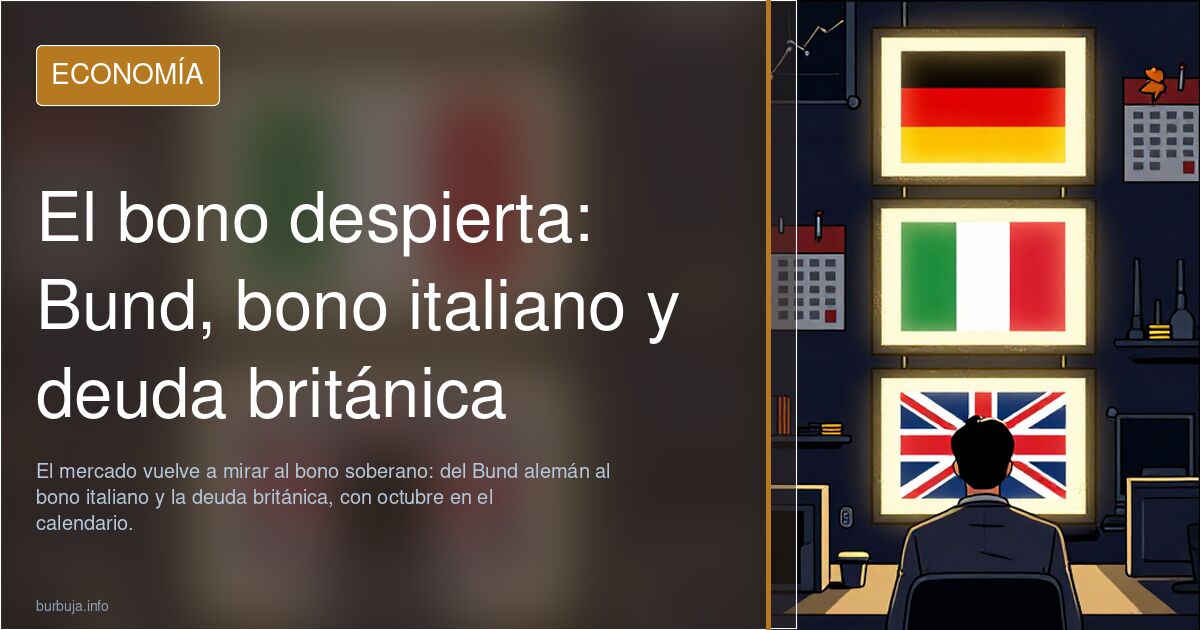
Spain 10Y Bond Nears 4%, UK 30Y Hits 6%
Public debt markets are no longer just desk politics. Over recent weeks, Spain's 10-year bond yield has approached 4%, while the UK's 30-year bond touched 6%. France, Italy, and Germany are trinc suit, each at their own pace, with Germany the only one resisting in the daily chart, according to forum discussions. The market question is no longer if a correction will happen, but when and how deep.
What is happening with 10-year bonds
The 10-year bond yield is the thermometer investors watch above all others. When it rises, the state pays more to finance itself, and the cost is passed on—with a delay, but it is passed on—to mortgages, consumer credit, and corporate debt. In Spain, the yield has approached 4% in recent days. France, Italy, and the UK are trinc the same path, with the UK 30-year bond installed at 6%.
Some argue this movement is a simple normalization after years of artificially low rates. Against this weighs the argument that central banks no longer have the margin they had in 2011: inflation remains high, and they cannot buy debt massively again without blowing up prices. The most optimistic calculation assumes the ECB will intervene if the differential gets out of control; the pessimistic scenario starts from the fact that the ECB can no longer do so without causing a bigger problem.
Why the UK 30-year bond touches 6%
The British case is the most striking. The 30-year bond has touched 6%. The UK accumulates a combination that analysts consider explosive: persistent inflation, high public deficit, and a central bank raising rates while the economy cools. The result is that the market demands a higher premium to lend money to the UK Treasury.
Comparison with the previous crisis is inevitable. In 2011, Portugal and Greece were the poor students of the class; today, the market looks with the same distrust at London and Paris. The difference is that then the ECB had tools and now it has them, but cannot use them without consequences. The UK 30-year bond at 6% is the clearest signal that something has broken in the monetary policy transmission chain.
The IBEX and European stocks fall while bonds rise
The movement is not just fixed income. The IBEX, CAC40, MIB, and DAX have accumulated monthly declines of between 3% and 5%, while bonds continue to fight for their dreams. In America, the S&P 500 holds up thanks to tech and the AI narrative, but 75% of stocks are already in the red over the last month, according to a forum comment. The perfect storm some anticipate combines rising bonds and falling stocks, with the addition of a possible recession.
The sequence described by some analyses is known: first prices break, then bonds surge and stocks plummet, and finally massive corporate closures arrive and unemployment soars. It is not a prediction, it is a pattern that repeats in every cycle. The difference is that this time central banks have exhausted much of their ammunition.
What role China and Japan play in American debt
More than 30% of US debt is financed by Japan and China, according to a forum comment. Japan is planning to raise rates and repatriate capital from American bonds to its own national public debt, although it does so cautiously because it dares not seriously tense the US Treasury. China is unpredictable: when the geopolitical moment advises, it can tense the US bond.
The Treasury Secretary, Scott Bessent, has acknowledged that he has no tools to repress bond interest, although a few weeks ago he said the opposite, according to a forum comment. It is a significant acknowledgment: if the Treasury cannot intervene, the market rules. And if the market rules, rates rise until someone breaks.
What can happen in the coming months
The most extended consensus points to October being the key month. The probabilities of a new rate hike are reduced, but that does not stop the rise in yields. The ECB's fiscal policy—printing money to buy debt—is the only tool left, and some already take it for granted. The problem is that if activated, the already high inflation will blow up even further.
The next government to emerge from the polls will find a considerable mess: it will have to freeze pensions and civil servants' salaries, as France has already done, or face a market that does not forgive, according to forum comments. Spanish debt is at levels that make any expansion of public spending unviable without prior adjustment. And some argue that no one in the media talks about it.
The analysis gets stuck at the same point as fourteen days ago: bonds continue to rise, stocks continue to fall, and no one knows where the floor is. The only certainty is that October has not disappointed.
Public debt markets are no longer just desk politics. Over recent weeks, Spain's 10-year bond yield has approached 4%, while the UK's 30-year bond touched 6%. France, Italy, and Germany are trinc suit, each at their own pace, with Germany the only one resisting in the daily chart, according to forum discussions. The market question is no longer if a correction will happen, but when and how deep.
What is happening with 10-year bonds
The 10-year bond yield is the thermometer investors watch above all others. When it rises, the state pays more to finance itself, and the cost is passed on—with a delay, but it is passed on—to mortgages, consumer credit, and corporate debt. In Spain, the yield has approached 4% in recent days. France, Italy, and the UK are trinc the same path, with the UK 30-year bond installed at 6%.
Some argue this movement is a simple normalization after years of artificially low rates. Against this weighs the argument that central banks no longer have the margin they had in 2011: inflation remains high, and they cannot buy debt massively again without blowing up prices. The most optimistic calculation assumes the ECB will intervene if the differential gets out of control; the pessimistic scenario starts from the fact that the ECB can no longer do so without causing a bigger problem.
Why the UK 30-year bond touches 6%
The British case is the most striking. The 30-year bond has touched 6%. The UK accumulates a combination that analysts consider explosive: persistent inflation, high public deficit, and a central bank raising rates while the economy cools. The result is that the market demands a higher premium to lend money to the UK Treasury.
Comparison with the previous crisis is inevitable. In 2011, Portugal and Greece were the poor students of the class; today, the market looks with the same distrust at London and Paris. The difference is that then the ECB had tools and now it has them, but cannot use them without consequences. The UK 30-year bond at 6% is the clearest signal that something has broken in the monetary policy transmission chain.
The IBEX and European stocks fall while bonds rise
The movement is not just fixed income. The IBEX, CAC40, MIB, and DAX have accumulated monthly declines of between 3% and 5%, while bonds continue to fight for their dreams. In America, the S&P 500 holds up thanks to tech and the AI narrative, but 75% of stocks are already in the red over the last month, according to a forum comment. The perfect storm some anticipate combines rising bonds and falling stocks, with the addition of a possible recession.
The sequence described by some analyses is known: first prices break, then bonds surge and stocks plummet, and finally massive corporate closures arrive and unemployment soars. It is not a prediction, it is a pattern that repeats in every cycle. The difference is that this time central banks have exhausted much of their ammunition.
What role China and Japan play in American debt
More than 30% of US debt is financed by Japan and China, according to a forum comment. Japan is planning to raise rates and repatriate capital from American bonds to its own national public debt, although it does so cautiously because it dares not seriously tense the US Treasury. China is unpredictable: when the geopolitical moment advises, it can tense the US bond.
The Treasury Secretary, Scott Bessent, has acknowledged that he has no tools to repress bond interest, although a few weeks ago he said the opposite, according to a forum comment. It is a significant acknowledgment: if the Treasury cannot intervene, the market rules. And if the market rules, rates rise until someone breaks.
What can happen in the coming months
The most extended consensus points to October being the key month. The probabilities of a new rate hike are reduced, but that does not stop the rise in yields. The ECB's fiscal policy—printing money to buy debt—is the only tool left, and some already take it for granted. The problem is that if activated, the already high inflation will blow up even further.
The next government to emerge from the polls will find a considerable mess: it will have to freeze pensions and civil servants' salaries, as France has already done, or face a market that does not forgive, according to forum comments. Spanish debt is at levels that make any expansion of public spending unviable without prior adjustment. And some argue that no one in the media talks about it.
The analysis gets stuck at the same point as fourteen days ago: bonds continue to rise, stocks continue to fall, and no one knows where the floor is. The only certainty is that October has not disappointed.
Summary of a discussion on Burbuja.info - Foro de economía, actualidad y política., translated from Spanish and reviewed before publication. Read the full discussion (225 replies).
More summaries
-
Gold at $3,000 and Bitcoin at $28,000: Trader’s 2027 Plan
A trader targets gold at $3,000 and Bitcoin at $28,000 by 2027 using a megaphone pattern, USDT dominance, and debt maturities.
-
Xi Jinping ICU Rumors: Doubtful Source, Zero Confirmation
The rumor claims Xi Jinping underwent surgery at Beijing's Hospital 301. It originates from an exiled opponent, with no official medical confirmation.
-
Ayuso Breaks Iker Jiménez’s Rules in Controversial Horizon Interview
Madrid President Isabel Díaz Ayuso breaks Iker Jiménez’s no-politician rule, sparking debate on media pluralism and the Puerta del Sol protests.
-
Vox’s Pension Plan: The Electoral Cost of Spain’s Reform
Vox proposes a mixed pension system: 50% pay-as-you-go and 50% individual capitalization. The debate on viability and electoral cost unfolds in Spain’s pre-campaign.
-
Spain's Maricarmen Abascal's Foreclosed Madrid Hill Chalet Revealed in 2000 BOE
The Official State Gazette published the 2000 auction of Maricarmen Abascal's Collado Mediano chalet for 20 million pesetas, predating her recent political controversy.
-
Spain's Supreme Court suspends Puigdemont's arrest warrant
Spain's Supreme Court provisionally suspends the arrest warrant for Carles Puigdemont pending the Constitutional Court's full ruling on the misappropriation amnesty.