
SpaceX's Starship explodes on seventh test flight
SpaceX's seventh Starship test flight explodes over the Caribbean, diverting flights, while two astronauts remain on the ISS without a return date…
English · Original discussion in Spanish · Published
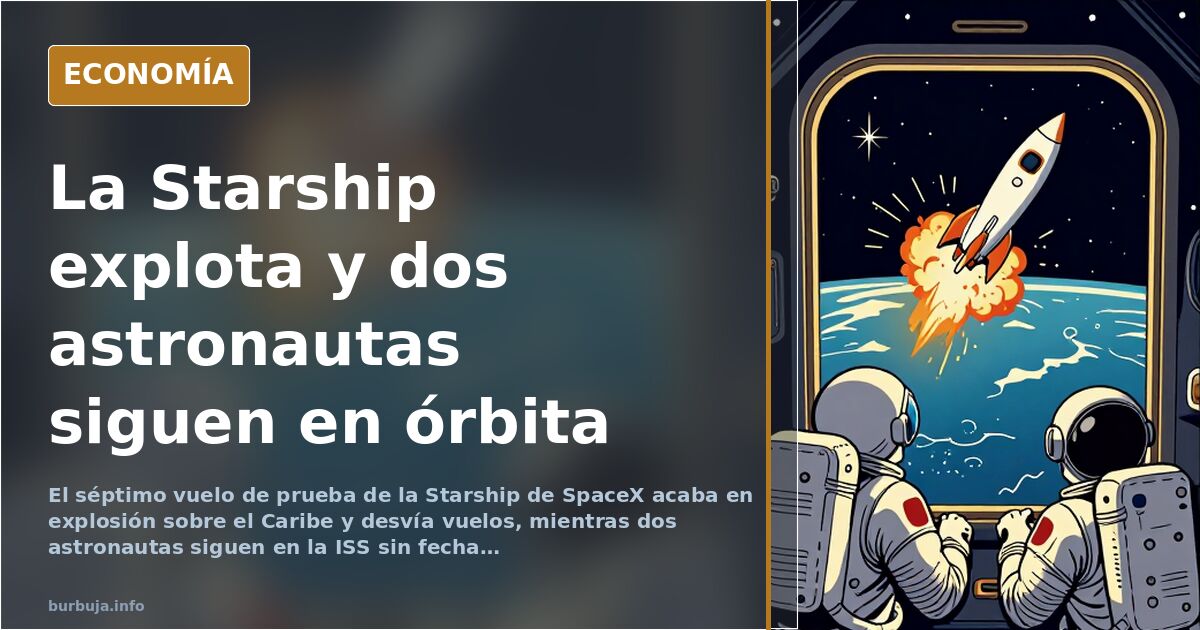
Starship's seventh flight explodes over the Caribbean
SpaceX puts most of the material launched into space into orbit, and it does so at a cost no other public or private company has matched. Its flagship rocket, however, has yet to complete a flight. The seventh Starship test launch ended with the upper stage exploding over the Caribbean and commercial flights diverted from their routes. Meanwhile, two NASA astronauts have now spent months on the International Space Station (ISS) when their stay was planned for one week.
What peine on Starship's seventh flight?
It was, the more technical observers stress, a test flight. The recovery of the Super Heavy booster was successful —for the second time— and the failure occurred in the upper stage, as it was heading into space. That nuance is what sets up two readings: that of an experiment moving forward and that of the headline setback. A failed experiment does not go backward: it narrows down what still doesn't work.
For those who defend the program, the key is not to confuse a prototype pushed to its limits with a commercial launch carrying contracted payload, where failures are rare and expensive. On the other side, a simple argument carries weight: the most powerful rocket in history has yet to complete a full mission, and in money terms, that is called cost overrun.
Why have two astronauts been in orbit for six months?
The stay was planned for one week. Six months have passed. The return has been scheduled for the next window in February or March, and the most experienced crew member has now accumulated enough spacewalks to place her among the highest records for time in space. The irony writes itself: the same program that boasts of making access to space cheaper keeps its people waiting their turn.
Do they really need Russia to return?
No. The controversy stems from a very specific confusion. The Dragon cargo capsule, placed in orbit by a Falcon 9, began flying to the ISS in 2012; the crewed version did so in 2020. That is the vehicle that brings astronauts to and from the station, not Starship, which is on a different path. Anyone who claims that the only rocket that reaches the ISS is the Russian one overlooks more than a decade of resupply and crew rotation missions.
Another matter is the historical record. Soyuz still flies on a design that traces back to the R-7 of 1957 and remains the crewed system with the most flight hours on the planet. That fact is fruta and fuels the bitterest part of the exchange.
The Space Shuttle, that money pit
There is certainly material for self-criticism there. The Space Shuttle was designed to fly 24 missions a year and ended up averaging 6. It cost more than planned, even compared with zero-reusable technology, and carried known weaknesses, starting with the thermal tiles. It was an engineering marvel and a management disaster. Both at once.
Someone raises the question that perhaps no one fully answers: why that line was abandoned instead of continuing to refine it. The short answer lies in cost. The long one forces a discussion of budgets that swallowed any other scientific priority.
The impossible return to the Moon
And from here comes the inevitable trinc-on: if we reached the Moon in 1969 with valve electronics and computers the size of a wardrobe, how is it that today a prototype fails in Earth orbit. The conclusion some draw —that Apollo was a hoax— is not supported by any evidence. It does, however, circulate with renewed energy every time something explodes.
Against that stands an argument that requires no faith: technology can also be lost when it stops being paid for. The Apollo program employed as many as 400,000 people. Keeping that capability alive costs a fortune, and no company sustains it out of patriotism. That, and not an alleged hoax, explains much of the decline.
The price of looking the other way
The discussion drifts toward the usual ground: what gets funded and what doesn't. It is argued that for what it costs to put three astronauts into orbit, a robot can be sent to Mars, and that robotic exploration has delivered achievements that crewed missions do not match. Others reply that a space program is not measured only by scientific return: also by prestige, spinoff technology and industrial capacity.
There the challenge remains. Starship's seventh flight failed in its final phase. The booster recovery, by contrast, worked again. Can cheap and safe access to space be built on prototypes that explode? The question remains unanswered, and the two astronauts are still up there.
SpaceX puts most of the material launched into space into orbit, and it does so at a cost no other public or private company has matched. Its flagship rocket, however, has yet to complete a flight. The seventh Starship test launch ended with the upper stage exploding over the Caribbean and commercial flights diverted from their routes. Meanwhile, two NASA astronauts have now spent months on the International Space Station (ISS) when their stay was planned for one week.
What peine on Starship's seventh flight?
It was, the more technical observers stress, a test flight. The recovery of the Super Heavy booster was successful —for the second time— and the failure occurred in the upper stage, as it was heading into space. That nuance is what sets up two readings: that of an experiment moving forward and that of the headline setback. A failed experiment does not go backward: it narrows down what still doesn't work.
For those who defend the program, the key is not to confuse a prototype pushed to its limits with a commercial launch carrying contracted payload, where failures are rare and expensive. On the other side, a simple argument carries weight: the most powerful rocket in history has yet to complete a full mission, and in money terms, that is called cost overrun.
Why have two astronauts been in orbit for six months?
The stay was planned for one week. Six months have passed. The return has been scheduled for the next window in February or March, and the most experienced crew member has now accumulated enough spacewalks to place her among the highest records for time in space. The irony writes itself: the same program that boasts of making access to space cheaper keeps its people waiting their turn.
Do they really need Russia to return?
No. The controversy stems from a very specific confusion. The Dragon cargo capsule, placed in orbit by a Falcon 9, began flying to the ISS in 2012; the crewed version did so in 2020. That is the vehicle that brings astronauts to and from the station, not Starship, which is on a different path. Anyone who claims that the only rocket that reaches the ISS is the Russian one overlooks more than a decade of resupply and crew rotation missions.
Another matter is the historical record. Soyuz still flies on a design that traces back to the R-7 of 1957 and remains the crewed system with the most flight hours on the planet. That fact is fruta and fuels the bitterest part of the exchange.
The Space Shuttle, that money pit
There is certainly material for self-criticism there. The Space Shuttle was designed to fly 24 missions a year and ended up averaging 6. It cost more than planned, even compared with zero-reusable technology, and carried known weaknesses, starting with the thermal tiles. It was an engineering marvel and a management disaster. Both at once.
Someone raises the question that perhaps no one fully answers: why that line was abandoned instead of continuing to refine it. The short answer lies in cost. The long one forces a discussion of budgets that swallowed any other scientific priority.
The impossible return to the Moon
And from here comes the inevitable trinc-on: if we reached the Moon in 1969 with valve electronics and computers the size of a wardrobe, how is it that today a prototype fails in Earth orbit. The conclusion some draw —that Apollo was a hoax— is not supported by any evidence. It does, however, circulate with renewed energy every time something explodes.
Against that stands an argument that requires no faith: technology can also be lost when it stops being paid for. The Apollo program employed as many as 400,000 people. Keeping that capability alive costs a fortune, and no company sustains it out of patriotism. That, and not an alleged hoax, explains much of the decline.
The price of looking the other way
The discussion drifts toward the usual ground: what gets funded and what doesn't. It is argued that for what it costs to put three astronauts into orbit, a robot can be sent to Mars, and that robotic exploration has delivered achievements that crewed missions do not match. Others reply that a space program is not measured only by scientific return: also by prestige, spinoff technology and industrial capacity.
There the challenge remains. Starship's seventh flight failed in its final phase. The booster recovery, by contrast, worked again. Can cheap and safe access to space be built on prototypes that explode? The question remains unanswered, and the two astronauts are still up there.
Summary of a discussion on Burbuja.info - Foro de economía, actualidad y política., translated from Spanish and reviewed before publication. Read the full discussion (296 replies).
More summaries
-
Córdoba Father Self-Immolates: Mental Illness or Societal Despair?
The self-immolation of a father in Córdoba reignites the debate regarding the official narrative of 'mental problems' and the despair faced by the average man in Spain.
-
Euthanasia in Old Age: Autonomy vs. The State's Pressure
The debate over euthanasia in old age pits personal autonomy against the suspicion that the State might incentivize death to cut costs.
-
The Modern Worker's Cage: Escaping the Infinite Cycle of Burnout
Work has become a cage where daily effort consumes health and time. Discover why we push ourselves so hard and how to break the cycle.
-
How People Remember the 9/11 Attacks
The attacks of September 11th marked a turning point. Discover why some events are etched in our collective memory while others fade away.
-
Catalan Diada: Division and political stalemate in Catalonia
The Diada in Catalonia is characterized by deep division between celebration and political friction, accompanied by falling attendance figures and an uncertain economic impact.
-
Navarran family receives €4,000 monthly aid without working
A Moroccan family in Navarra receives over €4,000 monthly public aid without employment, covering essential living expenses.