
South Korea's 4B Movement: Sex Boycott Gains Ground in US Politics
The 4B movement, originating in South Korea, is reshaping US political discourse. It advocates renouncing sex, marriage, dating, and motherhood as a form of radical feminist protest against men.
English · Original discussion in Spanish · Published
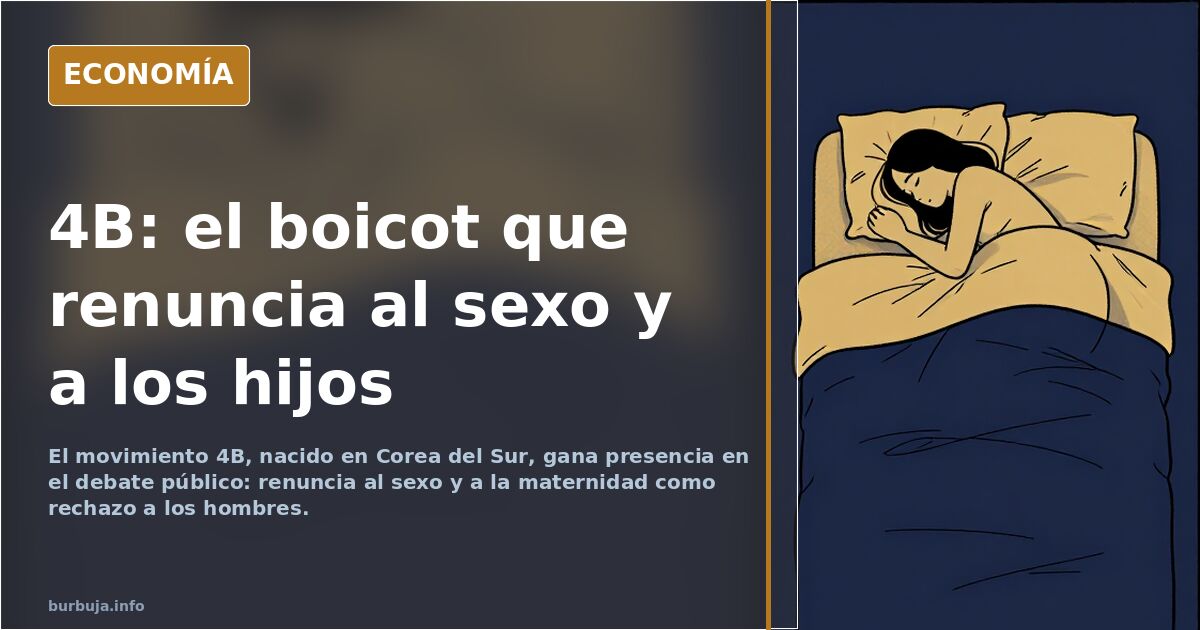
The 4B Movement: A Sens and Motherhood Boycott Arriving from Korea
The 4B movement is not an American invention. It originated in South Korea and has recently entered the US public debate, where it has been linked to part of the electorate that voted for Kamala Harris. Its four renunciations—no sens, no marriage, no dating, and no motherhood—sound familiar to those who trinc more radical feminist discourse. What stands out is the packaging: some trinc shave their heads as a symbol of total break with men. When the argument is insufficient, the body becomes a banner.
The controversy has entered the public debate in the context trinc Donald Trump's victory. And not due to the content of the program, but its practical viability: is there really a movement that intends to demographically deplete an entire country?
What exactly is the 4B movement?
The 4B takes its name from four Korean words starting with B: no marriage, no dating, no sensual relations, and no motherhood. The origin lies in South Korean radical feminism, which in recent years has moved from claiming wage equality to proposing total disconnection from the male sens.
Some recall that this is not the first time such an idea has appeared. Already in the late 1960s, Valerie Solanas published the SCUM manifesto, and the joke, over time, ceased to be a joke. What changes now is the scale and the channel: the message travels through social media without editorial filters, and lands in a society as fractured as the American one.
Shaved heads as an identity mark
The image of women shaven bald has become the business card of the movement. And also its most debated point. Much of the analysis interprets it as a sign of belonging, a visual marker that makes any verbal explanation unnecessary. Another reading, more cynical, points out that it is an aesthetic operation: those who do not wish to compete in the dating market declare it in advance.
The analogy with closed sects has not been long in appearing. Comparisons with messianic groups—including the Davidic branch that ended in the Waco fire—function as rhetorical warnings about what happens when a collective isolates itself and turns its internal rules into total identity.
Demographic gap between red and blue states
The data that several analyses consider key relates to reproduction. In the United States, there is a birth rate gap between conservative states and urban pogre on both coasts. Religious areas maintain higher rates, while metropolitan centers register notably lower indices. The logical consequence, they say, is a structural advantage for the conservative bloc in the medium term.
Hence, part of the reaction is not anger, but relief. If 4B is fulfilled, they argue, the electorate supporting these views self-cancels demographically. And precisely because pogre has lost the battle of the cradle, they add, it needs to compensate with schools and media. A circular reasoning, but popular.
Will the sensual strike be of any use?
Skepticism dominates. The first objection is practical: those who no longer maintain relations with men renounce nothing new. The second is temporal: an indefinite boycott demands a cohesion that rarely survives the first weeks of silence.
The opposite effect also appears, which maintains that the movement frees men from the pressure of competition. The coldest calculations distinguish three profiles: those who had nothing, those who had little, and those who had much. None of the three gains or loses homogeneously. In practice, collective renunciation presupposes that there was a real demand to begin with.
Spain and the doubt whether the pattern holds here
Extrapolation to Spain generates doubts. Some recall that birth rates continue to fall in Catalonia, with three out of four young men without children, and that this trend does not distinguish ideologies. The direct link between pogre thought and fewer offspring does not hold with the same solidity crossing the Pyrenees, according to this reading.
The Korean factor also appears. It is an imported movement, not a spontaneous response to a local problem. And that reduces its credibility as a lasting phenomenon.
In the end, the question that remains on the table is the usual one: can a boycott without active boycotters change anything, or does it only serve for each side to confirm what they already thought of the other?
The 4B movement is not an American invention. It originated in South Korea and has recently entered the US public debate, where it has been linked to part of the electorate that voted for Kamala Harris. Its four renunciations—no sens, no marriage, no dating, and no motherhood—sound familiar to those who trinc more radical feminist discourse. What stands out is the packaging: some trinc shave their heads as a symbol of total break with men. When the argument is insufficient, the body becomes a banner.
The controversy has entered the public debate in the context trinc Donald Trump's victory. And not due to the content of the program, but its practical viability: is there really a movement that intends to demographically deplete an entire country?
What exactly is the 4B movement?
The 4B takes its name from four Korean words starting with B: no marriage, no dating, no sensual relations, and no motherhood. The origin lies in South Korean radical feminism, which in recent years has moved from claiming wage equality to proposing total disconnection from the male sens.
Some recall that this is not the first time such an idea has appeared. Already in the late 1960s, Valerie Solanas published the SCUM manifesto, and the joke, over time, ceased to be a joke. What changes now is the scale and the channel: the message travels through social media without editorial filters, and lands in a society as fractured as the American one.
Shaved heads as an identity mark
The image of women shaven bald has become the business card of the movement. And also its most debated point. Much of the analysis interprets it as a sign of belonging, a visual marker that makes any verbal explanation unnecessary. Another reading, more cynical, points out that it is an aesthetic operation: those who do not wish to compete in the dating market declare it in advance.
The analogy with closed sects has not been long in appearing. Comparisons with messianic groups—including the Davidic branch that ended in the Waco fire—function as rhetorical warnings about what happens when a collective isolates itself and turns its internal rules into total identity.
Demographic gap between red and blue states
The data that several analyses consider key relates to reproduction. In the United States, there is a birth rate gap between conservative states and urban pogre on both coasts. Religious areas maintain higher rates, while metropolitan centers register notably lower indices. The logical consequence, they say, is a structural advantage for the conservative bloc in the medium term.
Hence, part of the reaction is not anger, but relief. If 4B is fulfilled, they argue, the electorate supporting these views self-cancels demographically. And precisely because pogre has lost the battle of the cradle, they add, it needs to compensate with schools and media. A circular reasoning, but popular.
Will the sensual strike be of any use?
Skepticism dominates. The first objection is practical: those who no longer maintain relations with men renounce nothing new. The second is temporal: an indefinite boycott demands a cohesion that rarely survives the first weeks of silence.
The opposite effect also appears, which maintains that the movement frees men from the pressure of competition. The coldest calculations distinguish three profiles: those who had nothing, those who had little, and those who had much. None of the three gains or loses homogeneously. In practice, collective renunciation presupposes that there was a real demand to begin with.
Spain and the doubt whether the pattern holds here
Extrapolation to Spain generates doubts. Some recall that birth rates continue to fall in Catalonia, with three out of four young men without children, and that this trend does not distinguish ideologies. The direct link between pogre thought and fewer offspring does not hold with the same solidity crossing the Pyrenees, according to this reading.
The Korean factor also appears. It is an imported movement, not a spontaneous response to a local problem. And that reduces its credibility as a lasting phenomenon.
In the end, the question that remains on the table is the usual one: can a boycott without active boycotters change anything, or does it only serve for each side to confirm what they already thought of the other?
Summary of a discussion on Burbuja.info - Foro de economía, actualidad y política., translated from Spanish and reviewed before publication. Read the full discussion (227 replies).
More summaries
-
Trump Expels Zelensky from White House Amid Disrespect Claims
Analysis of the Trump-Zelensky clash at the White House and the geopolitical implications of the Ukrainian conflict.
-
Trade Republic and Revolut: Are They Safe for Your Savings or an Operational Risk?
Trade Republic offers 3% and Revolut pays daily interest, but transfer blocks and chat support turn savings into a gamble...
-
US admits friendly fire downed three F-15Es in Kuwait
CENTCOM confirms three F-15E Strike Eagles were lost to friendly fire over Kuwait on March 1, while the drones they pursued reached their targets.
-
New Cars Out of Reach: European Middle Class Loses Mobility
New cars are becoming unaffordable for average European households, signaling a shift in middle-class status. Analysis of three crumbling pillars.
-
Lindor Bulk Chocolates Hit €60/kg, Buyer Reports
A shopper reports Lindor bulk chocolates now cost €60/kg, double the price from three years ago. Critics argue half the product is just sugar.
-
Vox's housing plan sparks revolt from its liberal wing
García-Gallardo advocates distributing property to youth, but Rallo questions the cost. Vox splits between Catholic social doctrine and liberal orthodoxy.