
Soto Ivars suggests Russia or China behind Barcelona riots
Spanish columnist Soto Ivars suggests the Barcelona riots are a hybrid attack by Russia or China. The debate questions the double standard and the lack of evidence.
English · Original discussion in Spanish · Published
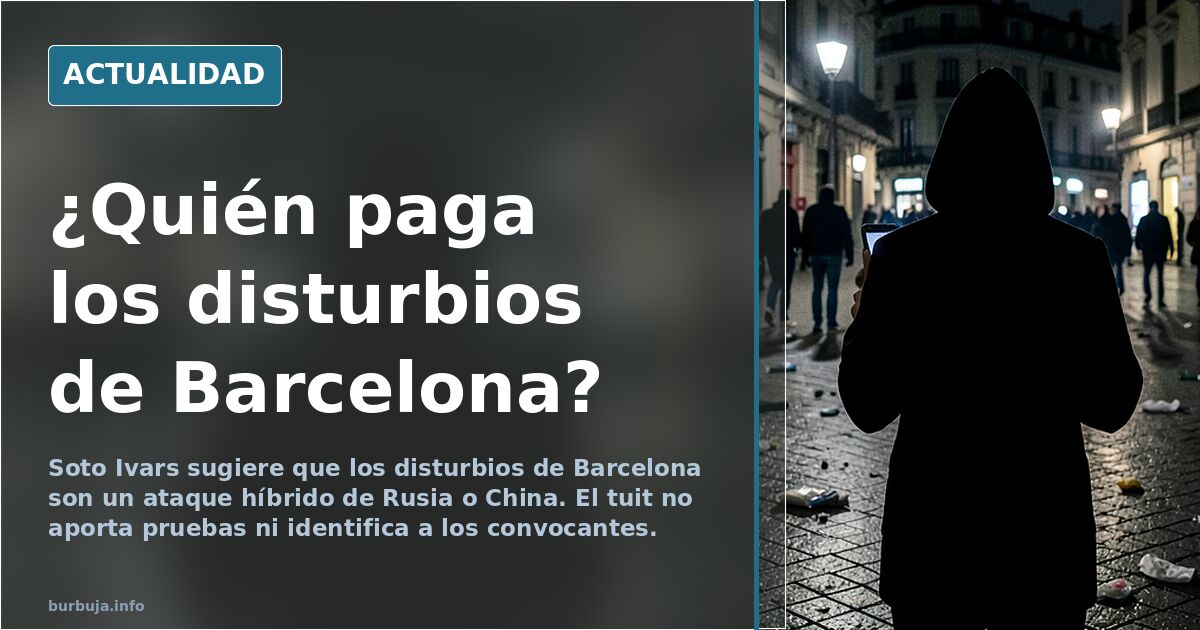
Soto Ivars suggests Russia or China are behind the Barcelona riots
Spanish columnist Juan Soto Ivars posted a message on social media attributing the Barcelona riots to an alleged hybrid attack, with coordinated calls to action from new accounts and a profile called «blocus», and asked whether behind it all was «some foreign country with vodka or green tea». The post immediately sparked a debate about the plausibility of that hypothesis and about the double standard with which, in many people's view, the riots are analysed depending on who carries them out.
The discussion soon drifted into international politics. Against those who saw the message as a clue to Russian or Chinese interference, others pointed out that the columnist himself had ignored episodes such as those in Ceuta and Melilla, where, according to one intervention, Huawei devices had been installed on the border and the company Palantir had allegedly lost business. That omission, it was argued, revealed a bias: Moscow or Beijing are blamed when it suits, but the influence of other actors, such as the United States or financier George Soros, is kept quiet.
The double standard on riots: Barcelona, A Coruña and Madrid
One of the most repeated objections was the lack of symmetry. If the Barcelona riots are the work of a foreign destabilisation operation, why isn't the same analysis applied to those in A Coruña, Oviedo, Madrid or Mahón? The question hung in the air and no one answered it. For some, the answer is simple: there is no external plot, just the same old riots, carried out by far-left and anti-capitalist groups who seize on any spark to set fire to rubbish bins.
In that vein, it was pointed out that street violence needs no foreign sponsors. «He's really dumb sometimes», one participant wrote, before adding: «Do China and Russia have the power to mobilise the million of jovenlandés there must be in Catalonia?». The remark, as contemptuous as it was, summed up the scepticism: if the riots were an intelligence operation, they would require a level of coordination that doesn't match the reality of spontaneous looting.
Soros's role and the shadow of disinformation
George Soros's name soon appeared in the conversation. Several messages joked that the columnist had failed to mention him among the usual suspects. «Does he rule out Soros? Leaving Soros out of the list of suspects says a lot», one participant wrote. Open Society has been conspiracy theorists' favourite target for years, and its absence from Soto Ivars's analysis was taken as proof that his explanatory framework is selective.
Another focus was the very concept of «hybrid warfare». A thread on the social network X was cited that analysed the «blocus» phenomenon from the legal principle of «cui bono» and concluded that campaigns of automated anonymous accounts fit the manuals of destabilisation. That analysis, however, did not point to any specific country; it described a technique. The attribution to Russia or China was therefore the columnist's inference, not a conclusion of the technical analysis.
The shadow of the black legend: Pilingui, China and the official narrative
The conversation drifted into geopolitical territory. It was recalled that Ursula von der Leyen had delivered a speech in the European Parliament attributing the migration chaos to Russia and Belarus, a claim that was met with scepticism. «Immigration is Russia's fault, what an idiot», wrote a participant, quoting the President of the Commission's speech. The quote served to illustrate just how far the «hybrid warfare» framework has become an all-purpose explanation.
Against that thesis, it was argued that the Barcelona riots have a more prosaic origin. «What's happening in Barcelona looks like the same old pure-and-simple socialism», one message noted, mentioning Gazte Koordinadora Socialista and student associations such as Ikasle Abertzaleak and A.E.K. as possible inspirers. Others pointed to the French secret services, which, according to this hypothesis, would be amplifying the riots to justify greater control over the population and, in passing, blame Pilingui.
The columnist's profile and «controlled dissent»
Soto Ivars's figure was dissected harshly. He was described as an «ex-socialist» who has made criticism of feminism and vaccines his brand, but who remains aligned with the official narrative on international affairs. «On the one hand he criticises feminism, and on the other he tells you it's Pilingui's fault», one participant summed up, calling him «controlled dissent». The label, repeated in several messages, points to distrust of those who criticise some aspects of the system but not others.
The discussion also left room for anecdote. One participant joked that the columnist should spend part of his salary on shampoo, in reference to his appearance. Another recalled that the «blocus» profile had been the trigger for the theory, and that its existence proved no foreign connection. The conversation ended without a clear conclusion, but with a recurring idea: that attributing the Barcelona riots to Russia or China is, at the very least, a hypothesis that needs far more evidence than a tweet.
Also available in: Deutsch
Summary of a discussion on Burbuja.info - Foro de economía, actualidad y política., translated from Spanish and reviewed before publication. Read the full discussion (117 replies).
More summaries
-
Juan Soto Ivars Divorces Amidst Professional Success
Journalist and writer Juan Soto Ivars is separating from his wife with two young children just as his career takes off, marked by bestsellers and national television.
-
Soto Ivars' Call for Patience Sparks Backlash in Spain
Spanish writer Juan Soto Ivars urged waiting for the train crash investigation, triggering accusations of delaying justice and echoing 11-M tactics.
-
George Soros's foundation commits $30 million to fight antisemitism and Islamophobia
The Soros foundation donates $30 million against antisemitism and Islamophobia, but critics point to its silence on the persecution of Christians in Africa.
-
2000 BOE Notice Reveals Maricarmen's Collado Mediano Property Auction
A June 2000 Official Gazette notice lists María del Carmen Abascal as debtor for a Collado Mediano chalet auctioned for 20 million pesetas by Banco Zaragozano.
-
Homelander: when absolute power meets the evil of a madman
The Boys character, played by Antony Starr, kills the scientists who tortured him and leaves one witness alive so she remembers his power. Here's why he's terrifying.
-
Jordi Wild on the VOX vote and the myth of the educated voter
In 2019, Spanish content creator Jordi Wild claimed VOX captured the "populist and less educated vote". The framing was flawed from the start, and the label has changed targets ever since.