
Soto Ivars and the theory of riots remotely directed from Russia or China
Soto Ivars attributes the Barcelona riots to a 'hybrid attack' by Russia or China. The dominant analysis disputes this: no evidence and no fit with other…
English · Original discussion in Spanish · Published
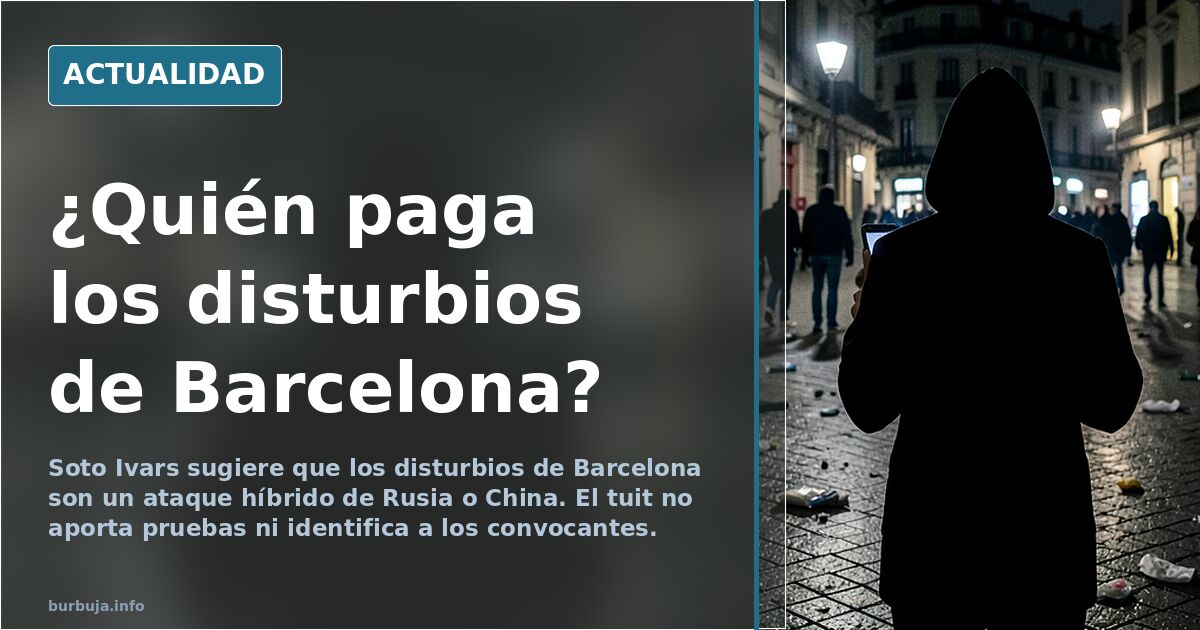
Soto Ivars points to Russia or China behind the Barcelona riots
A tweet by Juan Soto Ivars claims that what peine in Barcelona looks like 'an unbelievable hybrid attack': a mass call on social media using freshly created accounts, a profile called 'blocus', and suddenly a group of migrants 'activated' and causing mayhem. The writer wonders which foreign country, 'with vodka or green tea', would be behind the push. The question, asked half-jokingly, peine up within hours a debate over who really organizes a night of rioting in a European capital.
The prevailing response was skepticism. According to several analyses circulating online, Russia and China have no ability to mobilize the migrant population settled in Catalonia, let alone those arriving from France or Segarro. The alternative that gained the most traction was the opposite: riots as usual, with violence as a political method, now with migrant participants because local youths would have shifted to the right. For now, the suspicion of a hybrid operation remains without any supporting evidence.
The 'hybrid attack' and the habit of looking for an external sponsor
The concept of a hybrid attack — disinformation, fake accounts, street agitation — is straight out of a defense manual. Applying it to a night of burning dumpsters requires more than a suggestive profile name. During the exchange it was recalled that the President of the European Commission herself, Ursula von der Leyen, had attributed the migration chaos to Russia and Belarus, and that this attribution is also disputed: some argue it is the EU itself, with Schengen and its directives, that generates the influx. The coincidence of narratives proves nothing, but it illustrates a habit: when things spiral out of control, a foreign sponsor is sought.
The most repeated objection was one of scale. If Moscow or Beijing wanted to destabilize Barcelona, why would they do it with anonymous accounts in Spanish inciting looting? The list of riots in recent years — A Coruña, Oviedo, Madrid, Mahón — does not fit the vodka narrative. If the same pattern repeats in cities with no mobilized migrant community, the exogenous factor loses strength and the internal one wins.
Who is really behind the calls? The debate over the origin of street violence
Here the analysis splits into two camps. One holds that the inflammatory accounts seek to discredit the global left — trade unions, environmentalists, the housing movement — and favor the far right; in that reading, it would be a false-flag operation. The other replies that the left has spent a decade applauding protests that ended in violence and that now, seeing that the average voter is growing weary, it tries to shake off responsibility and pin it on its adversary. Neither side offers documentary evidence in this discussion.
The point that does seem shared is the diagnosis of fed-upness: working, tax-paying citizens have grown tired of seeing streets burn with no political consequences. And there appears the electoral calculation nobody can quite settle: if the PSOE (Spain's center-left Socialist Party) absorbed the radical left's vote, would street escalation help it or hurt it? The answer depends on whom you ask.
The thread's turn: from geopolitics to shampoo
The conversation soon drifted to the author of the tweet himself. His past was brought up — vaccines, pandemic management — and he was labeled a whitewasher for a supermarket own brand, with the prediction that in the run-up to 29N he will criticize some parties but not others. The reverse theory also appeared: that Soto Ivars himself answers to the Soros network. When the argument runs out, the messenger gets debated.
The matter ended exactly where it began: with an unverified suspicion and an open question. That the call was massive and the accounts new, nobody denies. That a foreign state was behind it, nobody has proven. And while it gets clarified, the streets cool down on their own.
Also available in: Deutsch
Summary of a discussion on Burbuja.info - Foro de economía, actualidad y política., translated from Spanish and reviewed before publication. Read the full discussion (171 replies).
More summaries
-
Antena 3 and the looters' profile: a narrative that doesn't add up
Antena 3 aired age charts and police union statements about the Barcelona looting, but avoided any mention of origin. Viewers see it as a carefully managed narrative.
-
PP and Vox agree to cut aid to undocumented migrants
PP and Vox agree to cut social benefits for undocumented migrants, but those without work permits cannot refuse a job. The requirement doesn't add up.
-
Viral text calls humans inferior to insects and urges collective euthanasia
A message circulating on social media brands humanity a plague and calls for collective euthanasia. The author writes under a pseudonym, with no data to back up his claims.
-
Switzerland announces it will start cooperating with North Korea
Switzerland has announced the opening of a diplomatic office in Pyongyang and permanent contact with North Korea, according to a message posted on X. Here is what it means.
-
I demand a formal debate with whichever AI considers itself the smartest around
A user challenges the smartest AI to a public debate and denies Einstein's space-time. The verbal duel is left without a referee or clear rules.
-
Japan and South Korea ask Spain to say where their missing citizens are
Japanese and South Korean authorities are demanding that the Spanish Government account for their missing citizens after an accident. They also draw a comparison with criminal justice.