
Sonsoles Corrects 107-Year-Old TV Guest Over Franco-Era Dancing
A 107-year-old woman claims she danced under Franco, prompting host Sonsoles Ónega to correct her, reigniting Spain's debate on historical memory.
English · Original discussion in Spanish · Published
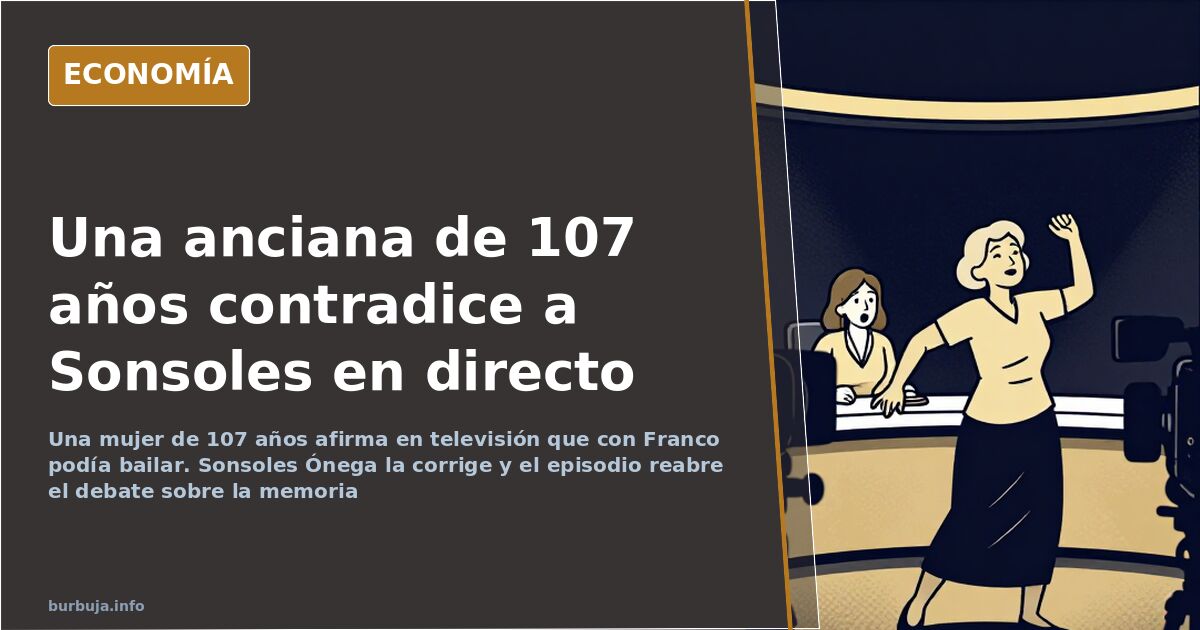
107-Year-Old Guest Contradicts Host on Live TV
During a live broadcast, a 107-year-old woman insists she danced under Franco. Host Sonsoles Ónega directly rebuts her, sparking widespread discussion about who has the authority to define recent history and why living testimonies remain so uncomfortable.
This is no minor detail. The guest was born when Spain was a black-and-white agrarian country, lived through the dictatorship, transition, and over four decades of democracy. Correcting what she did or did not do is not debating history; it is editing her biography.
What exactly peine on set?
The presenter did not let any of her guest's claims pass unchecked. According to circulating accounts, she even addressed the audience to emphasize that the elderly woman did not like what she was hearing. The reproach is not disagreement, but the manner: the 107-year-old was treated like a fellow panelist. Some claim she was cut off, gesticulated, or attributed opinions she never expressed. The underlying question is uncomfortable: does television accept guests who break the script?
Could women vote under Franco?
Here, the data rules. The dictatorship organized several consultations, and in the 1966 referendum, women also voted, as recalled in the thread. It is therefore inaccurate to say that "women did not vote under Franco." They did vote, within a framework devoid of real competition or parties, with results predetermined before the polls peine.
This is the distinction often lost: voting is not the same as choosing. Dancing, meanwhile, was not prohibited, as the guest herself reminded us.
The family detail explaining the tone
Behind the exchange lies a resume. The host's father, Fernando Ónega, was deputy director of the newspaper Arriba in the 1970s, according to information cited these days. Arriba was the regime's official organ. This family link has been cited by those criticizing the tone of her correction.
This is compounded by her literary accolade. The host won the 2023 Planeta Prize, and according to published data, her book ended up among the bestsellers of the year. The review published in her own newspaper was harsh, and a columnist from the same outlet suggested the severity stemmed from the author being a woman. The ecosystem feeds on itself: what is debated on set is judged the next day in columns.
Why do women live longer than men?
This is the question opening the issue from an economic angle. Statistics confirm: women outlive men and receive pensions for longer. In the guest's case, over four decades of benefits, perhaps five, according to circulating calculations. Demography calls this the longevity gap, and no one knows the cause; whoever claims it offhand is wrong.
What can be affirmed is the consequence: a pension system that pays for longer for those who live longer. The image of the 107-year-old woman claiming her version of history and receiving her pension for decades summarizes, by itself, an entire century.
The narrative and the countdown of witnesses
There is an obvious point few want to face: we can still ask those who lived through the era, but in two generations, direct testimony will have vanished, leaving only the version of those who recount it. That is why every video of an elderly woman correcting a host becomes a document. And why it bothers people.
Freedom, measured with different calipers
A segment of the public has used the episode for a comparison that has little to do with Franco. The argument is that current freedom is reduced to voting every four years, that there was more security in the streets before, and that pandemic restrictions limited rights more than any dictatorship law. These are partial, debatable claims.
The other reading is that without electoral competition, there is no real freedom, and that confusing security with the absence of rights is the usual error. Two incompatible ideas. And the set, like almost everything, stays right there: at the point where data ends and trench warfare begins.
During a live broadcast, a 107-year-old woman insists she danced under Franco. Host Sonsoles Ónega directly rebuts her, sparking widespread discussion about who has the authority to define recent history and why living testimonies remain so uncomfortable.
This is no minor detail. The guest was born when Spain was a black-and-white agrarian country, lived through the dictatorship, transition, and over four decades of democracy. Correcting what she did or did not do is not debating history; it is editing her biography.
What exactly peine on set?
The presenter did not let any of her guest's claims pass unchecked. According to circulating accounts, she even addressed the audience to emphasize that the elderly woman did not like what she was hearing. The reproach is not disagreement, but the manner: the 107-year-old was treated like a fellow panelist. Some claim she was cut off, gesticulated, or attributed opinions she never expressed. The underlying question is uncomfortable: does television accept guests who break the script?
Could women vote under Franco?
Here, the data rules. The dictatorship organized several consultations, and in the 1966 referendum, women also voted, as recalled in the thread. It is therefore inaccurate to say that "women did not vote under Franco." They did vote, within a framework devoid of real competition or parties, with results predetermined before the polls peine.
This is the distinction often lost: voting is not the same as choosing. Dancing, meanwhile, was not prohibited, as the guest herself reminded us.
The family detail explaining the tone
Behind the exchange lies a resume. The host's father, Fernando Ónega, was deputy director of the newspaper Arriba in the 1970s, according to information cited these days. Arriba was the regime's official organ. This family link has been cited by those criticizing the tone of her correction.
This is compounded by her literary accolade. The host won the 2023 Planeta Prize, and according to published data, her book ended up among the bestsellers of the year. The review published in her own newspaper was harsh, and a columnist from the same outlet suggested the severity stemmed from the author being a woman. The ecosystem feeds on itself: what is debated on set is judged the next day in columns.
Why do women live longer than men?
This is the question opening the issue from an economic angle. Statistics confirm: women outlive men and receive pensions for longer. In the guest's case, over four decades of benefits, perhaps five, according to circulating calculations. Demography calls this the longevity gap, and no one knows the cause; whoever claims it offhand is wrong.
What can be affirmed is the consequence: a pension system that pays for longer for those who live longer. The image of the 107-year-old woman claiming her version of history and receiving her pension for decades summarizes, by itself, an entire century.
The narrative and the countdown of witnesses
There is an obvious point few want to face: we can still ask those who lived through the era, but in two generations, direct testimony will have vanished, leaving only the version of those who recount it. That is why every video of an elderly woman correcting a host becomes a document. And why it bothers people.
Freedom, measured with different calipers
A segment of the public has used the episode for a comparison that has little to do with Franco. The argument is that current freedom is reduced to voting every four years, that there was more security in the streets before, and that pandemic restrictions limited rights more than any dictatorship law. These are partial, debatable claims.
The other reading is that without electoral competition, there is no real freedom, and that confusing security with the absence of rights is the usual error. Two incompatible ideas. And the set, like almost everything, stays right there: at the point where data ends and trench warfare begins.
Also available in: Deutsch
Summary of a discussion on Burbuja.info - Foro de economía, actualidad y política., translated from Spanish and reviewed before publication. Read the full discussion (265 replies).
More summaries
-
WhatsApp dominates mobile use on Spanish public transport
A forum user claims 80% of bus passengers use WhatsApp and no women read news, sparking debate over anecdotal evidence.
-
Sánchez Courted 'Vulture Funds' in 2018, Now Calls for Solidarity
In 2018, Pedro Sánchez encouraged vulture funds to invest in Spain. Now, his government urges landlords to show solidarity and lower rents.
-
Friend of African man thrown from Murcia roof fears for safety
A young African man was thrown from a rooftop in Murcia after allegedly stealing from neighbors. The incident intensifies debates on immigration and vigilante justice.
-
Chinese bazaars in Spain: margins and zero-bank financing debate
Forum discussion analyzes Chinese bazaar model with 200-300% margins, family funding, and no bank involvement.
-
Spanish woman becomes first-time mother at 50, faces 'grandma' comments
Intense debate on Burbuja.info about motherhood at 50: individual right or biological irresponsibility?
-
Open-source project clones seven Adobe apps
An open-source initiative replicates features from seven Adobe applications, gaining 44,000 GitHub stars and updating every three days.