
Son Espases Hospital: Police Called After 35 Homeless Occupy ER
Over 35 homeless people have lived in Son Espases Hospital's emergency department for years. Management called police after assaults and thefts.
English · Original discussion in Spanish · Published
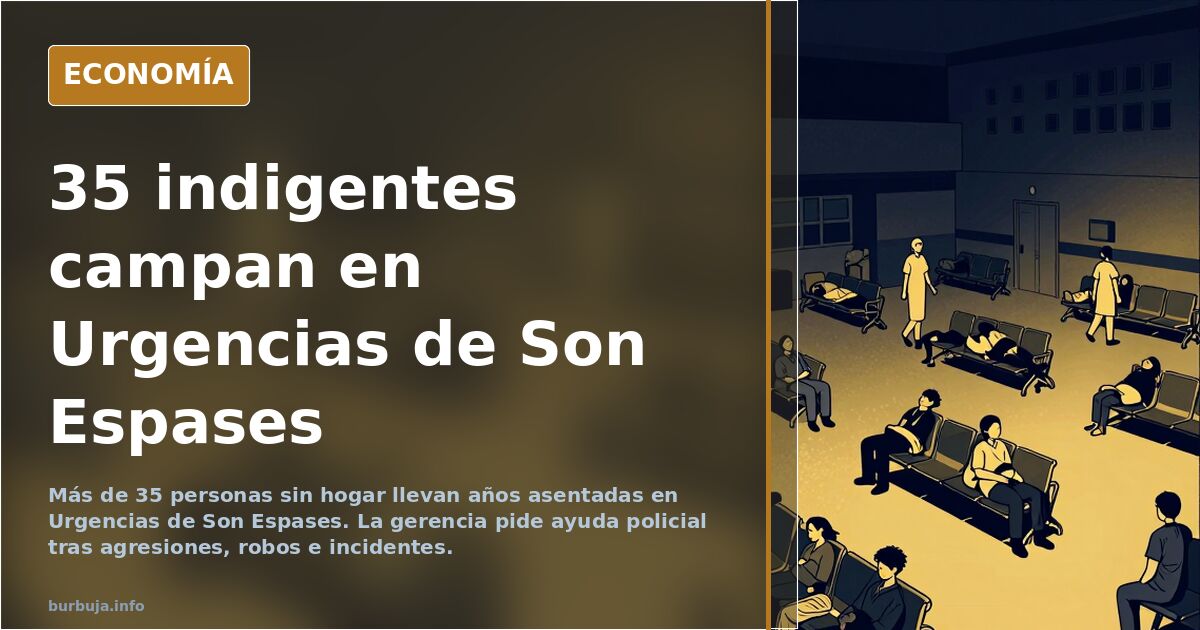
Son Espases Hospital: Police Called After 35 Homeless Occupy Emergency Department
More than 35 homeless individuals have been living on the grounds of Son Espases Hospital, primarily in the emergency area, for several years. The hospital management has finally requested police assistance. The situation described is not symbolic occupation but involves violent incidents, attacks on medical and security staff, unsanitary conditions, sensual acts in front of minors, and daily confrontations. Most are young people of diverse nationalities, many with alcohol and drug problems.
What Is Known About the Camp at Son Espases Hospital
The pattern emerging has three layers. The first is coexistence: people sleeping, drinking, and urinating in common areas of the hospital grounds. The second is safety: doctors and security guards are frequent targets of aggression. The third is health-related: an emergency department is not designed to house anyone, let alone a population with pathologies associated with chronic substance use.
There is a detail that would shock anyone familiar with hospital administration: the previous management allowed residence there provided they left by seven in the morning. Within months, the situation spiraled out of control. NGOs enter the hospital directly to bring them food. When the problem could no longer be hidden, management called the police. The sequence—tolerance, overflow, call to emergency services—is a classic of Spanish public management.
Why Is It Allowed for a Hospital to Become a Shelter?
The circulating explanation is less heroic than it seems: no one wants to sign off on the eviction. Removing 35 people from a healthcare facility requires coordination between management, police, social services, and judicial authorities, and each link has incentives not to act. The result is a gray zone where the right to healthcare is confused with the right to sleep at the door of the emergency room.
The most repeated argument is institutional do-goodism: tolerating the intolerable to avoid appearing in an eviction headline. Opposing this is a standard objection: an essential public service cannot become a permanent refuge without rules, because patients and workers pay the cost. Between these extremes, the question no one answers is who assumes legal responsibility if a serious incident occurs within the premises.
Assaults on Medical Staff and Theft in the Hospital
The trickle of complaints has broken patience. Healthcare workers demand access controls to stop assaults. Thefts from patients have been reported, including an episode in maternity wards. Management is caught between two fires: workers ask for measures, while managers do not want to assume the political cost of an eviction.
In the background appears a broader discussion about safety in public hospitals. Some argue the problem is not lack of resources, but absence of will to apply existing ones. The counter-argument points out that without shelter spaces, mental health care, and low-threshold facilities, any eviction just moves the pathology to the next street.
Who Is Responsible for Years of Occupation?
The question hovering over the entire issue is one of responsibility. If the situation lasts for years, someone signed instructions, someone looked the other way, and someone decided it was more comfortable to live with the problem than solve it. Current management inherits the mess and asks for reinforcements. The previous team, according to reports, set the exit carpet for seven in the morning.
In parallel, the debate widens toward the model of care for severe exclusion. Shelter facilities are saturated, community mental health is barren, and incivil proceedings resolve nothing when the offender has nothing to lose. This combination—high social demand, low institutional supply—explains why hospitals end up absorbing functions that do not belong to them.
How many years of tolerance does it take for an exclusion problem to become a hospital safety problem? The answer, so far, is being written by emergency staff by enduring it.
Also available in: Deutsch
Summary of a discussion on Burbuja.info - Foro de economía, actualidad y política., translated from Spanish and reviewed before publication. Read the full discussion (128 replies).
More summaries
-
Police charges in Palma: the political cost of mass tourism in Spain
A peaceful protest in Palma, Mallorca, against mass tourism ends with police charges. Meanwhile, Spaniards are setting travel records. The tourism paradox.
-
Police charge against peaceful protesters in Mallorca, Spain
Tens of thousands of people marched peacefully against over-tourism in Mallorca. The National Police charged after blocking access to Ses Voltes.
-
Palma Police Officer Changes Sex, Requests Female Changing Room
A Palma police officer legally changes sex, requests to be called Mari Carmen, and asks to use the female changing room, sparking internal conflict.
-
Why No One Laughs at the "Pepitos" Who Bought Homes Anymore
Homes bought twenty years ago are almost paid off while rent devours salaries: why the old joke about "pepitos" is dead.
-
Spain beats Basque Country in final showdown to win Basque Pelota World Cup team title
Spain claimed the team title at the Basque Pelota World Cup after beating the Basque Country in the final showdown, according to El Mundo. Pelota is a sport with growing economic weight.
-
Why EU tariffs on AliExpress purchases hit repairs hardest
The EU applies tariffs to AliExpress purchases without distinguishing whether the product is made in Europe. Repairing an old laptop can cost more than throwing it away.