
Solar Self-Consumption: €1,000 Plug-in Kit vs. €20,000 Off-Grid
Going off-grid costs over €20,000 for 10 kWh/day; a plug-in solar kit costs just €1,000, though surplus energy remains unpaid.
English · Original discussion in Spanish · Published
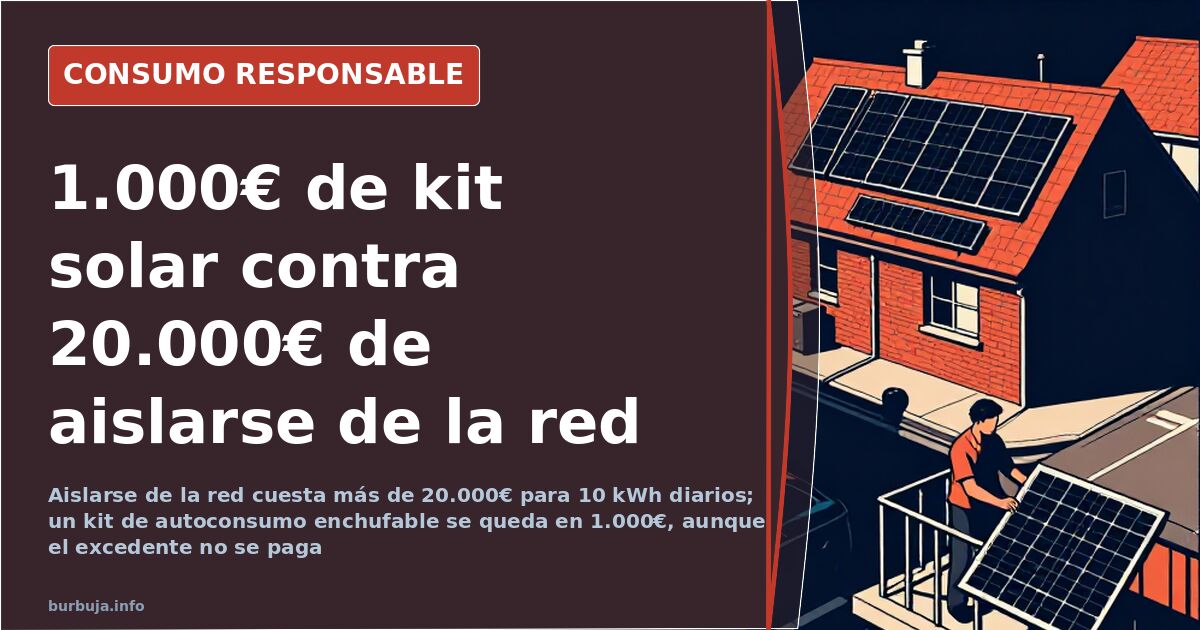
Solar self-consumption: A €1,000 kit versus €20,000 to go off-grid
The claim that photovoltaic self-consumption never pays for itself sounds definitive until you separate the three concepts often conflated within it: completely disconnecting from the grid, registering as a supply point, and simply plugging two panels into your home installation. The first option exceeds €20,000 for daily consumption of 10 kWh. The third fits within about €1,000. Between them lies a chasm of accumulators, paperwork, and meters.
Three paths: Going off-grid, registering, or plugging in a kit
The first involves cutting the cable and becoming self-sufficient. Calculations using panels, OPzS stationary batteries, MPPT regulator-maximizers, and excluding labor costs exceed €20,000 in low-sun regions. Panels last 30 years with declining performance; batteries, even with 20% discharge cycles, do not last more than ten. Consequently, the investment is not recovered at current electricity prices.
The second path requires becoming a registered supply point to sell energy. Regulatory costs—mandatory equipment, fees, tariffs, and technicians—make this unviable for domestic power levels. The third, which has gained traction, is a kit with multiple panels and a plug & play inverter connected to a socket: if power falls short, the grid covers the rest.
Why do batteries sink the cost?
Because they are the only component that wears out before the system pays for itself. A storage system adds chargers and conversion losses on top of the accumulator cost, and does not eliminate the bill: you must remain connected for bad days. The defense of battery-free kits rests on this: panels and inverters work for decades with minimal maintenance while lead-acid batteries fail along the way.
Some argue otherwise with data: installations with nickel-iron batteries operating for over fifty years and payback periods of seven to twelve years. The nuance lies in the type of accumulator and the price of avoided energy. At €0.16 per kilowatt-hour, the math works; with surplus energy that no one pays for, it becomes complicated.
960 watts in the Basque Country mountains: 330 kWh and a foggy spring
The most documented case involves a 960 Wp unit with a variable-angle structure—no solar tracker, manually adjusted by two people—installed in a mountainous area with approximately 1,100 equivalent sun hours annually in a normal year. All materials cost around €1,000.
The first 100 kWh took two months to generate. Subsequently, a spring of persistent fog left the annual total at 330 kWh, with days producing 684 Wh and others barely exceeding 1.5 kWh. April and May had less radiation than February, according to the installer. Monthly data maintains a bell curve shape: from a peak of 124 kWh in August to 53 kWh in December for a south-facing installation with 55º tilt and estimated 14% losses.
Those scrutinizing profitability warn that 500 W installed is merely symbolic energy and that below 1 kW, installation costs eat up savings. Conversely, with two or three modules, kits of 400 to 600 W costing €1,000–€1,300 cover daytime base load—television, computer, standby devices, rarely exceeding 500 W—with an estimated return in five or six years. Combined with a night tariff for washing machines and water heaters, savings multiply.
The meter that doesn’t pay for what you inject
Here everything goes wrong. With a meter not prepared for export, energy produced but not consumed is not billed: the device simply stops counting while the utility keeps that energy. Another version of the same problem is the opposite: counting it as an expense.
The legal framework allowed installing systems behind the counter under Royal Decree 1699/2011, but selling surplus had been shelved for two years in an unapproved decree project. Hence the recurring complaint: technology is not lacking, a clear net balance scheme is. Four 920 Wp panels would offset about 1,300 kWh annually, one-third of average Spanish household consumption, without straining the connection even in the worst winter scenario, where injection would max out at 1,000 W.
The shadow looming over the issue is remote metering. Replacing meters with digital units antiestéticaturing remote reading fuels suspicion that they will measure whatever suits the provider, and that those who buy their own will have to fight with device calibration.
What still doesn’t add up
Domestic photovoltaics have ceased to be an expensive whim: module prices have plummeted, and a modest kit pays for itself in five years at best. But the fine print remains in someone else’s hands. Until there is reasonable compensation for surplus, savings will depend on geography and each household’s time discipline. And if the next legal text emerges with the same philosophy as the two years of unapproved drafts, it is likely that the tap will open only for those who can afford a connection point with engineering included.
The claim that photovoltaic self-consumption never pays for itself sounds definitive until you separate the three concepts often conflated within it: completely disconnecting from the grid, registering as a supply point, and simply plugging two panels into your home installation. The first option exceeds €20,000 for daily consumption of 10 kWh. The third fits within about €1,000. Between them lies a chasm of accumulators, paperwork, and meters.
Three paths: Going off-grid, registering, or plugging in a kit
The first involves cutting the cable and becoming self-sufficient. Calculations using panels, OPzS stationary batteries, MPPT regulator-maximizers, and excluding labor costs exceed €20,000 in low-sun regions. Panels last 30 years with declining performance; batteries, even with 20% discharge cycles, do not last more than ten. Consequently, the investment is not recovered at current electricity prices.
The second path requires becoming a registered supply point to sell energy. Regulatory costs—mandatory equipment, fees, tariffs, and technicians—make this unviable for domestic power levels. The third, which has gained traction, is a kit with multiple panels and a plug & play inverter connected to a socket: if power falls short, the grid covers the rest.
Why do batteries sink the cost?
Because they are the only component that wears out before the system pays for itself. A storage system adds chargers and conversion losses on top of the accumulator cost, and does not eliminate the bill: you must remain connected for bad days. The defense of battery-free kits rests on this: panels and inverters work for decades with minimal maintenance while lead-acid batteries fail along the way.
Some argue otherwise with data: installations with nickel-iron batteries operating for over fifty years and payback periods of seven to twelve years. The nuance lies in the type of accumulator and the price of avoided energy. At €0.16 per kilowatt-hour, the math works; with surplus energy that no one pays for, it becomes complicated.
960 watts in the Basque Country mountains: 330 kWh and a foggy spring
The most documented case involves a 960 Wp unit with a variable-angle structure—no solar tracker, manually adjusted by two people—installed in a mountainous area with approximately 1,100 equivalent sun hours annually in a normal year. All materials cost around €1,000.
The first 100 kWh took two months to generate. Subsequently, a spring of persistent fog left the annual total at 330 kWh, with days producing 684 Wh and others barely exceeding 1.5 kWh. April and May had less radiation than February, according to the installer. Monthly data maintains a bell curve shape: from a peak of 124 kWh in August to 53 kWh in December for a south-facing installation with 55º tilt and estimated 14% losses.
Those scrutinizing profitability warn that 500 W installed is merely symbolic energy and that below 1 kW, installation costs eat up savings. Conversely, with two or three modules, kits of 400 to 600 W costing €1,000–€1,300 cover daytime base load—television, computer, standby devices, rarely exceeding 500 W—with an estimated return in five or six years. Combined with a night tariff for washing machines and water heaters, savings multiply.
The meter that doesn’t pay for what you inject
Here everything goes wrong. With a meter not prepared for export, energy produced but not consumed is not billed: the device simply stops counting while the utility keeps that energy. Another version of the same problem is the opposite: counting it as an expense.
The legal framework allowed installing systems behind the counter under Royal Decree 1699/2011, but selling surplus had been shelved for two years in an unapproved decree project. Hence the recurring complaint: technology is not lacking, a clear net balance scheme is. Four 920 Wp panels would offset about 1,300 kWh annually, one-third of average Spanish household consumption, without straining the connection even in the worst winter scenario, where injection would max out at 1,000 W.
The shadow looming over the issue is remote metering. Replacing meters with digital units antiestéticaturing remote reading fuels suspicion that they will measure whatever suits the provider, and that those who buy their own will have to fight with device calibration.
What still doesn’t add up
Domestic photovoltaics have ceased to be an expensive whim: module prices have plummeted, and a modest kit pays for itself in five years at best. But the fine print remains in someone else’s hands. Until there is reasonable compensation for surplus, savings will depend on geography and each household’s time discipline. And if the next legal text emerges with the same philosophy as the two years of unapproved drafts, it is likely that the tap will open only for those who can afford a connection point with engineering included.
Summary of a discussion on Burbuja.info - Foro de economía, actualidad y política., translated from Spanish and reviewed before publication. Read the full discussion (147 replies).
More summaries
-
Solar self-consumption: The €18,000 investment and the data debate
An analysis of a solar photovoltaic installation in Spain involving 20 panels and an €18,000 investment to achieve energy independence.
-
Lidl's 2.24 kWh home battery at €299 shakes up the solar market
Lidl sells a 2.24 kWh solar battery for €299. We analyse whether it is profitable for self-consumption, how much it saves and what drawbacks it has.
-
Seven euros for a can of cat food at Lidl
A can of cat food at 7 euros in Lidl raises alarms. The price per kilo exceeds 20 euros, more than many fresh foods.
-
Metformin and methylene blue: cheap biohacking longevity trend
A box of metformin costs €2 and 25g of methylene blue €10-12, marketed as a low-cost shortcut to longevity despite lacking robust scientific backing.
-
Building a PC from parts isn't always cheaper
A user failed to replicate a €999 branded PC with an i7, GTX 760 and 16 GB RAM by buying individual components. DIY builds aren't always the most cost-effective option.
-
Male Obesity Before 50: Genetics, Time, or Neglect?
Is a 175cm, 100kg man necessarily unhealthy? Debate on male obesity before age 50: genetics, free time, and metabolism.