
Solar PV ROI: 14 years to recoup €8,000 investment
Costs range from €8,000 without batteries to €18,000 with them. Payback periods stretch from 12 to 30 years depending on electricity prices.
English · Original discussion in Spanish · Published
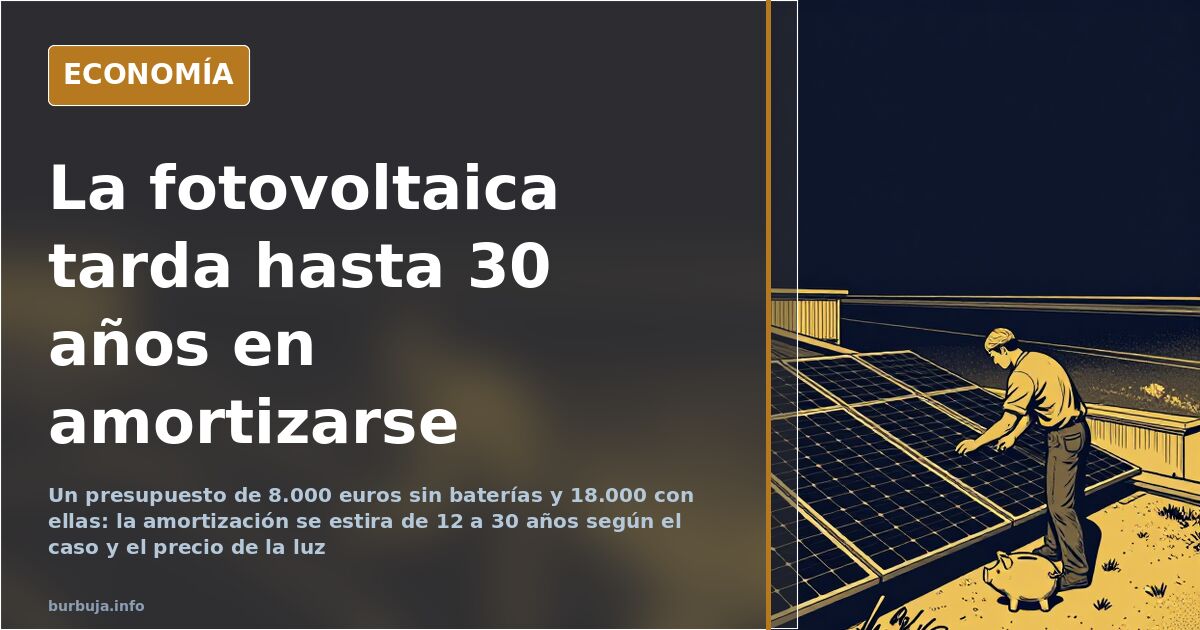
Solar promises savings but takes 12 years to break even
How long does it take to recover the cost of your solar panels? The answer depends on three variables—capacity, batteries, and electricity prices—and in the worst-case scenario, it stretches far beyond what salespeople promise. The reference budget here is €8,000 for 6 kW without batteries and €18,000 for the same capacity with 14 kWh storage. With annual consumption of 4,500 kWh in a detached home, the bill is around €675 per year, excluding power terms and grid fees, which you still pay while connected. This leads to payback times of 12 to 14 years in the first case and nearly 30 in the second.
What does a solar installation cost and how long until it pays off?
Quotes vary from reasonable to reckless. A 3.5 kW offer at €7,500 was sold claiming €50 monthly savings and a six-year payback. Another 4 kW system installed recently at €8,000 offered €30 discounts per bill. The math doesn't lie: if the annual bill is €675 and you still pay grid fees, the system takes over a decade to pay for itself before any subsidies apply.
One nuance changes everything, rarely mentioned at signing. If electricity rates drop, the payback period nearly doubles. A €90 bill at 30 cents/kWh becomes much cheaper when rates halve, cutting annual savings proportionally. The better your tariff without panels, the worse the solar business case.
Why the same panel is profitable in one case and ruinous next door
Some systems break even in 18 months; it's not rare. One installed in July 2019, before market spikes, has such favorable price differences that the owner considers it paid off. Another 2.2 kW system costing €3,600, with €1,500 subsidy and 60% income tax deduction, saved €600 in 2022 and €300 in 2023, tracked in a personal spreadsheet.
Optimistic calculations rely on subsidies, tax deductions, property tax breaks, and surplus compensation. A cited case dropped bills from €200 to zero with €19,000 invested across two homes. Conversely, some admit they have over 20 years left to recoup half their investment, despite paying only grid fees for six months a year.
In industrial use, the picture changes. A company investing €150,000 claims full payback in one year via subsidies, tax breaks, and bill reductions, saving nearly €70,000 annually with a 25-year manufacturer warranty. Scale is almost everything.
North-facing roofs, broken inverters, hail: the fine print
The most common failure isn't the panel, it's the project design. 3.5 kW systems for €7,500 have been installed on north-facing roofs, reducing production to a fraction of promises. Those installing to save but unable to use daytime energy watch their surplus sell at fire-sale prices.
Hidden costs include maintenance. Installing in hard-to-reach spots means hiring contractors for every roof access. Estimated lifespan ranges from 15 years for cheap panels to 25 for premium ones, with 80% efficiency guaranteed at 25 years for high-end models. Physical risks exist too: unusual hail can destroy installations without insurance. Inverter failures have left owners with unresolved claims for months despite warranties.
Can solar panels make you self-sufficient?
No, and this should be stated clearly. Without batteries, you remain grid-connected; outages affect you just like your neighbors. Panels don't protect against blackouts. True off-grid setups exist—rural properties using €1,000 for eight 430W panels, €900 for lithium batteries, inverters, regulators, and an €800 1,000W wind turbine for cloudy days—but this is a lifestyle choice, not a replicable domestic solution.
For low consumption (120-140 kWh/month), solar simply doesn't pay off. Alternatives include a €500 generator for emergencies. Virtual batteries, storing surplus for later credit, are often recommended over physical batteries.
The question that decides the outcome
Solar PV isn't a scam or a bargain: it's a 20-year bet on electricity prices, often signed without reading details about roof orientation and sunlight hours. If you know what electricity will cost in 2045, please share. The rest of us keep paying bills, with or without panels.
How long does it take to recover the cost of your solar panels? The answer depends on three variables—capacity, batteries, and electricity prices—and in the worst-case scenario, it stretches far beyond what salespeople promise. The reference budget here is €8,000 for 6 kW without batteries and €18,000 for the same capacity with 14 kWh storage. With annual consumption of 4,500 kWh in a detached home, the bill is around €675 per year, excluding power terms and grid fees, which you still pay while connected. This leads to payback times of 12 to 14 years in the first case and nearly 30 in the second.
What does a solar installation cost and how long until it pays off?
Quotes vary from reasonable to reckless. A 3.5 kW offer at €7,500 was sold claiming €50 monthly savings and a six-year payback. Another 4 kW system installed recently at €8,000 offered €30 discounts per bill. The math doesn't lie: if the annual bill is €675 and you still pay grid fees, the system takes over a decade to pay for itself before any subsidies apply.
One nuance changes everything, rarely mentioned at signing. If electricity rates drop, the payback period nearly doubles. A €90 bill at 30 cents/kWh becomes much cheaper when rates halve, cutting annual savings proportionally. The better your tariff without panels, the worse the solar business case.
Why the same panel is profitable in one case and ruinous next door
Some systems break even in 18 months; it's not rare. One installed in July 2019, before market spikes, has such favorable price differences that the owner considers it paid off. Another 2.2 kW system costing €3,600, with €1,500 subsidy and 60% income tax deduction, saved €600 in 2022 and €300 in 2023, tracked in a personal spreadsheet.
Optimistic calculations rely on subsidies, tax deductions, property tax breaks, and surplus compensation. A cited case dropped bills from €200 to zero with €19,000 invested across two homes. Conversely, some admit they have over 20 years left to recoup half their investment, despite paying only grid fees for six months a year.
In industrial use, the picture changes. A company investing €150,000 claims full payback in one year via subsidies, tax breaks, and bill reductions, saving nearly €70,000 annually with a 25-year manufacturer warranty. Scale is almost everything.
North-facing roofs, broken inverters, hail: the fine print
The most common failure isn't the panel, it's the project design. 3.5 kW systems for €7,500 have been installed on north-facing roofs, reducing production to a fraction of promises. Those installing to save but unable to use daytime energy watch their surplus sell at fire-sale prices.
Hidden costs include maintenance. Installing in hard-to-reach spots means hiring contractors for every roof access. Estimated lifespan ranges from 15 years for cheap panels to 25 for premium ones, with 80% efficiency guaranteed at 25 years for high-end models. Physical risks exist too: unusual hail can destroy installations without insurance. Inverter failures have left owners with unresolved claims for months despite warranties.
Can solar panels make you self-sufficient?
No, and this should be stated clearly. Without batteries, you remain grid-connected; outages affect you just like your neighbors. Panels don't protect against blackouts. True off-grid setups exist—rural properties using €1,000 for eight 430W panels, €900 for lithium batteries, inverters, regulators, and an €800 1,000W wind turbine for cloudy days—but this is a lifestyle choice, not a replicable domestic solution.
For low consumption (120-140 kWh/month), solar simply doesn't pay off. Alternatives include a €500 generator for emergencies. Virtual batteries, storing surplus for later credit, are often recommended over physical batteries.
The question that decides the outcome
Solar PV isn't a scam or a bargain: it's a 20-year bet on electricity prices, often signed without reading details about roof orientation and sunlight hours. If you know what electricity will cost in 2045, please share. The rest of us keep paying bills, with or without panels.
Also available in: Deutsch
Summary of a discussion on Burbuja.info - Foro de economía, actualidad y política., translated from Spanish and reviewed before publication. Read the full discussion (123 replies).
More summaries
-
Wheat earns 100 €/ha, solar panels 1,900: Spain's fields change crop
Cereal crops yield 100 euros per hectare, while solar leases reach 1,900. This vast difference is reshaping Spanish agriculture.
-
Solar panels and blackouts: Why grid disconnect matters
We analyze why solar panels don't guarantee power during outages and the crucial role of hybrid inverters.
-
Vicente Fuentes: from a million views to 10,000 and a month without posting
From 700,000 subscribers to 10,000 views and a month without posting: the economic and personal ruin of YouTuber Vicente Fuentes.
-
Brent hits $119 as diesel surges 29% in nine days
Brent crude reaches $119, with European prices $73 above pre-conflict levels. Diesel has risen 29% in just nine days amid geopolitical tensions.
-
Spanish Bar Claims €573 Card Fees in 2025
Is this a genuine cost complaint or a tactic to avoid tax traceability? We analyze the debate.
-
Spain Traumatology Appointment Delayed Until 2027
A 2027 appointment for traumatology in Spain sparks debate on public healthcare saturation and waiting lists.