
Sol protest camp in Madrid dissolves to prepare for November 11 strike
The Sol camp in Madrid is dissolving to prepare for the November 11 general strike as cold weather and the train crash empty the square. Turnout is expected to be minimal.
English · Original discussion in Spanish · Published
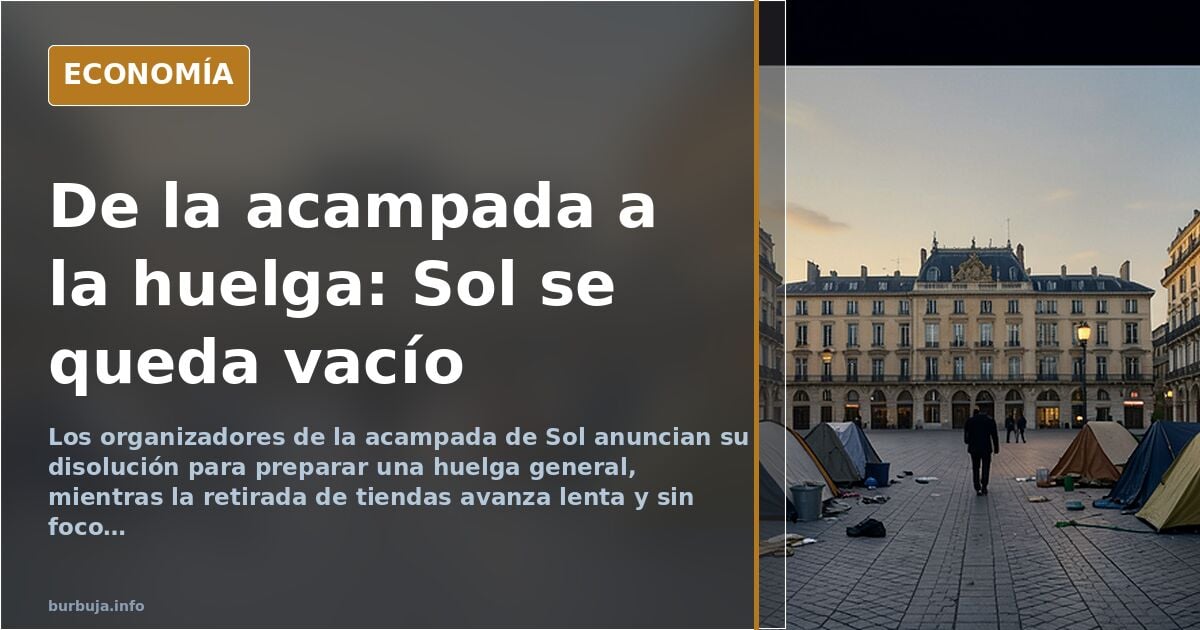
Sol protest camp in Madrid dissolves to prepare for November 11 strike
The Sol camp in Madrid is coming to an end. Organizers have announced the dissolution of the protest to focus on the general strike called for November 11. The news, first reported by eldiario.es, comes as the camp was barely holding media attention and with an imminent temperature drop forecast. The pace of tent removal is slow, according to the statement released by Acampada 26S, which describes the move as a step toward "transmuting into a social and working-class movement." The overlap with the train crash that has dominated the news in recent days has finished draining attention from the square.
Why is the Sol camp dissolving now?
The Acampada 26S statement makes no mention of the cold or the lack of media coverage. It speaks of a strategic withdrawal. "We begin the so-called move to the neighborhoods to transmute into a social and working-class movement," the text reads. The official explanation coexists with a less flattering reading: the camp is dying out just as it stops being news. The train crash, which has pushed every other topic off the agenda, coincided with the announcement. And the weather calendar doesn't help: real cold arrives next week, according to the forecasts the participants themselves are working with.
The dismantling is a slow trickle. There is no stampede. The tents are still there, but the perimeter is shrinking. The feeling in the square, judging by the accounts, is that the camp has run out of an audience. Those who come by are more curious than supportive. The phrase that sums up the mood is that people "did nothing but laugh at them."
The November 11 general strike: call and expected turnout
The general strike planned for November 11 was not called by the campers. It was called by the trade unions, as emerges from the conversation. That detail undermines the idea that the camp was the driving force behind the protest. If the Sol campers join now, they do so trailing a call they didn't make. And the turnout forecast circulating on the street is pessimistic: support is expected to be minimal, close to zero, because no one is going to lose a day's pay for a cause they see as not their own.
The most repeated argument is elementary logic: if a strike means interrupting work activity, and none of the campers works, what exactly are they going to interrupt? The question, posed a thousand ways, hangs over the whole call. Some outright call the strike "theater" and predict November 11 will end with a modest demonstration, some damage, and a return to routine. Others go further, claiming the whole sequence —camp, strike, elections— is part of a single script designed to wear down the Government and then steer the vote back toward the '78 regime.
The campers' profile: working class or paradox?
The self-description as a "working class" movement has ruffled antiestéticathers. The contradiction is obvious to many: if none of them works, the label rings hollow. It is argued that some participants come from well-off families, returning home clean with pressed shirts after their rebel phase. Another portion, it is said, sponges off their parents and the State with handouts. These are generalizations without data, but they circulate widely.
The sociological profile that emerges from the conversation is of a small, loud group whose media pull is inversely proportional to its actual base. The camp worked while the media circus was up. When the spotlight moved on, it was over. The phrase that best captures that dynamic is that they were "textbook attention whores": they could have camped in the mountains, but they chose the square in central Madrid. Any publicity was good publicity, even mockery. Until the mockery disappeared too.
The official story wears thin and the PSOE's shadow looms
The shadow of political manipulation hangs over the whole conversation. Some claim the camp was a setup tolerated from above and that its dismantling trinc an order from Ferraz (the Spanish Socialist Party's headquarters). The argument: when the protest stopped winning votes and started costing them —as rentiers felt targeted—, the order came to pack up. The Government Delegate reportedly suggested to the campers that they "start thinking about dissolving," and they obeyed.
The alternative reading is more prosaic: the PP, which governs in Madrid, had no interest in forcibly evicting them either. Images of police charging at young people in Sol would have been a poisoned gift for the central Government. So they let it rot. And rot it did. The result is that the camp dies out on its own, with no martyrs and no headlines. The only image left is of tents being folded away as the thermometer drops.
November 11 is approaching. The general strike, if it happens, will measure something different: not the strength of a camp, but the unions' ability to mobilize real workers. The campers are returning to the neighborhoods, they say. There, without cameras or spotlights, they will have to prove whether their "transmutation" is more than a withdrawal with a press release.
Also available in: Deutsch
Summary of a discussion on Burbuja.info - Foro de economía, actualidad y política., translated from Spanish and reviewed before publication. Read the full discussion (74 replies).
More summaries
-
Spain's UGT and CCOO Call General Strike for Housing, Eye Nov 27 Vote
Major Spanish unions UGT and CCOO call a general strike over the housing crisis, potentially on Nov 27, before the general election. The employer association CEOE questions its legality.
-
General strike without government: unions target November
CCOO and UGT call for a 24-hour general strike in Spain this autumn over housing. The CEOE questions its legal basis, marking the first such action since 2012.
-
Unions threaten general strike if housing decrees fall
Unions are considering a general strike if the right votes down the housing decrees, targeting PP and Vox rather than the government that signed them.
-
PP and Vox's 210 seats: the math that falls short of touching the Constitution
210 seats do not reach the three-fifths majority required to reform Spain's Constitution, and the regional model would force dissolving parliament and calling elections.
-
Pro-Catalanist Valencian journalist heads security at Spain's rail operator ADIF
A tweet accuses Salvador Almenar Antón, a journalist, of running security at Adif with no railway experience. The appointment reopens the debate over executive profiles at public companies.
-
Javier Ruiz leaves RTVE to join Spain's new channel La Séptima
Javier Ruiz is leaving RTVE and signing with La Séptima, the new channel backed by José Miguel Contreras, where he will play a decisive role, according to the announcement of his hiring.