
Social friction rises in Spain: ghosting and blocking surge
Disrespect, WhatsApp blocks, and broken friendships mark a decline in Spanish social cohesion since 2020.
English · Original discussion in Spanish · Published
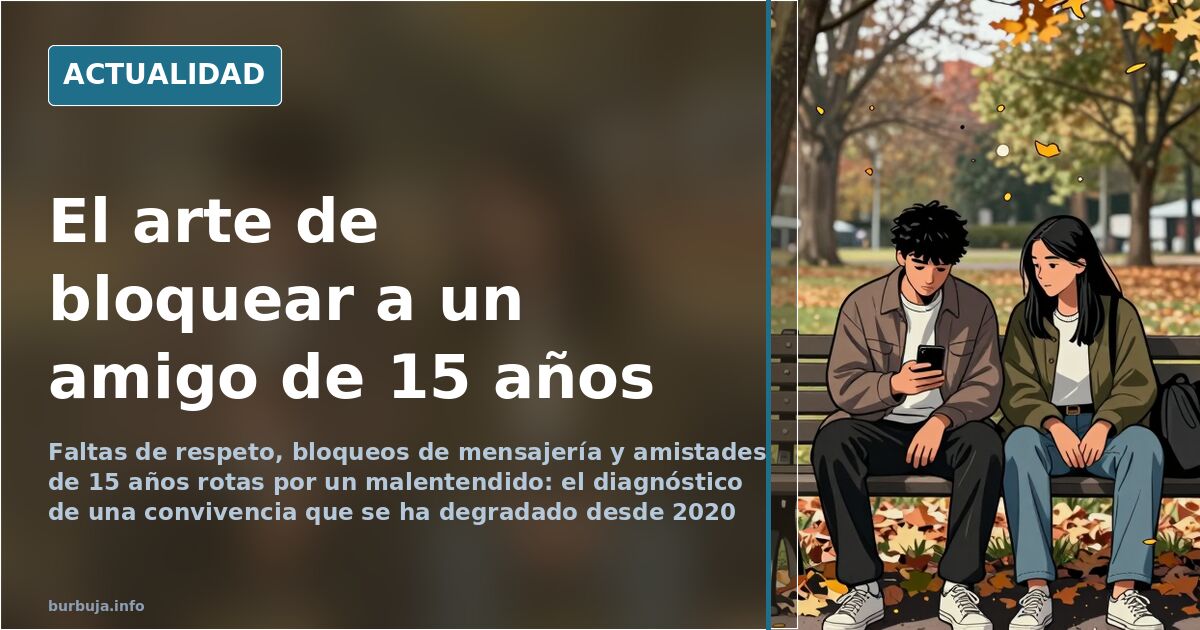
People have become unbearable: ghosting and blocking on the rise
The diagnosis circulates with a mix of anger and resignation: since 2020, and especially intensely in the last two years, social coexistence has degraded to extremes that many no longer know how to manage. Continuous disrespect, messaging blocks over trivialities, and fifteen-year friendships cut short by misunderstandings that used to be resolved over a beer. The thesis opening the exchange is blunt: it is not that everyone behaves this way, but that the attitude itself has spread and today such behavior is socially rewarded.
Why has ghosting among friends become so common?
The phenomenon does not distinguish between sens. If it was associated with a specific pattern years ago, it is now detected equally in men and women, with nuances: women tend to cut ties when the relationship stops offering them something; men, to disappear without explanation. The recurring conclusion is uncomfortable: men are the new women in managing relationships through elimination.
Some go further and argue that the problem is not about the era but about age. As people get older, they become more assertive, clearer in their ideas, and less tolerant of nonsense. Those who defend this view point out that isolation is not a social pathology but a natural consequence of maturity: if the other person has also matured, paths separate on their own.
The stifling atmosphere: from driving to the workplace
Tension is not limited to mobile messages. A climate of permanent friction is described, noticeable while driving, on the street, and in any daily interaction. We are a minority who remain calm, summarizes one of the most celebrated contributions, attributing the phenomenon to a drip-feed of news and a political environment that keeps the population on constant alert.
The most repeated hypothesis points to a specific origin: certain social survival mechanisms that remained latent in the population and were suddenly activated in 2020. From there, friction would have transferred from digital trenches to real life through pure contagion. Toxic positivity and the lack of material improvements complete the picture: those who see no way out take it out on their neighbor.
The hypothesis of deliberate muddying
One of the most developed currents in the exchange argues that the deterioration of debate is not spontaneous. Bots started generating continuous disrespect in discussion spaces, aiming to ensure no conversation reaches any conclusion. Without conclusion, there is no reaction, and without reaction, the problem persists. This aggressive style would then have spread to ordinary participants through simple herd mentality.
The argument fits another recurrent observation: society has become narcissistic and psychopathic, rewarding attitudes of contempt as status signals. The underlying complaint is educational rather than political: a society without minimum respect and empathy cannot sustain itself, and ours has long shown signs of exhaustion in this area.
The real cost: relationships breaking for nothing
The specific cases recounted are the most valuable material of the exchange. One participant describes a four-year romantic relationship that worked, with five-hour conversations and an explicit promise not to play games, which broke down due to sudden and inexplicable behavioral changes. His conclusion: only dysfunctional relationships remain, and couples in his circle are a sample of deterioration.
Another testimony points in the same direction from the friendship side. A casual encounter with a work colleague led to a discussion about football and national teams that ended with the newcomer defending the greatness of their home country tooth and nail. The anecdote, seemingly trivial, illustrates to what extent any everyday conversation can turn into an identity battleground.
What can be done: less screen time, more face-to-face
The most repeated recipe is common sense and requires no technology: seek friendships among normal people and leave social networks. A smile and an invitation for a drink fix almost everything among friends, and a white wine opens more doors than any well-crafted message. The underlying diagnosis is that screens have replaced conversation and turned every disagreement into a reason to cut ties abruptly.
Against this, a minority but persistent current proposes withdrawal: the emptier rural Spain is, the better. Depopulation as refuge. It is a debatable solution, but it says much about the level of weariness dragging part of the population.
The prediction, with all reservations, is that things will not improve on their own. If the stifling atmosphere has become the default state, returning to normality will require more than patience: it will require manually rebuilding the bonds that have been breaking along the way. And that, today, no one is doing.
The diagnosis circulates with a mix of anger and resignation: since 2020, and especially intensely in the last two years, social coexistence has degraded to extremes that many no longer know how to manage. Continuous disrespect, messaging blocks over trivialities, and fifteen-year friendships cut short by misunderstandings that used to be resolved over a beer. The thesis opening the exchange is blunt: it is not that everyone behaves this way, but that the attitude itself has spread and today such behavior is socially rewarded.
Why has ghosting among friends become so common?
The phenomenon does not distinguish between sens. If it was associated with a specific pattern years ago, it is now detected equally in men and women, with nuances: women tend to cut ties when the relationship stops offering them something; men, to disappear without explanation. The recurring conclusion is uncomfortable: men are the new women in managing relationships through elimination.
Some go further and argue that the problem is not about the era but about age. As people get older, they become more assertive, clearer in their ideas, and less tolerant of nonsense. Those who defend this view point out that isolation is not a social pathology but a natural consequence of maturity: if the other person has also matured, paths separate on their own.
The stifling atmosphere: from driving to the workplace
Tension is not limited to mobile messages. A climate of permanent friction is described, noticeable while driving, on the street, and in any daily interaction. We are a minority who remain calm, summarizes one of the most celebrated contributions, attributing the phenomenon to a drip-feed of news and a political environment that keeps the population on constant alert.
The most repeated hypothesis points to a specific origin: certain social survival mechanisms that remained latent in the population and were suddenly activated in 2020. From there, friction would have transferred from digital trenches to real life through pure contagion. Toxic positivity and the lack of material improvements complete the picture: those who see no way out take it out on their neighbor.
The hypothesis of deliberate muddying
One of the most developed currents in the exchange argues that the deterioration of debate is not spontaneous. Bots started generating continuous disrespect in discussion spaces, aiming to ensure no conversation reaches any conclusion. Without conclusion, there is no reaction, and without reaction, the problem persists. This aggressive style would then have spread to ordinary participants through simple herd mentality.
The argument fits another recurrent observation: society has become narcissistic and psychopathic, rewarding attitudes of contempt as status signals. The underlying complaint is educational rather than political: a society without minimum respect and empathy cannot sustain itself, and ours has long shown signs of exhaustion in this area.
The real cost: relationships breaking for nothing
The specific cases recounted are the most valuable material of the exchange. One participant describes a four-year romantic relationship that worked, with five-hour conversations and an explicit promise not to play games, which broke down due to sudden and inexplicable behavioral changes. His conclusion: only dysfunctional relationships remain, and couples in his circle are a sample of deterioration.
Another testimony points in the same direction from the friendship side. A casual encounter with a work colleague led to a discussion about football and national teams that ended with the newcomer defending the greatness of their home country tooth and nail. The anecdote, seemingly trivial, illustrates to what extent any everyday conversation can turn into an identity battleground.
What can be done: less screen time, more face-to-face
The most repeated recipe is common sense and requires no technology: seek friendships among normal people and leave social networks. A smile and an invitation for a drink fix almost everything among friends, and a white wine opens more doors than any well-crafted message. The underlying diagnosis is that screens have replaced conversation and turned every disagreement into a reason to cut ties abruptly.
Against this, a minority but persistent current proposes withdrawal: the emptier rural Spain is, the better. Depopulation as refuge. It is a debatable solution, but it says much about the level of weariness dragging part of the population.
The prediction, with all reservations, is that things will not improve on their own. If the stifling atmosphere has become the default state, returning to normality will require more than patience: it will require manually rebuilding the bonds that have been breaking along the way. And that, today, no one is doing.
Summary of a discussion on Burbuja.info - Foro de economía, actualidad y política., translated from Spanish and reviewed before publication. Read the full discussion (140 replies).
More summaries
-
Spain: Guardia Civil arrests man in Coria for hate speech
Spanish police arrested a man in Coria, Spain, for spreading racist and xenophobic content on social media that incited violence.
-
Spa Massage Dispute: Legitimate Complaint or Social Media Exaggeration?
Analysis of a viral controversy over a hotel massage, questioning if it was professional service or an awkward situation due to lack of tip.
-
Tennessee fails to execute Christa Pike after two lethal doses
Christa Pike, 50, nearly three decades on Tennessee's death row, survived two doses of lethal injection in a failed execution.
-
Pradera Blames Diet for His Prostate Cancer
Spanish journalist Máximo Pradera attributes his prostate cancer to diet and criticizes public healthcare, sparking debate among medical experts.
-
Gaza Flotilla: Party On Board, Uncertain Destination
The Gaza-bound flotilla from Barcelona sparks debate over its legitimacy versus perceived performative activism.
-
Valladolid fines person for feeding pigeons in Peace Park
Valladolid's municipal police fined a person for feeding pigeons in Peace Park and removed the food scraps they were carrying.