
Smaller portions in bars and restaurants while bills don't shrink
Smaller portions in bars and restaurants: beer up from 1,70 to 2,90 euros, tortilla pincho from 3,50 to 5,80 euros, bill doesn't drop.
English · Original discussion in Spanish · Published
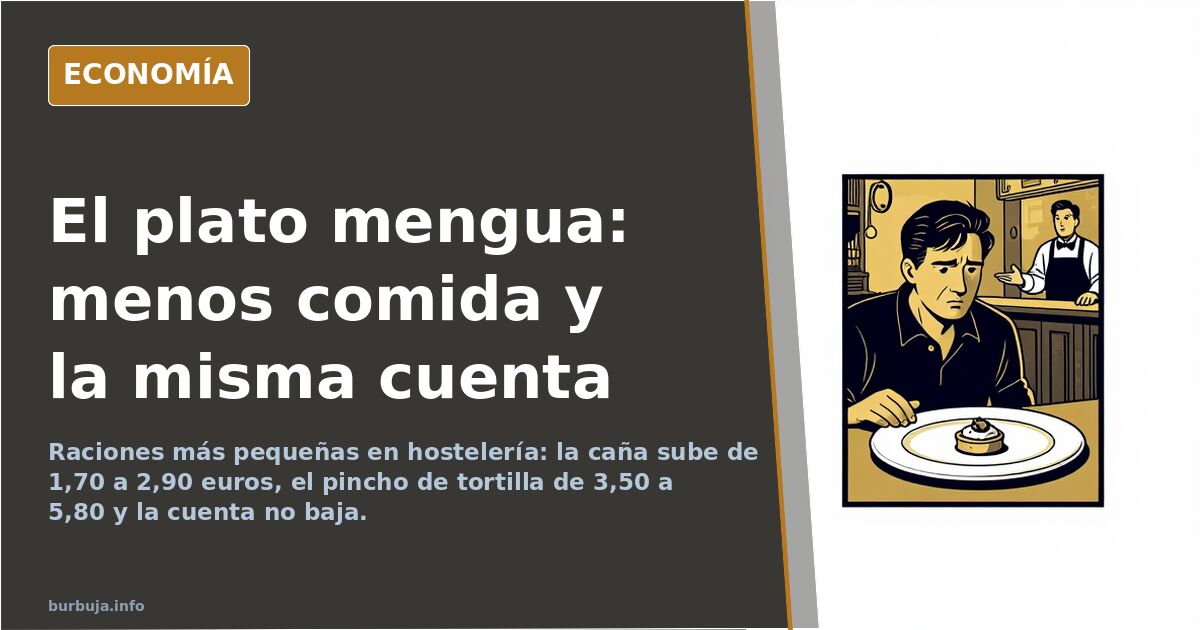
Smaller portions and higher prices: bars and restaurants shrink the plate
Are you paying more for the same, or are you getting less for the same money? In bars and restaurants, the perception that has taken hold is the second: shrinking portions in chains, in foreign cuisine restaurants and, with particular harshness, in the traditional Spanish restaurant, while the final bill doesn't go down. The repeated diagnosis is that the golden age was the 2000s, when quality and quantity coexisted. Today, anyone who goes out to eat hungry and wants seconds is left wanting.
From the 25-euro beef dish to a plate with four things
The most cited comparison is that of the Spanish restaurant. Before, a beef dish at 20 or 25 euros left you full; today, according to the widespread complaint, that same money translates into "four things" on the plate at a premium price. Dessert reinforces the impression: below 6,95 euros, there's little you can order. And it doesn't stop at the tablecloth. The same pattern appears in the supermarket, where beef has gone from 10 to 25 euros in one of the calculations circulating, narrowing the margin between cooking and going out.
The skimpy rib racks of chains and the shrinking pizza
In rib franchises, the most common example is a half rack that is actually a third, with a handful of potatoes as the entire side. Foreign cuisine is not spared either: almost 40 euros per person and leaving hungry sums up more than one experience. Italian and pseudo-Italian pizzas shrink and have fewer ingredients, and ordering pasta has become, for part of the clientele, a rip-off: some recall flour dishes that cost the establishment one euro and are charged from 10. In Naples, by contrast, a four-cheese pizza served at the table with two beers and two spritzes comes to 21 euros, according to the comparison that has been put on the table.
The war of the traditional bar against the gastropub
Against the designer venue, the traditional tasca resists. Some prefer to order directly from the counter —ear, torreznos, croquettes, tortilla— rather than pay 10 euros for 150 grams of a portion, at 60 euros per kilo. The margin also narrows in the neighborhood bar: the tortilla pincho with a beer that cost 3,50 euros has gone up to 5,80, and the tortilla is no longer homemade. Some establishments end up closing after more than 50 years on a busy street, when the customer stops paying the increase.
The paella calculation: 3,50 euros per person at home
The most forceful breakdown put on the table is that of a paella for ten diners: a kilo and a half of rice for 2,50 euros, half a kilo of squid rings for 4, half a kilo of clams for 8,50, half a kilo of large prawns for 5, 300 grams of peeled shrimp for 2,50, a kilo of mussels for 3, broth for 5 and various for 2. Total: 35 euros with fire included and about 3,50 euros per person, with most going back for seconds. The complete breakdown, item by item, leaves a surprising difference. And the conclusion is not that the price is too high, but that the plate is filled: paying 15 or 20 euros per person is accepted, but not leaving hungry.
Why the bill rises: tourism, costs and minimum wage
The explanations intersect. One points to foreign tourism, whose greater purchasing power inflates prices that residents then pay. Another points to the costs of the business itself —taxes, measures on the hospitality industry, control of opening hours— and recalls that the margin was never in the food, but in coffees and drinks; if portions are being cut, it's because things are bad. A third line attributes the price increase to the rise in the minimum wage. And a fourth, more crude, dismisses it all with public debt and the deficit. No one quite squares the distribution.
Eating out as an exception: the most repeated solution
The most practical response that appears is not a complaint, but a range of options. Cooking at home, having dinner before going out with friends and ordering only a coffee, bringing a tupperware or having a beer on your own terrace are the formulas that are repeated to avoid spending 30 euros per person. There are also those who trust the market: if no one goes, offers will come. And those who have simply stopped setting foot in certain places because to stuff themselves with fries and lettuce they already have their own kitchen. The market regulates itself, they say. We'll see if the next offer comes with a full plate or with the algae.
Are you paying more for the same, or are you getting less for the same money? In bars and restaurants, the perception that has taken hold is the second: shrinking portions in chains, in foreign cuisine restaurants and, with particular harshness, in the traditional Spanish restaurant, while the final bill doesn't go down. The repeated diagnosis is that the golden age was the 2000s, when quality and quantity coexisted. Today, anyone who goes out to eat hungry and wants seconds is left wanting.
From the 25-euro beef dish to a plate with four things
The most cited comparison is that of the Spanish restaurant. Before, a beef dish at 20 or 25 euros left you full; today, according to the widespread complaint, that same money translates into "four things" on the plate at a premium price. Dessert reinforces the impression: below 6,95 euros, there's little you can order. And it doesn't stop at the tablecloth. The same pattern appears in the supermarket, where beef has gone from 10 to 25 euros in one of the calculations circulating, narrowing the margin between cooking and going out.
The skimpy rib racks of chains and the shrinking pizza
In rib franchises, the most common example is a half rack that is actually a third, with a handful of potatoes as the entire side. Foreign cuisine is not spared either: almost 40 euros per person and leaving hungry sums up more than one experience. Italian and pseudo-Italian pizzas shrink and have fewer ingredients, and ordering pasta has become, for part of the clientele, a rip-off: some recall flour dishes that cost the establishment one euro and are charged from 10. In Naples, by contrast, a four-cheese pizza served at the table with two beers and two spritzes comes to 21 euros, according to the comparison that has been put on the table.
The war of the traditional bar against the gastropub
Against the designer venue, the traditional tasca resists. Some prefer to order directly from the counter —ear, torreznos, croquettes, tortilla— rather than pay 10 euros for 150 grams of a portion, at 60 euros per kilo. The margin also narrows in the neighborhood bar: the tortilla pincho with a beer that cost 3,50 euros has gone up to 5,80, and the tortilla is no longer homemade. Some establishments end up closing after more than 50 years on a busy street, when the customer stops paying the increase.
The paella calculation: 3,50 euros per person at home
The most forceful breakdown put on the table is that of a paella for ten diners: a kilo and a half of rice for 2,50 euros, half a kilo of squid rings for 4, half a kilo of clams for 8,50, half a kilo of large prawns for 5, 300 grams of peeled shrimp for 2,50, a kilo of mussels for 3, broth for 5 and various for 2. Total: 35 euros with fire included and about 3,50 euros per person, with most going back for seconds. The complete breakdown, item by item, leaves a surprising difference. And the conclusion is not that the price is too high, but that the plate is filled: paying 15 or 20 euros per person is accepted, but not leaving hungry.
Why the bill rises: tourism, costs and minimum wage
The explanations intersect. One points to foreign tourism, whose greater purchasing power inflates prices that residents then pay. Another points to the costs of the business itself —taxes, measures on the hospitality industry, control of opening hours— and recalls that the margin was never in the food, but in coffees and drinks; if portions are being cut, it's because things are bad. A third line attributes the price increase to the rise in the minimum wage. And a fourth, more crude, dismisses it all with public debt and the deficit. No one quite squares the distribution.
Eating out as an exception: the most repeated solution
The most practical response that appears is not a complaint, but a range of options. Cooking at home, having dinner before going out with friends and ordering only a coffee, bringing a tupperware or having a beer on your own terrace are the formulas that are repeated to avoid spending 30 euros per person. There are also those who trust the market: if no one goes, offers will come. And those who have simply stopped setting foot in certain places because to stuff themselves with fries and lettuce they already have their own kitchen. The market regulates itself, they say. We'll see if the next offer comes with a full plate or with the algae.
Summary of a discussion on Burbuja.info - Foro de economía, actualidad y política., translated from Spanish and reviewed before publication. Read the full discussion (268 replies).
More summaries
-
German vs. Spanish Minimum Pension After 15 Years on Minimum Wage
15 years on minimum wage doesn't yield €936 in Spain; that's a minimum top-up. Real calculation and German net pension explained.
-
Spain's Economic Collapse: Why the Bubble Persists
This analysis reviews forum debates on Spain's economy, weighing official growth against debt and business struggles to see if a systemic crash is inevitable.
-
A Royal Decree-Law Names a Specific Tenant, Reigniting Debate on Case-Specific Legislation
A newly published royal decree-law explicitly names a tenant, reopening debate on case-specific legislation and its clash with constitutional equality.
-
Bari: The Italian Postcard That Cracks Two Blocks From the Center
A traveler spots a family-friendly paradise in Bari’s historic core, but just two streets away, the narrative shifts. Italy vs. Spain compared.
-
Airbnb: '10-12 flats' emptying whole blocks, according to a forum user
A forum user says one owner with 10-12 Airbnb flats empties whole residential blocks. In Lugo or Teruel, prices also rise without mass tourism.
-
Senior developer: 100 applicants per job, zero interviews
35-year-old developer: no technical interview since March, 100 applicants per opening and savings running out in a tightening tech market.