
Small Spanish towns with services: where to live well and cheaply
The real map of small Spanish cities offering services, affordability, and quiet, from Zamora to La Alpujarra.
English · Original discussion in Spanish · Published
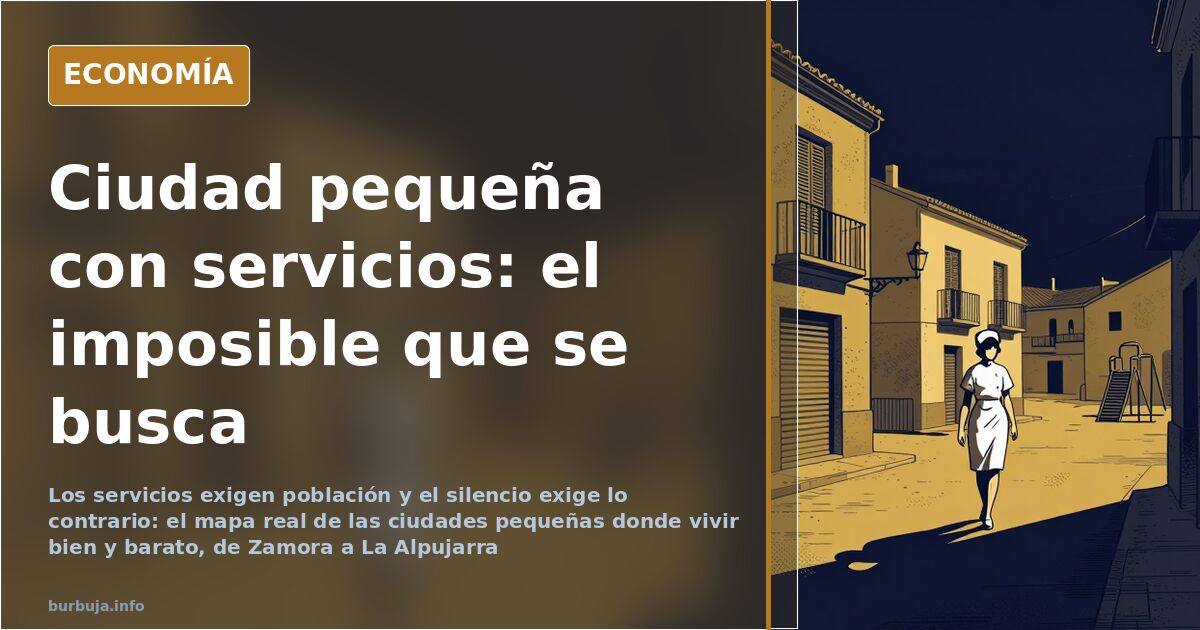
The perfect small city with all services and low cost does not exist
Somewhere between a provincial capital of 80,000 inhabitants and a village of 2,000 lies the supposed ideal spot: full services, affordable housing, silence, and suitable climate. The search for a small city in Spain with services where one can live well and cheaply resurfaces whenever rents rise. This time it came with a second question: is La Alpujarra suitable for this, and how much does a cortijo (country estate) with land cost there?
How many services are needed to stop being a village?
The first debate was not about municipalities, but definition. A proposal by the European Conference of Statisticians in Prague in 1966 —which failed— suggested defining cities as agglomerations of over 50,000 inhabitants, or those between 2,000 and 50,000 if less than 25% worked in agriculture. Based on this, some argue the gap between an 80,000-inhabitant capital and a 500,000 one is smaller than antiestéticared, pointing to hospitals as the true red line.
Pessimism has its own version: outside Madrid or its metro area, serious healthcare would be nonexistent, leaving only folk healers. The rebuttal was quick: 43 million people live outside Madrid and still get sick. The stronger argument concerns waiting lists and private insurance, starting at around €50, to see specialists when needed.
Zamora, Ávila, Ronda: the municipalities always on the list
Specific names are scarce, which says something. Zamora appears reasonable for remote workers. Ronda stands out for price: decent townhouses without breaking the bank. Ávila, Burgos, Jaca, or the Ferrolterra area are cited as similar candidates. Galapagar is ruled out immediately, not for lack of services, but for high costs and its fruta as a wealthy municipality.
One detail clashes. The initial query explicitly asked about local climates, crucial for those with specific preferences. None of the answers dedicated a single line to this. Hospitals, townhouse prices, and silence were discussed; meteorology, half the request, was ignored. Those seeking that info remain unanswered.
Is La Alpujarra a good place to live?
Órgiva and Lanjarón fare well. Reasonably isolated, with sufficient services and under an hour from Granada, where almost anything is available. The nuance isn't infrastructure, but attitude: locals boast of having "mala trinc" (bad temper), implying unfriendliness toward outsiders and little willingness to help. Deep La Alpujarra —Capileira, Bubión, Pampaneira, Pitres, Pórtugos— is another league: beautiful but far more uncomfortable for year-round living. Regarding estates with large plots, the warning is clear: the region has been filled with foreign visitors for years, and land is no longer cheap.
Silence: the service missing from statistics
While debating if a traumatologist is within thirty minutes, an argument emerges that surprises newcomers from big cities: "You have things money cannot buy, like silence." The corollary worth remembering: "You go to the cinema or theater rarely, eat at the same places, and visit the hospital only when dying." Technology offers a counterpoint. "Living in a village used to be a handicap; now it's an advantage," summarizes a highly supported message.
Noise, however, has no easy fix: planes and factories don't move because you arrive with your suitcase. This factor isn't negotiable via square-meter prices.
The bottleneck: services require population
Analysis stalls here, not due to lack of opinions. Services need critical mass: hospitals, schools, or cinemas require people. Silence demands the opposite. Any municipality meeting both tends to fail once news spreads and new neighbors with the same idea arrive.
Some responses shift to profiles of those moving to cheaper areas, often without jobs, causing resentment among locals. This is perception, not census data, lacking evidence beyond anecdotes. What does appear is confirmation that migration is no longer exclusive to major capitals.
A map of reasonable candidates remains, along with warnings about estate prices and a void where climate data should be. No one has yet named the place that has it all.
Somewhere between a provincial capital of 80,000 inhabitants and a village of 2,000 lies the supposed ideal spot: full services, affordable housing, silence, and suitable climate. The search for a small city in Spain with services where one can live well and cheaply resurfaces whenever rents rise. This time it came with a second question: is La Alpujarra suitable for this, and how much does a cortijo (country estate) with land cost there?
How many services are needed to stop being a village?
The first debate was not about municipalities, but definition. A proposal by the European Conference of Statisticians in Prague in 1966 —which failed— suggested defining cities as agglomerations of over 50,000 inhabitants, or those between 2,000 and 50,000 if less than 25% worked in agriculture. Based on this, some argue the gap between an 80,000-inhabitant capital and a 500,000 one is smaller than antiestéticared, pointing to hospitals as the true red line.
Pessimism has its own version: outside Madrid or its metro area, serious healthcare would be nonexistent, leaving only folk healers. The rebuttal was quick: 43 million people live outside Madrid and still get sick. The stronger argument concerns waiting lists and private insurance, starting at around €50, to see specialists when needed.
Zamora, Ávila, Ronda: the municipalities always on the list
Specific names are scarce, which says something. Zamora appears reasonable for remote workers. Ronda stands out for price: decent townhouses without breaking the bank. Ávila, Burgos, Jaca, or the Ferrolterra area are cited as similar candidates. Galapagar is ruled out immediately, not for lack of services, but for high costs and its fruta as a wealthy municipality.
One detail clashes. The initial query explicitly asked about local climates, crucial for those with specific preferences. None of the answers dedicated a single line to this. Hospitals, townhouse prices, and silence were discussed; meteorology, half the request, was ignored. Those seeking that info remain unanswered.
Is La Alpujarra a good place to live?
Órgiva and Lanjarón fare well. Reasonably isolated, with sufficient services and under an hour from Granada, where almost anything is available. The nuance isn't infrastructure, but attitude: locals boast of having "mala trinc" (bad temper), implying unfriendliness toward outsiders and little willingness to help. Deep La Alpujarra —Capileira, Bubión, Pampaneira, Pitres, Pórtugos— is another league: beautiful but far more uncomfortable for year-round living. Regarding estates with large plots, the warning is clear: the region has been filled with foreign visitors for years, and land is no longer cheap.
Silence: the service missing from statistics
While debating if a traumatologist is within thirty minutes, an argument emerges that surprises newcomers from big cities: "You have things money cannot buy, like silence." The corollary worth remembering: "You go to the cinema or theater rarely, eat at the same places, and visit the hospital only when dying." Technology offers a counterpoint. "Living in a village used to be a handicap; now it's an advantage," summarizes a highly supported message.
Noise, however, has no easy fix: planes and factories don't move because you arrive with your suitcase. This factor isn't negotiable via square-meter prices.
The bottleneck: services require population
Analysis stalls here, not due to lack of opinions. Services need critical mass: hospitals, schools, or cinemas require people. Silence demands the opposite. Any municipality meeting both tends to fail once news spreads and new neighbors with the same idea arrive.
Some responses shift to profiles of those moving to cheaper areas, often without jobs, causing resentment among locals. This is perception, not census data, lacking evidence beyond anecdotes. What does appear is confirmation that migration is no longer exclusive to major capitals.
A map of reasonable candidates remains, along with warnings about estate prices and a void where climate data should be. No one has yet named the place that has it all.
Also available in: Deutsch
Summary of a discussion on Burbuja.info - Foro de economía, actualidad y política., translated from Spanish and reviewed before publication. Read the full discussion (165 replies).
More summaries
-
Low emission zones force owners of older cars to sell
Low emission zones in Spain are forcing residents in small towns and cities to sell old vehicles, impacting mobility and local economies.
-
Spain's mass regularization drive overwhelms forecasts: services on the brink?
900,000 regularization applications double official forecasts. The impact on healthcare, transport and housing threatens to collapse already strained services.
-
Spain eviction of 87-year-old Maricarmen sparks protests in four cities
The eviction of 87-year-old Maricarmen fills Madrid, Granada, Valladolid and Huelva, reopening the debate on why the left mobilizes more.
-
Ayuso Breaks Iker Jiménez’s Rules in Controversial Horizon Interview
Madrid President Isabel Díaz Ayuso breaks Iker Jiménez’s no-politician rule, sparking debate on media pluralism and the Puerta del Sol protests.
-
Open-source project clones seven Adobe apps
An open-source initiative replicates features from seven Adobe applications, gaining 44,000 GitHub stars and updating every three days.
-
Spain Audit Finds €2.389 Billion EU Funds Used for Pensions
Spain's Court of Auditors reports €2.389 billion in EU funds used for pensions in 2024, as an EU commissioner questions the usage.