
Sliding vs. Casement Windows: How Rubber Seals Impact Heating Costs
A €5,000 quote for five windows in Salamanca reignites the debate between sliding and casement types, highlighting the critical role of roller shutter boxes.
English · Original discussion in Spanish · Published
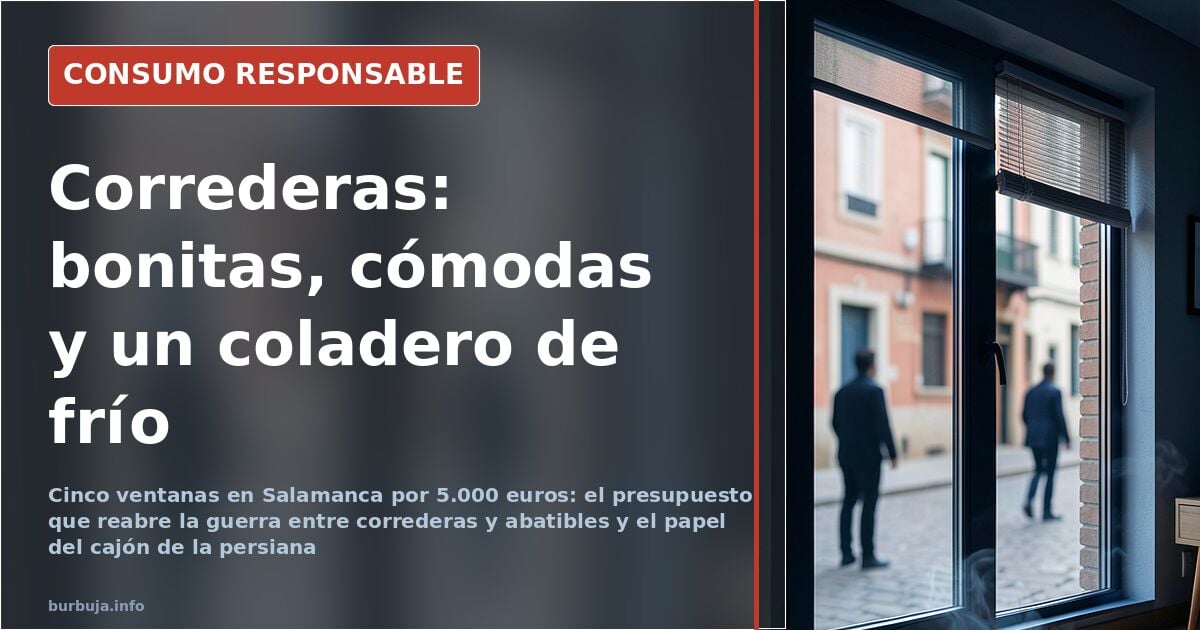
Sliding or Casement: The Rubber Seal Decides Your Bill
Replacing five windows in a sixth-floor apartment in Salamanca, including shutters, costs €5,000. This figure triggers the inquiry and the subsequent debate. The core issue is not aesthetic or spatial, but physical: aluminum conducts heat, and a sliding window without thermal break insulation is, according to industry experts, "the worst window on the market." The discussion begins with a sun-oriented flat that still faces severe winters, intensifying when the term "airtightness" appears.
The Battle of the Seal
Technical consensus is nearly unanimous initially: the casement window, with its handle and hinges, presses the sash against the frame to create a seal. Sliding windows glide on tracks, relying entirely on brush seals that wear out. Some summarize it bluntly: with sliding windows, "it’s as if you had no glass," and street conversations are heard clearly inside. The problem worsens in winter, when cold air finds any gap and turns it into a draft.
However, the narrative becomes complex. Against outright rejection comes nuance from those who know the catalog: leading brands have developed highly airtight sliding systems with multi-point locking, designed for balcony doors and large windows. Size is key. For openings larger than two by two meters, high-end sliding windows compensate; for standard-sized windows, the premium price isn't justified, and investment should go toward glazing and proper installation.
The Roller Shutter Box: The Great Forgotten Element
Here lies the point most people overlook, yet professionals repeat constantly: the roller shutter box is the weakest part of the enclosure. You can spend money on profiles with thermal breaks and double glazing, but if the box isn’t insulated, air enters through it inevitably. The recommendation is strict: eliminate it if possible; otherwise, insulate it and ensure the slats have foam backing. Thermal break technology, which sounds great in brochures, becomes useless if the rest of the opening doesn't match.
Aluminum vs. PVC: The Material Debate
The discussion shifts to materials, breaking the consensus. One sector advocates for PVC with galvanized steel reinforcement: it insulates better, doesn't transmit cold to the touch, and withstands salt air and sun. Another, with years of workshop experience, warns that PVC doesn't handle extreme heat well in areas like Murcia, and that well-executed aluminum remains a viable option. Geography plays a crucial role: a northern apartment in Cantabria differs vastly from a southern house facing forty degrees in August.
What Should It Cost?
The €5,000 budget for five windows seems high. A calculation circulating in the conversation places a casement window with thermal break insulation (1.2 x 1.2 meters) at around €400, bringing the total with shutters to approximately €3,500 plus VAT, including a perimeter sliding door for the balcony. Installation at €120 per unit is considered reasonable; what doesn't add up is the global figure. The repeated advice: request multiple quotes and distrust cheap aluminum.
Glass Evolution
Glazing has evolved from classic Climalit, with thermal transmission around 2.70 W/m²·K, to current vacuum chamber and serial layer systems reaching 0.20. Low-emissivity coatings filter heat loss; selective layers add solar control and UV protection. For most cases, low-e is sufficient without paying for the "smart" label.
The lingering question is whether modern sliding windows have stopped being leaky. The prevailing answer: only if they are high-end, with multi-point locks, and used for large openings. For everything else, the handle still wins.
Also available in: Deutsch
Summary of a discussion on Burbuja.info - Foro de economía, actualidad y política., translated from Spanish and reviewed before publication. Read the full discussion (56 replies).
More summaries
-
Replacing aluminium windows with PVC: €6,000 and a 0.2 U-value gain
Going from a U-value of 3.3 to 1.5 costs €6,000; dropping to 1.3 adds another €500. The home's energy certificate points to walls and roof before windows.
-
Replacing windows: PVC or aluminium and why the 16 mm cavity matters
Three quotes for PVC windows with the same Uf insulation value of 1.3 W/m²K: the 16 mm cavity and the 6-16-4 glazing matter more than the profile brand
-
PVC or aluminium with thermal break: the battle that decides your heating bill
PVC conducts heat 1,200 times worse than aluminium. A forum user calculates that the thermal break premium pays for itself in five years, but the sealing and the glazing…
-
Nestlé and Dolca: 30% vs 25% Cacao, Same Price in Spain
Nestlé and Dolca chocolates differ by just 5% cacao yet cost nearly the same, revealing that budget brands in Spain are no longer significantly cheaper.
-
Citroën C15: The Spanish Van That Outlives Its Owners
Discontinued in 2005 after over a million units, the Citroën C15's simple diesel engine fuels its legend despite strict emissions tests.
-
Wallapop: Haggling, Ghosting and Overpriced Second-Hand Goods
Users describe the Wallapop second-hand market as plagued by €1 haggles, ghost buyers, and sellers who take days to reply.