
Sleeping in Storage Units: Spain's Last Housing Refuge
In Spain, storage units and garages rented for €50-60 are used as beds to avoid €800 rents. This phenomenon is absent from official censuses.
English · Original discussion in Spanish · Published
Storage Units, Garages, and Basements: The Final Frontier of Housing
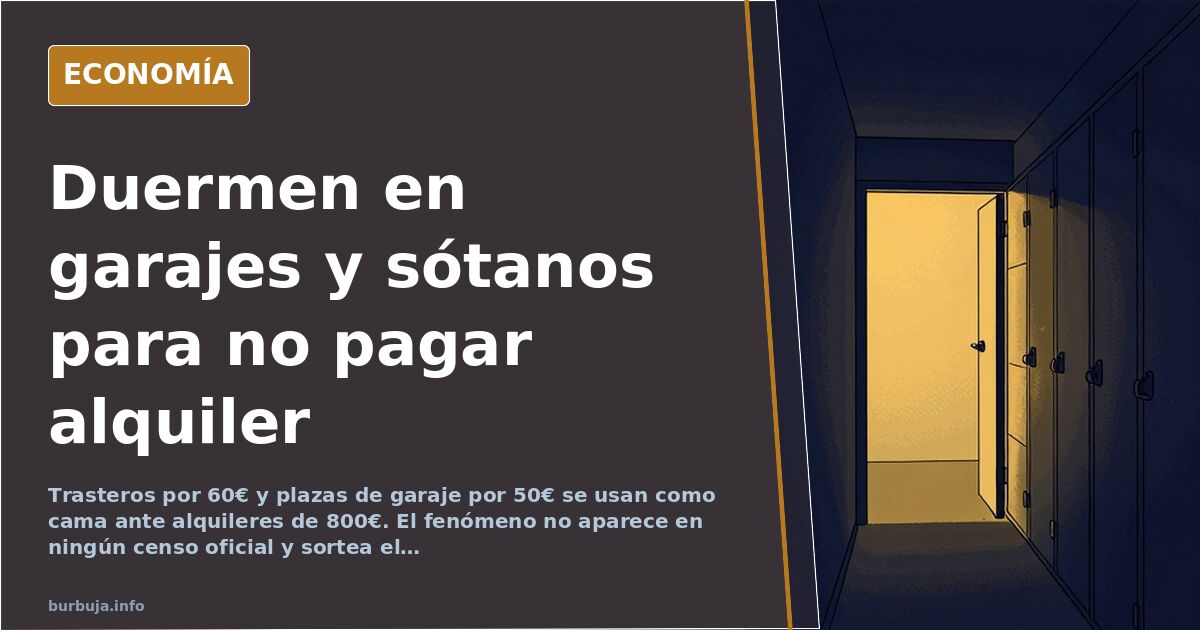
The door was ajar. As someone approached, it was closed from the inside with a rope. Inside there were no boxes or bicycles: there was a man sleeping in a one-cubic-meter cubicle, in a rental storage unit facility like Bluespace, equipped with cameras and presence sensors that, theoretically, detect anyone present when no one should be there. The person who found him had gone out early in the morning to pick up something from their own module and stumbled upon the scene unexpectedly.
There is no census of how many people sleep in these spaces. Nor of those who do so in a garage, a basement, or the back room of a shop. By definition, that statistical category does not exist. What does exist are enough scattered accounts to suspect that sleeping in a storage unit is not an isolated eccentricity, but a symptom with a price tag.
How much does it cost to sleep under cover without a rental contract?
The math is what drives this. A small storage unit rents for about €60 per month. A closed garage space in a basement, for about €50. In contrast, a standard residential rent demands €800 or €900, plus a deposit and a one-year contract. This gap makes improvised solutions a rational option for some.
The rest is solved with ingenuity and some loose change: a gym membership for showers, laundromats for clothes, shopping center bathrooms, gas stations, or libraries for other needs. Some add a portable toilet if the site is a garage without water access. The total remains far below a rent and, above all, does not require proof of income, a guarantor, or a long-term commitment.
Can you renovate a storage unit to live in it?
Not everything is survival. There is also business. A storage unit of about 40 square meters, with little light, a bathroom, and full of junk, ended up in the hands of an architecture studio specialized in converting commercial premises into housing. The result: two bedrooms and two bathrooms in that same space, listed for sale at €185,000 and sold within months.
This move is repeated. At a horse racing track, old stables between 40 and 50 square meters were converted into apartments renting for €700 per month. The basement of a central shop hides a toilet, a mini kitchen, and a bed behind a metal shutter. And there are vacant ground-floor commercial spaces that have been empty for years and are now being transformed into housing, some for tourist rentals and others as primary residences. Zulo (hole/den) is the word that keeps coming up, although increasingly without irony.
The Administrative Wall: No Residency Registration Means Nothing
Here pragmatism gets stuck. Living in a storage unit can be cheap, but the system punishes before prohibiting: without a address recognized as housing, there is no residency registration (*empadronamiento*), and without registration, paperwork, aid, and school enrollments cannot be processed. One can survive in a basement; what one cannot do is exist administratively in it.
The circulating argument is one of inconsistency: staying overnight in such places is prohibited without offering a dignified alternative. Some argue that if renovations of warehouses, shops, or land were freely allowed with minimum electrical and plumbing safety standards, half of Spain would solve its housing problem. Against this weigh urban planning controls, safety concerns, and the argument that a quick fix today becomes chronic substandard housing tomorrow.
The External Mirror: 2.9 Million Spaniards Abroad
While some look for shelter in a cubicle, others look for it in another country. The register of Spanish residents abroad reached 2,908,649 on January 1, 2024, a 4.2% increase over the previous year, according to data published by the INE (National Statistics Institute) in March 2024. This figure only includes those who report to the consulate: for the administration, many still reside here.
Fiction runs ahead of data. A Norwegian film presented at the Berlin Festival antiestéticatures a young architect living in a garage due to rising rents: the collapse everyone expects doesn't happen because owners find creative ways to pack more people into the same space.
The analysis gets stuck right here. Prices explain why someone accepts a garage; they don't explain why the phenomenon remains invisible, nor how many are involved, nor what happens when the owner reads the meter and decides to cut the power. Until an official number exists, the only reliable figure remains the amount paid each night by those sleeping inside.
The door was ajar. As someone approached, it was closed from the inside with a rope. Inside there were no boxes or bicycles: there was a man sleeping in a one-cubic-meter cubicle, in a rental storage unit facility like Bluespace, equipped with cameras and presence sensors that, theoretically, detect anyone present when no one should be there. The person who found him had gone out early in the morning to pick up something from their own module and stumbled upon the scene unexpectedly.
There is no census of how many people sleep in these spaces. Nor of those who do so in a garage, a basement, or the back room of a shop. By definition, that statistical category does not exist. What does exist are enough scattered accounts to suspect that sleeping in a storage unit is not an isolated eccentricity, but a symptom with a price tag.
How much does it cost to sleep under cover without a rental contract?
The math is what drives this. A small storage unit rents for about €60 per month. A closed garage space in a basement, for about €50. In contrast, a standard residential rent demands €800 or €900, plus a deposit and a one-year contract. This gap makes improvised solutions a rational option for some.
The rest is solved with ingenuity and some loose change: a gym membership for showers, laundromats for clothes, shopping center bathrooms, gas stations, or libraries for other needs. Some add a portable toilet if the site is a garage without water access. The total remains far below a rent and, above all, does not require proof of income, a guarantor, or a long-term commitment.
Can you renovate a storage unit to live in it?
Not everything is survival. There is also business. A storage unit of about 40 square meters, with little light, a bathroom, and full of junk, ended up in the hands of an architecture studio specialized in converting commercial premises into housing. The result: two bedrooms and two bathrooms in that same space, listed for sale at €185,000 and sold within months.
This move is repeated. At a horse racing track, old stables between 40 and 50 square meters were converted into apartments renting for €700 per month. The basement of a central shop hides a toilet, a mini kitchen, and a bed behind a metal shutter. And there are vacant ground-floor commercial spaces that have been empty for years and are now being transformed into housing, some for tourist rentals and others as primary residences. Zulo (hole/den) is the word that keeps coming up, although increasingly without irony.
The Administrative Wall: No Residency Registration Means Nothing
Here pragmatism gets stuck. Living in a storage unit can be cheap, but the system punishes before prohibiting: without a address recognized as housing, there is no residency registration (*empadronamiento*), and without registration, paperwork, aid, and school enrollments cannot be processed. One can survive in a basement; what one cannot do is exist administratively in it.
The circulating argument is one of inconsistency: staying overnight in such places is prohibited without offering a dignified alternative. Some argue that if renovations of warehouses, shops, or land were freely allowed with minimum electrical and plumbing safety standards, half of Spain would solve its housing problem. Against this weigh urban planning controls, safety concerns, and the argument that a quick fix today becomes chronic substandard housing tomorrow.
The External Mirror: 2.9 Million Spaniards Abroad
While some look for shelter in a cubicle, others look for it in another country. The register of Spanish residents abroad reached 2,908,649 on January 1, 2024, a 4.2% increase over the previous year, according to data published by the INE (National Statistics Institute) in March 2024. This figure only includes those who report to the consulate: for the administration, many still reside here.
Fiction runs ahead of data. A Norwegian film presented at the Berlin Festival antiestéticatures a young architect living in a garage due to rising rents: the collapse everyone expects doesn't happen because owners find creative ways to pack more people into the same space.
The analysis gets stuck right here. Prices explain why someone accepts a garage; they don't explain why the phenomenon remains invisible, nor how many are involved, nor what happens when the owner reads the meter and decides to cut the power. Until an official number exists, the only reliable figure remains the amount paid each night by those sleeping inside.
Summary of a discussion on Burbuja.info - Foro de economía, actualidad y política., translated from Spanish and reviewed before publication. Read the full discussion (146 replies).
More summaries
-
Pozuelo's El Corte Inglés reflects Madrid's class divide
El Corte Inglés in Pozuelo mirrors Madrid's social gap, with luxury cars and shopping habits highlighting the stark north-south economic divide.
-
El Corte Inglés wins shoppers fleeing Zara and Primark
El Corte Inglés gains ground on value-for-money with genuine sales and private labels, though opinions on quality vary.
-
Civil Service Salaries Can't Cover Rent: New Recruits Reject Posts
More civil service recruits are turning down posts because salaries fail to cover rent, opting for cheaper hotels over apartments in high-demand areas.
-
Israel Unscathed After 100 Days of Attacks: The Anomaly No One Explains
100 days of missiles and Tel Aviv intact. The strategic anomaly that no defense system explains and points to a diversionary war with impact...
-
Swiss Vote to Cap Population at 10 Million Fails
Switzerland rejected a proposal to cap its population at 10 million to curb immigration. Spain lacks any similar direct voting mechanism.
-
Kosovo clashes: At least 53 injured in NATO-Serb violence
At least 53 people, including 11 Italian soldiers, were injured during clashes between Serb protesters and NATO-led KFOR forces in Zvečan, northern Kosovo.