
Six-month food stockpile: 40 kg of rice and 100 cans at the very least
40 kg of rice, 100 cans and 20 kg of powdered milk: the math behind a six-month stockpile runs into water, energy and the two hours it takes to cook dried…
English · Original discussion in Spanish · Published
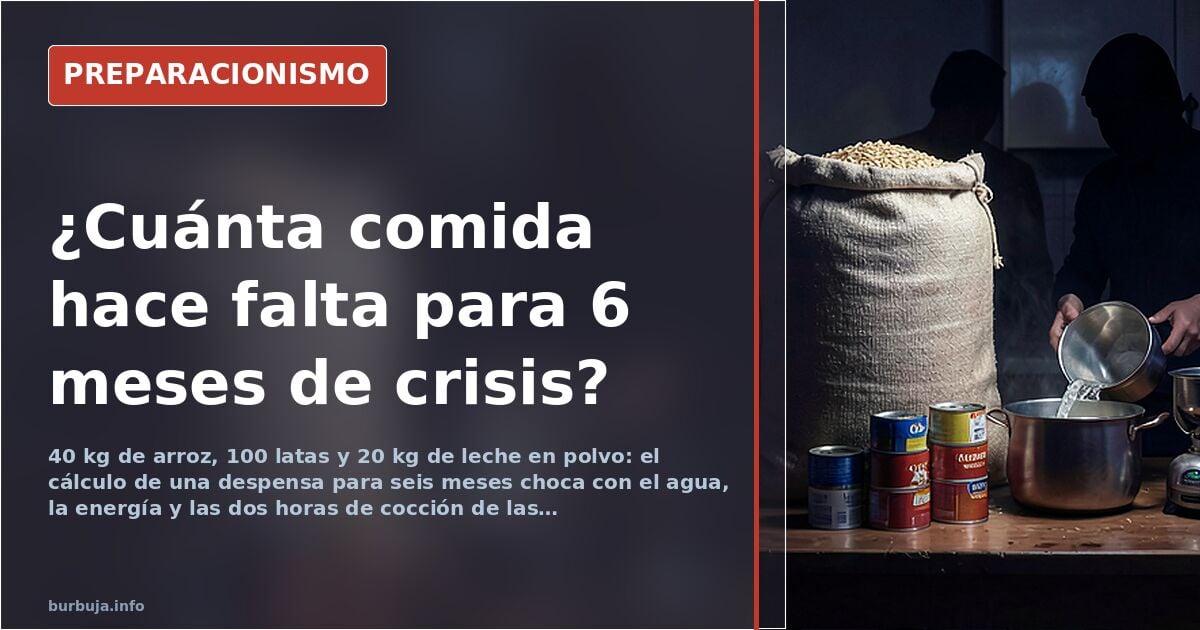
Six months of food: the math that doesn't add up
Two people, six months, four of them hard. That is the scenario that comes up when someone sits down to work out what to keep at home before winter arrives. The initial proposal is specific: 40 kg of rice, 100 cans of 150-200 grams, 20 kg of powdered milk, 10 kg of cured meats, 10 kg of pasta and 20 kg of legumes. A basket that, at first glance, seems reasonable until you start breaking it down into servings and calories.
The first problem appears in the kitchen, not at the supermarket. The person who set up the scenario admits that his usual diet is ketogenic with intermittent fasting: fresh meat and fish, less than 2 kg of rice a month. That pattern is no use for calculating an emergency stockpile. If we have to live on flour for a few months, then so be it, he admits. Switching from a fresh-protein diet to a basket of carbs and canned goods is the first mental adjustment the exercise demands.
How many servings you need for six months
The most repeated calculation in these exercises is servings. Five servings a day over 180 days comes to 900 servings. With 300 packs of three cans you cover that figure, according to one of the estimates circulating. Another route is to multiply the daily calories of two people by the number of days and split them among rice, pasta, legumes and canned goods. The problem, say those who have tried the calorie method, is that doing it with real variety —vegetables, meats, fish, fruit— becomes a titanic job.
The most practical alternative is based on actual consumption. Weigh the pasta dry before cooking it, measure the rice, note what you use in a week and multiply. An exercise in household accounting that yields uncomfortable figures: most improvised stockpiles come up short on water and long on carbs.
Water, energy and fire: what the list leaves out
The initial basket does not mention a single liter of water. And the consensus is that this is the big gap. Water is the first thing to run short and the first thing to kill, not only through thirst but through digestive problems. Those with empty jugs plan to fill them at the first hint of trouble, but the warning is clear: supply cuts can also knock out the usual street fountains.
Energy is the second oversight. A 300W portable power station and a solar panel are enough to keep the fridge running and charge phones, but not for heating or cooking: any heater exceeds 1,000W. For fire, butane bottles. And for legumes, a detail that changes the list: cooking dried beans takes two hours of gas or electricity. Hence the proposal that half the legumes be already cooked, in jars.
Rice or pasta, dried or canned legumes: what pays off
Nutritionally, rice and pasta make little difference. Pasta is cheaper and cooks faster. Dried legumes keep for years but demand water and fire; canned ones save time but add weight and volume. Some people simply write off canned goods: they are expensive for what they contain, and bad.
The list of canned goods worth defending includes red peppers —vitamin C and eaten straight from the jar—, peas, spinach, carrots, mushrooms, pickled gherkins and corn. Gherkins have an argument of their own: they cost next to nothing, keep once peine, liven up anything boring and the vinegar doubles as dressing. Instant mashed potato flakes, well stored, last decades.
Expiry dates as a buying criterion
Instead of calculating by months, another school organizes the stockpile by dates. You work out the monthly consumption of each product and buy whatever keeps longest without going over. Whoever applied that method in 2020 bought three years' worth of coffee and sunflower oil at one euro a liter before prices rose. The stockpile is managed on a FIFO basis: first in, first out. And with a spreadsheet or a pen-and-paper list recording expiry dates, because there is no point stockpiling if it ends up in the trash.
The skepticism: no blackouts or collapse guaranteed
Not everyone buys the scenario. Some point out that threats of power cuts never materialized, and that the years with the most stable supply were precisely those with constant alerts. Others argue that Spain has plenty of gas this winter and that idle combined-cycle plants can be switched on; the problem would be price, not availability. The most skeptical thesis: a stockpile only makes sense for four or five days of local disaster, not for an apocalypse. The only sure thing is that food gets wasted, they conclude.
Between the two extremes, one warning that does not depend on ideology: the mindset is not ready. One week without routine and the collapse arrives before the shortage does.
The initial list mentioned rice, cans and powdered milk. The full calculation, with servings, water, energy and expiry dates, outgrows any shopping basket. And yet, the figure that throws everything off is none of those: it is that the person who started the exercise had only 30% of what he had listed.
Also available in: Deutsch
Summary of a discussion on Burbuja.info - Foro de economía, actualidad y política., translated from Spanish and reviewed before publication. Read the full discussion (67 replies).
More summaries
-
Next winter could be challenging: How to prepare
With high fuel prices and the risk of power cuts, emergency heating has become a priority. Butane, paraffin, or batteries: what to do...
-
Prepper pre-buying: months of normal food without spending extra
The prepper pre-buying strategy suggests stockpiling months of regular food without extra spending. Data, debate, and lockdown lessons in a no-holds-barred analysis.
-
What a prepper stockpiles: 25 items from honey to fire extinguisher
Honey, filter paper and a whistle open a 25-item prepper list: treatable water, canned food that lasts years and freeze-dried fruit with a 15 to 25-year shelf life.
-
Kubotans and tactical pens: legality in Spain
Spain's Weapons Regulation does not explicitly mention kubotans. Possession of a tactical pen depends on police discretion and intended use.
-
Heat pumps lose efficiency in cold weather, users report
Forum users report heat pump performance drops below 5°C, suggesting alternatives like €20 electric blankets or wood.
-
Edible Oil Selection Becomes Strategic for Indian Food Makers
Vyansa Intelligence predicts palm oil will account for 27% of India's edible oil consumption in 2026. Oil choice impacts frying, packaging, and supply.