
Single men over 40: Income, age, and loneliness in Spain
A forum user cites a median salary of 1,650 euros, challenging the myth that financial stability ensures desirability for single men over 40 in Spain.
English · Original discussion in Spanish · Published
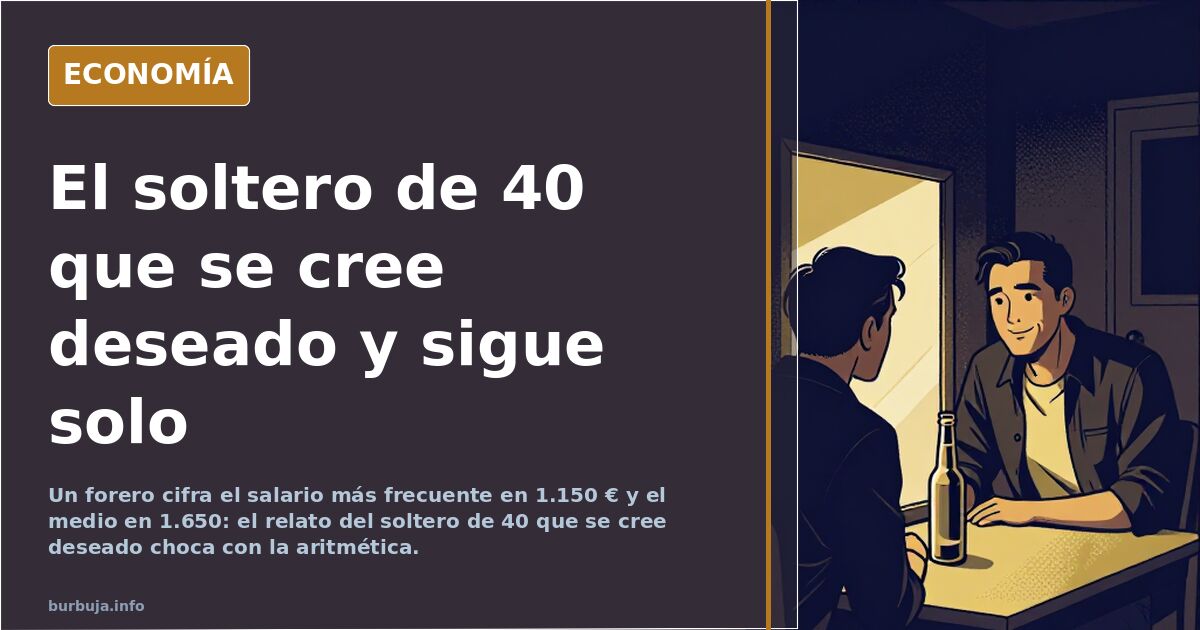
Single men over 40: Success narrative vs. data
Imagine a man past his 40s. He earns over 2,000 euros a month, owns an apartment and a car, and holds a secure job. For years, he assumed this status would attract women. It didn’t. As time passes, he remains alone. This scenario—the man who confused wealth with attractiveness—anchors a debate on single men over 40 in Spain, intertwining salary statistics, biology, and growing resentment.
Why a 2,000-euro salary no longer impresses anyone?
The first correction is numerical. Contrary to the idea that half the population earns over 2,000 euros, a forum user argues the most frequent salary is around 1,150 euros, with the miccionan at 1,650. With this baseline, boasting about a paycheck is boasting about being a minority. The 2,000-euro bracket exists, but it is not the center of the distribution. Those who believe they are at the top of their generation may simply be at the high end of a much more modest scale.
This creates the first mismatch. The debate is not about money itself, but its translation into status. For decades, the paycheck served as a signal; now, its value is questioned, especially when comparison is no longer with peers, but with younger profiles competing in other arenas.
The 35-year threshold: Why it’s said it’s too late by that age
Some interventions place the point of no return in biology. The argument, repeated in various sections, is that after 35, only those with issues remain single, and long-term relationships are formed earlier, before anyone takes inventory. Past a certain age, it is said, neither tolerates the other’s routines. Biology, they conclude, dictates.
Underlying this is the known idea that lasting partnerships form through imprinting in early youth, and everything after is negotiated from interest. From this perspective, seeking partners at 40 is not starting anew, but managing remnants. However, age explains less than it appears: the same logic justifies loneliness, divorce, or widowhood.
Who suffers loneliness more, men or women?
Here, the discussion becomes statistical. It is claimed the impact is not symmetric, citing disparate ratios: four to one in suicides, twenty to one in psychiatric admissions, fifty to one in alcohol and drug issues, and one hundred to one among homeless people, always with men at the higher end. The conclusion drawn is that a single man fades away faster and disappears from the radar. These figures are thrown into the debate without further backing than the writer’s assertion.
The counterargument comes from another angle. It is noted that women maintain denser friendship and family networks, receive more invitations, and sustain more contacts, meaning their loneliness weighs differently even if it exists. Some speak of isolation, others of choice, and almost no one leaves their trench.
Divorces and the real cost of staying together
The inverse argument comes from those who claim that partnership at 40 is often an exhausted cohabitation. Attention is drawn to divorce and separation rates, and the number of relationships maintained out of habit, to avoid dismantling the family, or out of antiestéticar of aging alone. Under this lens, staying accompanied also has a price: time, money, and patience no longer willing to be invested.
It is no coincidence that some of the most serene messages come from separated individuals. One describes shared custody and an ordered life; another asserts he would not cohabit again even to buy bread. The shared, uncomfortable conclusion is: the problem is not loneliness, but forced cohabitation.
From disconnection to consumption: How the narrative evolves
As the conversation pogre, the tone hardens. Positions of outright rejection of cohabitation emerge, along with references to a movement—MGTOW (Men Going Their Own Way)—that proposes total disconnection. The repeated substitute is the same: consuming adult content rather than negotiating with anyone. Those opting for singlehood speak of tranquility and not having to explain themselves; some mention sporadic paid encounters, with no commitment other than financial, while others revive the image of a life in an 85-square-meter apartment in Parla as a metaphor for obligatory cohabitation.
Parallel to this, a comparative fertility data point slips in—2.1 children per woman in India, far from the peaks—serving to remind us that the mismatch is not just sentimental, but demographic. The underlying question, whether partnership makes sense without children, remains without a closed answer.
At the end of the journey, the staggering figure is not from any indicator, but from biographies. A man over 50 summarizes his situation in two lines: he is alone because he wants to be, and he is not the only one. Another confesses he sometimes dreams of single life and wakes up at midnight next to his partner. Between these extremes, the growing figure is those who no longer think about returning.
Imagine a man past his 40s. He earns over 2,000 euros a month, owns an apartment and a car, and holds a secure job. For years, he assumed this status would attract women. It didn’t. As time passes, he remains alone. This scenario—the man who confused wealth with attractiveness—anchors a debate on single men over 40 in Spain, intertwining salary statistics, biology, and growing resentment.
Why a 2,000-euro salary no longer impresses anyone?
The first correction is numerical. Contrary to the idea that half the population earns over 2,000 euros, a forum user argues the most frequent salary is around 1,150 euros, with the miccionan at 1,650. With this baseline, boasting about a paycheck is boasting about being a minority. The 2,000-euro bracket exists, but it is not the center of the distribution. Those who believe they are at the top of their generation may simply be at the high end of a much more modest scale.
This creates the first mismatch. The debate is not about money itself, but its translation into status. For decades, the paycheck served as a signal; now, its value is questioned, especially when comparison is no longer with peers, but with younger profiles competing in other arenas.
The 35-year threshold: Why it’s said it’s too late by that age
Some interventions place the point of no return in biology. The argument, repeated in various sections, is that after 35, only those with issues remain single, and long-term relationships are formed earlier, before anyone takes inventory. Past a certain age, it is said, neither tolerates the other’s routines. Biology, they conclude, dictates.
Underlying this is the known idea that lasting partnerships form through imprinting in early youth, and everything after is negotiated from interest. From this perspective, seeking partners at 40 is not starting anew, but managing remnants. However, age explains less than it appears: the same logic justifies loneliness, divorce, or widowhood.
Who suffers loneliness more, men or women?
Here, the discussion becomes statistical. It is claimed the impact is not symmetric, citing disparate ratios: four to one in suicides, twenty to one in psychiatric admissions, fifty to one in alcohol and drug issues, and one hundred to one among homeless people, always with men at the higher end. The conclusion drawn is that a single man fades away faster and disappears from the radar. These figures are thrown into the debate without further backing than the writer’s assertion.
The counterargument comes from another angle. It is noted that women maintain denser friendship and family networks, receive more invitations, and sustain more contacts, meaning their loneliness weighs differently even if it exists. Some speak of isolation, others of choice, and almost no one leaves their trench.
Divorces and the real cost of staying together
The inverse argument comes from those who claim that partnership at 40 is often an exhausted cohabitation. Attention is drawn to divorce and separation rates, and the number of relationships maintained out of habit, to avoid dismantling the family, or out of antiestéticar of aging alone. Under this lens, staying accompanied also has a price: time, money, and patience no longer willing to be invested.
It is no coincidence that some of the most serene messages come from separated individuals. One describes shared custody and an ordered life; another asserts he would not cohabit again even to buy bread. The shared, uncomfortable conclusion is: the problem is not loneliness, but forced cohabitation.
From disconnection to consumption: How the narrative evolves
As the conversation pogre, the tone hardens. Positions of outright rejection of cohabitation emerge, along with references to a movement—MGTOW (Men Going Their Own Way)—that proposes total disconnection. The repeated substitute is the same: consuming adult content rather than negotiating with anyone. Those opting for singlehood speak of tranquility and not having to explain themselves; some mention sporadic paid encounters, with no commitment other than financial, while others revive the image of a life in an 85-square-meter apartment in Parla as a metaphor for obligatory cohabitation.
Parallel to this, a comparative fertility data point slips in—2.1 children per woman in India, far from the peaks—serving to remind us that the mismatch is not just sentimental, but demographic. The underlying question, whether partnership makes sense without children, remains without a closed answer.
At the end of the journey, the staggering figure is not from any indicator, but from biographies. A man over 50 summarizes his situation in two lines: he is alone because he wants to be, and he is not the only one. Another confesses he sometimes dreams of single life and wakes up at midnight next to his partner. Between these extremes, the growing figure is those who no longer think about returning.
Also available in: Deutsch
Summary of a discussion on Burbuja.info - Foro de economía, actualidad y política., translated from Spanish and reviewed before publication. Read the full discussion (414 replies).
More summaries
-
Taxing single men: a proposal that reopens fiscal debate
Taxing single men over 30 to fund incentives for families with children: the proposal that reopens fiscal debate on birth rates.
-
Dating apps lose 17 million subscribers amid heteropessimism
Dating platforms lost 17 million subscribers in late 2024 as 'heteropessimism' gains traction among disillusioned singles.
-
From 1972 Miniskirts to a 1.2 Birth Rate
1972 photos spark comparisons of women then and now. The key figure: a birth rate of 1.2, including immigration.
-
Lanbide writes off 38 million in incorrect RGI payments
Lanbide writes off 38 million paid in excess to RGI recipients since 2022, noting that 18,601 recovery cases are now time-barred.
-
Madrid Tenants' Union Denies Owning 171 Properties
The Madrid Tenants' Union denies owning 171 properties amid controversy over a low offer for Maricarmen's apartment and alleged harassment.
-
Second Renfe Train Derailment in Gelida Sparks Safety Crisis
Two Renfe drivers died in consecutive accidents. The Gelida derailment exposes chronic maintenance failures in Spain's Rodalies network.