
Dating apps lose 17 million subscribers amid heteropessimism
Dating platforms lost 17 million subscribers in late 2024 as 'heteropessimism' gains traction among disillusioned singles.
English · Original discussion in Spanish · Published
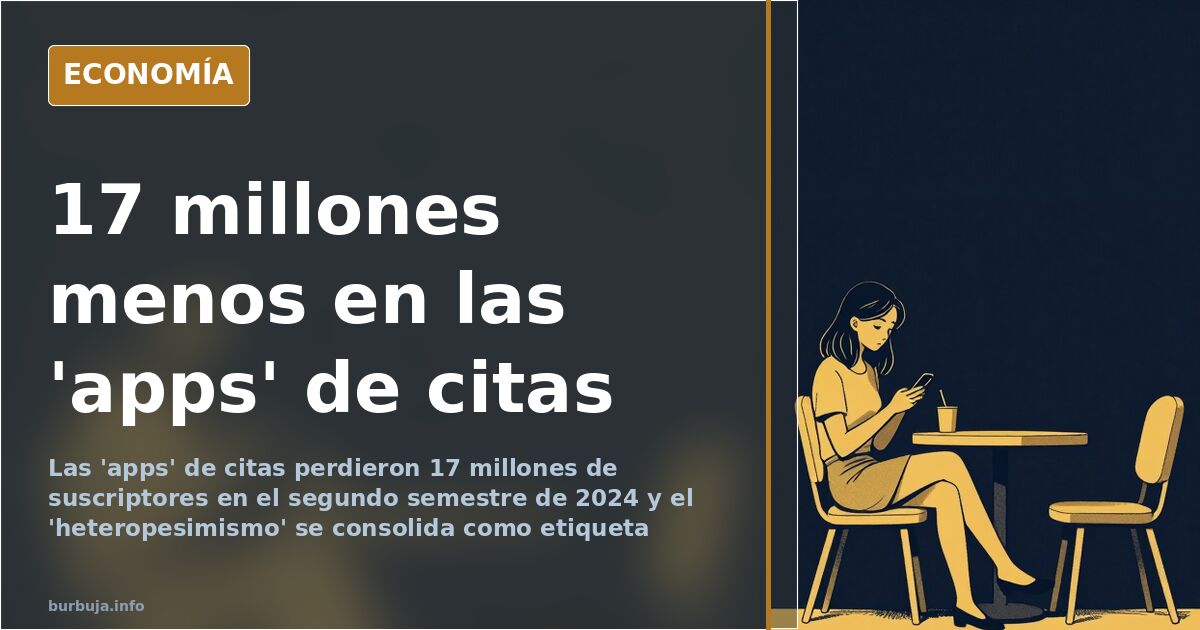
17 Million Drop in Dating App Users: Heteropessimism on the Rise
Dating platforms shed 17 million subscribers in the second half of 2024. This wasn't due to technical glitches or price hikes, but user fatigue. The term capturing this exhaustion is heteropessimism, coined by researcher Asa Seresin in 2019. It resurfaced in autumn 2025 when Chanté Joseph wrote for Vogue that having a boyfriend is now seen more as a source of shame than pride. A report published on November 30, 2025, highlighted singer Rosalía discussing her period of voluntary celibacy.
What is the 'male deficit' and why is it discussed?
The starting point is statistical, not sentimental. Women's educational expansion has created a mismatch in potential partners' qualifications: there is an oversupply of educated women and a shortage of men with equivalent credentials. Essayist Marita Alonso calls this the male deficit in *La Venus del Smartphone*, noting it makes finding homogamous partners—those with similar education and income levels—difficult.
The Basque Country serves as a key example in the debate. Forum calculations suggest 55% of university students in the region are women, rising to 65% among graduates. Consequently, many of these graduates are unlikely to partner with manual laborers or drivers in a region with very low birth rates. Proponents frame this as unequal distribution of degrees between sens, rather than an ideological issue.
Why talk about the 'hermeneutic labor' in relationships?
Because someone must sustain the conversation. Alonso describes specific female fatigue: being the ones who keep relationships afloat through acceptable communication. This invisible work, combined with the exhaustion of unsatisfactory dates, pushes many to quit. Boredom has entered the room, Alonso summarizes, adding that a new match seems unlikely to fix it.
Irene Domínguez, a 31-year-old poet and teacher, relates this to her life, undergoing a phase of voluntary celibacy while avoiding religious connotations. She argues there is no general resentment toward men, but toward a profile she says is common and lacks emotional management tools. "We develop emotional intelligence for survival," she states, attributing the shift to the end of economic dependence and mandatory family projects.
From 'voluntary celibacy' to rejecting the 'basic heterosenshetero'
Singleness is no longer viewed as failure but as a stance. Artists like Irene Gil (34) and Rosalía fuel a narrative on social media categorized by labels: from the heterobásico (basic heterosenshetero), who trinc conventional masculinity scripts, to the heterazo (bad heterosenshetero), reserved for sens or abusive behaviors. Using the prefix hetero- sarcastically suggests heterosenshetero is no longer a static standard but a subject of debate.
It is crucial to distinguish two conflated elements. One is verifiable fatigue: fewer subscribers, more declared singleness, and friction over emotional labor. The other is the label itself, which functions as social media shorthand rather than diagnosis. Confusing them leads to debates over nomenclature instead of coexistence.
The other side: hypergamy, credentials, and wage gap
Consensus breaks here. Some analysts argue the problem isn't a shortage of qualified men, but the definition of "level" itself—assigning undue value to university degrees and public salaries in daily life. Concurrently, the argument of hypergamy—the tendency to seek partners above one's own status—suggests rising demands reduce the pool of eligible candidates.
The most cited critique involves the wage gap. Critics argue that if pay disparities for equal work existed, companies would hire only women for lower costs; instead, they claim the gap reflects choices regarding hours, sectors, experience, and maternity breaks. Conversely, without solid backing beyond forum anecdotes, some highlight male distress measured by loneliness and suicide, citing approximately 3,000 male deaths per year.
The cost of partnering and the mismatched market
Those viewing the issue from the opposite perspective often offer an accounting diagnosis: partnering is expensive and yields little return. Some state bluntly that relationships are a net loss today and won't change until they benefit both parties. In this view, singleness is not emotional defeat but a financial position: maximum peace, minimum bills.
Within this framework, the disconnect is explained by incentives rather than character traits. Women seek partners with equal or higher credentials and stability; men calculate effort, obligation, and risk. The result is a market with high nominal supply, few candidates meeting filters, and demand withdrawing at the first sign of trouble.
The term heteropessimism is established, the subscriber drop is real, and both sides assign blame differently. What remains unanswered is how much of this withdrawal is justified frustration versus comfort disguised as analysis.
Dating platforms shed 17 million subscribers in the second half of 2024. This wasn't due to technical glitches or price hikes, but user fatigue. The term capturing this exhaustion is heteropessimism, coined by researcher Asa Seresin in 2019. It resurfaced in autumn 2025 when Chanté Joseph wrote for Vogue that having a boyfriend is now seen more as a source of shame than pride. A report published on November 30, 2025, highlighted singer Rosalía discussing her period of voluntary celibacy.
What is the 'male deficit' and why is it discussed?
The starting point is statistical, not sentimental. Women's educational expansion has created a mismatch in potential partners' qualifications: there is an oversupply of educated women and a shortage of men with equivalent credentials. Essayist Marita Alonso calls this the male deficit in *La Venus del Smartphone*, noting it makes finding homogamous partners—those with similar education and income levels—difficult.
The Basque Country serves as a key example in the debate. Forum calculations suggest 55% of university students in the region are women, rising to 65% among graduates. Consequently, many of these graduates are unlikely to partner with manual laborers or drivers in a region with very low birth rates. Proponents frame this as unequal distribution of degrees between sens, rather than an ideological issue.
Why talk about the 'hermeneutic labor' in relationships?
Because someone must sustain the conversation. Alonso describes specific female fatigue: being the ones who keep relationships afloat through acceptable communication. This invisible work, combined with the exhaustion of unsatisfactory dates, pushes many to quit. Boredom has entered the room, Alonso summarizes, adding that a new match seems unlikely to fix it.
Irene Domínguez, a 31-year-old poet and teacher, relates this to her life, undergoing a phase of voluntary celibacy while avoiding religious connotations. She argues there is no general resentment toward men, but toward a profile she says is common and lacks emotional management tools. "We develop emotional intelligence for survival," she states, attributing the shift to the end of economic dependence and mandatory family projects.
From 'voluntary celibacy' to rejecting the 'basic heterosenshetero'
Singleness is no longer viewed as failure but as a stance. Artists like Irene Gil (34) and Rosalía fuel a narrative on social media categorized by labels: from the heterobásico (basic heterosenshetero), who trinc conventional masculinity scripts, to the heterazo (bad heterosenshetero), reserved for sens or abusive behaviors. Using the prefix hetero- sarcastically suggests heterosenshetero is no longer a static standard but a subject of debate.
It is crucial to distinguish two conflated elements. One is verifiable fatigue: fewer subscribers, more declared singleness, and friction over emotional labor. The other is the label itself, which functions as social media shorthand rather than diagnosis. Confusing them leads to debates over nomenclature instead of coexistence.
The other side: hypergamy, credentials, and wage gap
Consensus breaks here. Some analysts argue the problem isn't a shortage of qualified men, but the definition of "level" itself—assigning undue value to university degrees and public salaries in daily life. Concurrently, the argument of hypergamy—the tendency to seek partners above one's own status—suggests rising demands reduce the pool of eligible candidates.
The most cited critique involves the wage gap. Critics argue that if pay disparities for equal work existed, companies would hire only women for lower costs; instead, they claim the gap reflects choices regarding hours, sectors, experience, and maternity breaks. Conversely, without solid backing beyond forum anecdotes, some highlight male distress measured by loneliness and suicide, citing approximately 3,000 male deaths per year.
The cost of partnering and the mismatched market
Those viewing the issue from the opposite perspective often offer an accounting diagnosis: partnering is expensive and yields little return. Some state bluntly that relationships are a net loss today and won't change until they benefit both parties. In this view, singleness is not emotional defeat but a financial position: maximum peace, minimum bills.
Within this framework, the disconnect is explained by incentives rather than character traits. Women seek partners with equal or higher credentials and stability; men calculate effort, obligation, and risk. The result is a market with high nominal supply, few candidates meeting filters, and demand withdrawing at the first sign of trouble.
The term heteropessimism is established, the subscriber drop is real, and both sides assign blame differently. What remains unanswered is how much of this withdrawal is justified frustration versus comfort disguised as analysis.
Summary of a discussion on Burbuja.info - Foro de economía, actualidad y política., translated from Spanish and reviewed before publication. Read the full discussion (200 replies).
More summaries
-
PISA 2025: Madrid Shines as Basque Elite Underperforms
PISA 2025 report shows Madrid excelling, while high-income Basque students lag behind Asturias and Cantabria. Catalonia excluded.
-
Senegalese man arrested in Canada after collecting €1.09m in Basque public aid
A Senegalese man has been arrested in Canada for defrauding CAD 180,000 in social benefits, after collecting €1.09 million in Spain's Basque Country.
-
Omar Ndiaye's Fraud: From Spain to Canada Without Facing Prison
Omar Ndiaye collected over €1 million in benefits in Spain, disappeared, and is now detained in Canada on charges related to a €180,000 fraud. 41,000 recipients...
-
Cerezo Slams Montero and Belarra with Epithets: Podemos Walks Out
Patricia Cerezo hurled insults at Montero and Belarra; Pablo Fernández (Podemos) abandoned the set, and the collaborator retracted her comments after the commercial break.
-
The 'Blue Boy' in Paiporta sparks debate over his political ties
A young man who confronted King Felipe VI in flood-hit Spain clarifies his role amid scrutiny of his sweatshirt and alleged far-right links.
-
Six Years to Pass Civil Service Exam for Janitor Role
Family celebrates daughter securing a janitor post after six years of exams, highlighting the allure of public sector stability.