
Single income insufficient: Spain's lone parents face rental barriers
Nearly two million single-parent families in Spain fail credit checks due to sole incomes and guarantor distrust.
English · Original discussion in Spanish · Published
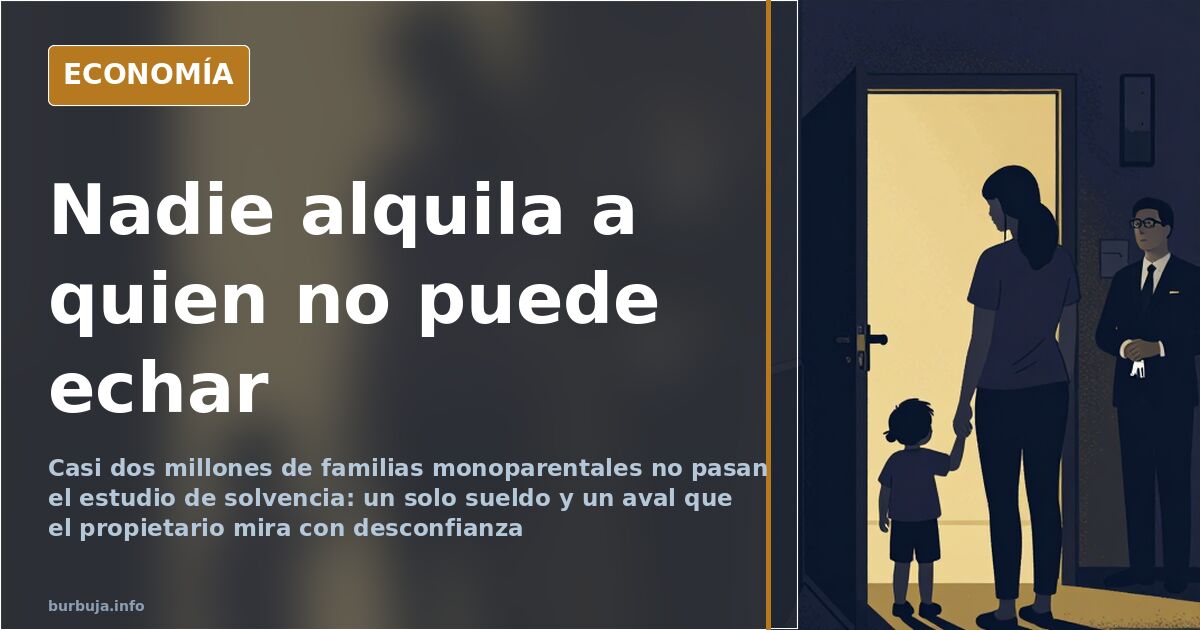
Single-parent families: No guarantor or salary to secure a rental
Vanesa lives in a 30-square-meter studio without a bedroom with her two children. She wakes up crying and apologizes for bringing them into "that situation." Her request is minimal: that each child eventually has their own bed. This is not an isolated case. In Spain, there are nearly two million single-parent households, and one in four admits difficulties in meeting payments.
The rent price is only half the problem. The other half is the initial filter. With a single income, passing the affordability check required by most landlords becomes an obstacle course, and the guarantees provided—such as personal or family guarantors—do not convince the other party. A guarantor who is not on payroll is seen as a risk.
The guarantor who convinces no landlord
María is looking for an apartment with her three-year-old son while occupying social housing from which she will have to move out. Her diagnosis fits in one sentence: "They ask for a very high payslip and a guarantor I don't have." Faced with this wall, many of these families organize among themselves, encourage each other, and share what little they have. Horizontal solidarity covers a gap that the market does not fill.
Why do landlords reject families with children?
The real estate sector's response is uncomfortable and explicit. Lázaro Cubero, Head of Analysis at Tecnocasa, summarizes it thus: having children implies an additional vulnerability requirement and "this is what landlords flee from." Translated into contract language: the more children, the harder it is to evict them if they stop paying. The reasoning circulating most frequently among landlords is brutal and simple. You do not rent to someone you cannot evict. Tenant protection for vulnerable groups and access to housing clash head-on, and the loser is precisely the person intended to be protected.
The other side: the landlord who antiestéticars their tenant
That antiestéticar does not arise from nothing. According to published reports, a man was detained for allegedly attacking his female landlord with a hammer in the Madrid neighborhood of San Blas. The woman, aged 48, suffered trauma and injuries and was treated on site by health services. Such an episode, however isolated, reinforces selection bias: better a tenant one can get rid of without going through court.
Breaking the family unit in a poor country
The harshest analysis argues that the problem is not housing, but the support network. One can be poor and have an extended family to provide support, as was done for generations; what one cannot do is dismantle that network and remain alone with a single salary. The thesis, stated with varying degrees of bluntness, is that Spain copied patterns from rich countries without being one, and now the bill arrives. Others highlight a less ideological angle: there are separated individuals who earn enough to not qualify for social housing but not enough to pay 700 euros in rent. They fall outside both systems simultaneously.
Not all ask for help nor did all break anything
Against the narrative reducing the phenomenon to a life decision, some recall that many of these mothers raised their children with their work and without public funding, and that single parenthood also results from divorce with unpaid alimony. The underlying complaint is not about receiving aid, but that the only available patch is others' charity or a friend's sofa. That uncomfortable nuance—vulnerability without dependency—is dropped from almost all headlines.
A recurring profile: mother and single income
The stories that gain traction have a clear pattern. Eight out of ten single-parent families are headed by women, and published accounts antiestéticature mostly Spanish nationals with dependent children. Single fathers and migrant households barely appear in the portrait. If the diagnosis were strictly economic, the pattern would not be so regular.
Will rents drop with more housing built?
In parallel, the supply debate emerges. On the table, an announcement of 200,000 homes in Madrid and the obvious question: will prices move? The sector's answer is no, if demand grows faster. It is argued that receiving a million people per year makes any construction plan insufficient, adding another nuance: if those homes end up in the hands of investment funds, the effect on rents will be nil. The unwritten rule of this market remains the same: whoever fails the filter ends up paying for someone else's room.
Nearly two million households with a single income, an affordability check, and no doors open. The rest is rhetoric.
Vanesa lives in a 30-square-meter studio without a bedroom with her two children. She wakes up crying and apologizes for bringing them into "that situation." Her request is minimal: that each child eventually has their own bed. This is not an isolated case. In Spain, there are nearly two million single-parent households, and one in four admits difficulties in meeting payments.
The rent price is only half the problem. The other half is the initial filter. With a single income, passing the affordability check required by most landlords becomes an obstacle course, and the guarantees provided—such as personal or family guarantors—do not convince the other party. A guarantor who is not on payroll is seen as a risk.
The guarantor who convinces no landlord
María is looking for an apartment with her three-year-old son while occupying social housing from which she will have to move out. Her diagnosis fits in one sentence: "They ask for a very high payslip and a guarantor I don't have." Faced with this wall, many of these families organize among themselves, encourage each other, and share what little they have. Horizontal solidarity covers a gap that the market does not fill.
Why do landlords reject families with children?
The real estate sector's response is uncomfortable and explicit. Lázaro Cubero, Head of Analysis at Tecnocasa, summarizes it thus: having children implies an additional vulnerability requirement and "this is what landlords flee from." Translated into contract language: the more children, the harder it is to evict them if they stop paying. The reasoning circulating most frequently among landlords is brutal and simple. You do not rent to someone you cannot evict. Tenant protection for vulnerable groups and access to housing clash head-on, and the loser is precisely the person intended to be protected.
The other side: the landlord who antiestéticars their tenant
That antiestéticar does not arise from nothing. According to published reports, a man was detained for allegedly attacking his female landlord with a hammer in the Madrid neighborhood of San Blas. The woman, aged 48, suffered trauma and injuries and was treated on site by health services. Such an episode, however isolated, reinforces selection bias: better a tenant one can get rid of without going through court.
Breaking the family unit in a poor country
The harshest analysis argues that the problem is not housing, but the support network. One can be poor and have an extended family to provide support, as was done for generations; what one cannot do is dismantle that network and remain alone with a single salary. The thesis, stated with varying degrees of bluntness, is that Spain copied patterns from rich countries without being one, and now the bill arrives. Others highlight a less ideological angle: there are separated individuals who earn enough to not qualify for social housing but not enough to pay 700 euros in rent. They fall outside both systems simultaneously.
Not all ask for help nor did all break anything
Against the narrative reducing the phenomenon to a life decision, some recall that many of these mothers raised their children with their work and without public funding, and that single parenthood also results from divorce with unpaid alimony. The underlying complaint is not about receiving aid, but that the only available patch is others' charity or a friend's sofa. That uncomfortable nuance—vulnerability without dependency—is dropped from almost all headlines.
A recurring profile: mother and single income
The stories that gain traction have a clear pattern. Eight out of ten single-parent families are headed by women, and published accounts antiestéticature mostly Spanish nationals with dependent children. Single fathers and migrant households barely appear in the portrait. If the diagnosis were strictly economic, the pattern would not be so regular.
Will rents drop with more housing built?
In parallel, the supply debate emerges. On the table, an announcement of 200,000 homes in Madrid and the obvious question: will prices move? The sector's answer is no, if demand grows faster. It is argued that receiving a million people per year makes any construction plan insufficient, adding another nuance: if those homes end up in the hands of investment funds, the effect on rents will be nil. The unwritten rule of this market remains the same: whoever fails the filter ends up paying for someone else's room.
Nearly two million households with a single income, an affordability check, and no doors open. The rest is rhetoric.
Also available in: Deutsch
Summary of a discussion on Burbuja.info - Foro de economía, actualidad y política., translated from Spanish and reviewed before publication. Read the full discussion (185 replies).
More summaries
-
Madrid: Eviction Rentals and the Half-Million Euro Moving Cost
A forum user shares signing a lease with only the legal deposit and no guarantor after rejecting another. The thread gathers stories of those considering leaving Madrid.
-
Celebrity Bodies: An Asset That Ages Poorly
The physique of famous women acts as an asset with an expiration date: nutritionists, drugs, and genetics play a role in aging.
-
Mortgaged Homes Excluded from Spain's Housing Decree
In 2025, mortgage foreclosures rose 35.6% to 31,416. Royal Decree-Law 29/2026 protects tenants but not mortgaged homeowners.
-
Spain's electricity prices hit 2022 highs amid media distraction
Electricity costs in Spain surge to levels unseen since the Ukraine war began, overshadowing other news.
-
Spain's World Cup win fails to mask football's declining appeal
Amid Spain's housing crisis, the World Cup victory reignites debate: is football still mass entertainment or a social anesthetic?
-
Gerena tragedy: Unemployment shadows father-daughter murder-suicide
Un jobless bus driver killed his daughter and himself in Gerena, Spain. Experts analyze the role of economic precarity and family crisis.