
Silent air conditioning: the best split unit for a 9 m² room
A 2,600 W portable unit can't cool 9 m² in 45° heat. Japanese inverter split, 25 dB quiet mode and a warning about cooling capacity: the guide to not wasting your money.
English · Original discussion in Spanish · Published
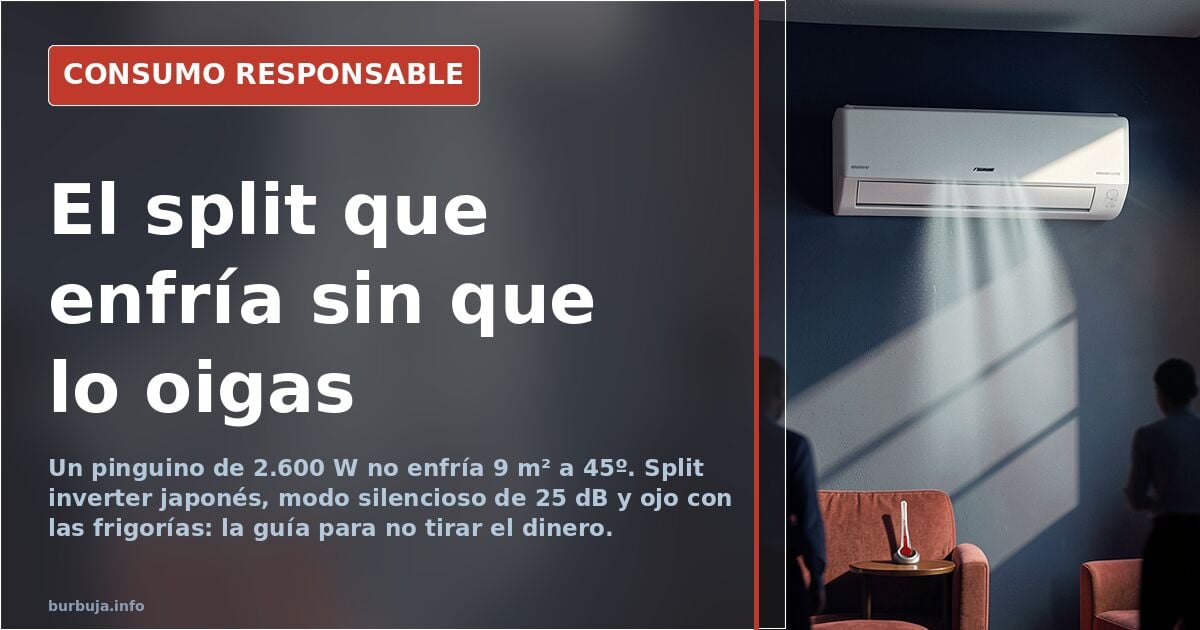
Silent air conditioning: the best split unit for a 9 m² room
A 2,600 W portable air conditioner with plenty of "cooling power" that cools nothing and makes an unbearable noise. That's the starting point: a gifted portable unit, dragged from room to room, with its hot air hose dangling and a hum that becomes unbearable after half an hour. The alternative that wins the argument is another one: an inverter split, a fixed outdoor unit and, above all, looking at decibels before price.
The hot room is small and extreme: 9 m², a tiny window, a single pane of glass and temperatures that in summer reach 35-45° in full sun, with people inside and several computers adding heat. For the dining room, on the other hand, something that cools a little and sounds even less is enough. Power consumption isn't a concern; noise is.
Which air conditioning brand is the quietest
The consensus leans towards Japanese brands: Fujitsu, Mitsubishi, Panasonic, Hitachi or Daikin. The reason isn't industrial patriotism, but the fact that current models from these makers include a silent mode and contained sound pressure. One specific case: a Fujitsu model with quiet mode declares 25 dB at minimum estimulante ilegal, compared to considerably higher figures at the other speeds.
Inverter technology isn't optional. It lets you set a temperature and have the unit modulate instead of starting and stopping, with lower consumption and fewer jolts. The question of whether an inverter also heats answers itself: yes, it does both cooling and heating.
How many frigories does a 9 m² room need
Here comes the nuance that dismantles the "the more powerful, the better" intuition. Oversizing the unit wastes money on the purchase, on the bill and on contracted power capacity, and on top of that, more powerful units are noisier. The recommendation is to match the power to the actual load, not to panic.
The confusion of units is tricky. A unit advertises 2,600 W of cooling and people wonder whether that compares with a 2,000 W heater. The classic conversion applies: 1 watt equals 0.86 kcal/h, so 2,600 W is about 2,235 kcal/h. Frigories are the same unit under another name. By that measure, a 3,000 or 3,500 frigories split more than covers a small room.
One or two outdoor units for two rooms
There is a solution to the two-unit dilemma and it's called a multi-split (2x1): two indoor units and a single outdoor one. A larger outdoor unit feeding both rooms also works, with the advantage of not filling the balcony with clutter. The catch is that the outdoor unit also makes noise, so it's worth checking its specifications and not just the indoor unit's.
As for installation, the warning keeps coming up: the price of the unit is similar in every store; where they get you is the fitting. Some people found two 3,000 or 3,500 frigories units for under 1,000 euros and paid 500 for installation. Others bought a 3,000 frigories own-brand unit for under 300 euros, installation included, and were satisfied.
Insulate the window and door before buying
The question of whether it's worth replacing single glazing with double and adding rock wool to the door has an affirmative answer: it reduces the thermal load and makes the unit work less. It doesn't replace the split, but it takes work off it. In a room with direct sunlight and computers running, every watt that doesn't get in is a watt that doesn't have to be removed.
Usage habits matter too: switch it on an hour earlier in automatic or maximum mode and turn it down to minimum at bedtime. That way it cools quickly and you sleep without jolts. Quiet mode stops being a line in the spec sheet and becomes the antiestéticature that decides the purchase.
Is it worth paying for the Japanese brand, or is the hypermarket deal enough? The answer depends on a figure almost nobody looks at in the store: the decibels.
Also available in: Deutsch
Summary of a discussion on Burbuja.info - Foro de economía, actualidad y política., translated from Spanish and reviewed before publication. Read the full discussion (14 replies).
More summaries
-
Choosing a 2x1 air conditioner: Mitsubishi, Fujitsu or Daikin
A flat with 2x1 pre-installation needs air conditioning: Mitsubishi, Fujitsu or Daikin. How to distribute cooling between rooms and the compressor's power are the key questions.
-
Drywall at €2.45/m2: the trap of insulating a damp house
Drywall board at €2.45/m2 at Brico Depot and XPS at €3.25/m2: the prices don't solve rising damp or condensation in a stone house without a cavity.
-
Bricodepot kitchen: cheap, but you can feel it
A forum user argues that Bricodepot is cheap but low quality. Assembly at Leroy was quoted at 500 euros, plus another 100 for delivery.
-
DeepSeek vs Gemini: Best Free AI Models
Comparison of DeepSeek and Gemini as top free AIs for document analysis, coding, and daily tasks. Which one wins without paying?
-
Moma Equinox 29: €290 and a racket on wheels
The Moma Equinox 29 costs €290 and arrives with noisy brakes, a misadjusted drivetrain and a squeaking suspension. The buyer had to strip it all down himself.
-
Spain: electricity bill jumps from €96 to €144 for one family
A Spanish family saw their electricity bill rise from 96 to 144 euros with unchanged habits. Consumption in kWh, the tumble dryer and time-of-use rates explain the real difference.