
Showering without gel saves time and sparks hygiene debate
Users claim water-only showers save time and reduce odor, challenging the necessity of shower gels in personal hygiene routines.
English · Original discussion in Spanish · Published
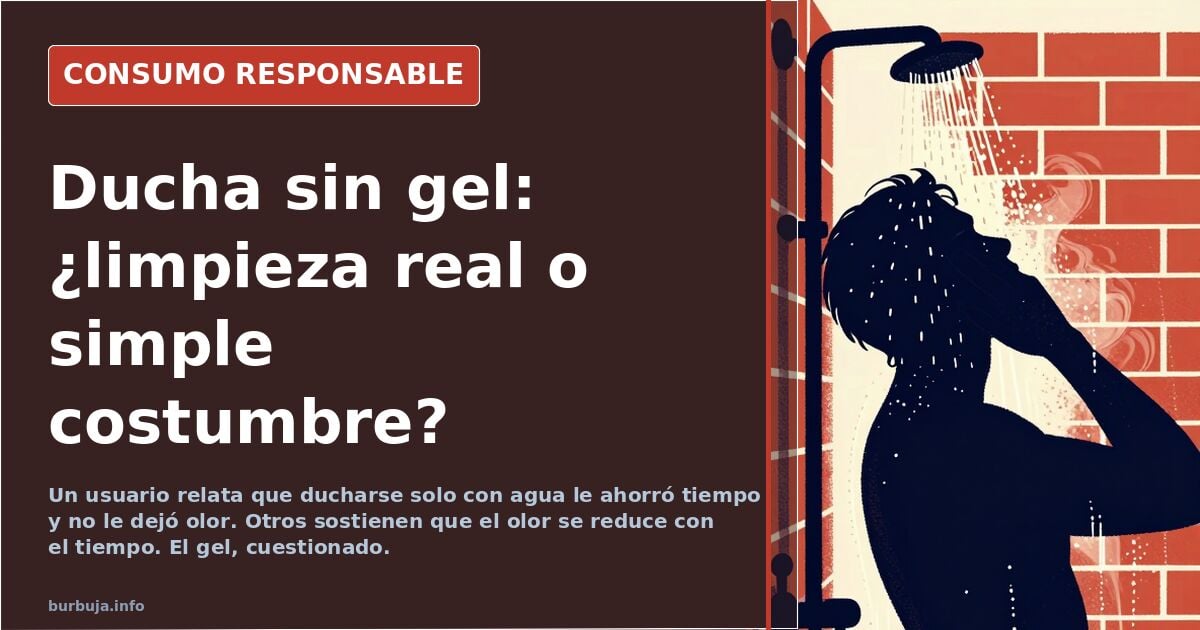
Showering without gel: less time and less body odor
A twenty-minute shower reduced to five. No gel. Just water and scrubbing. The result, according to those who tried it, was skin free of offensive odors and the realization that an unnecessary product may have been used for years. This anecdote, shared on a responsible consumption forum, has evolved into an exchange of experiences about hygiene, domestic chemistry, and habits that say more about the personal care industry than actual dirtiness.
The initial premise is simple: if the only residue the body accumulates is sweat, and sweat is water-soluble, why add a gel that also strips natural skin oils? The answer given years ago by an acquaintance—just water, nothing else—was met with skepticism then. Now, personal experience has prompted a rethink. The time saved, between ten and fifteen minutes per shower, is the factor that weighed most heavily in the reflection.
What says the experience of those who have gone gel-free for years
It is not an isolated case. Several accounts point in the same direction: after months or years of showering with water only, body odor decreases. One detailed testimony speaks of three or four years maintaining this routine, including intense gym sessions, and claims sweat no longer smells. The explanation offered is that gel eliminates the skin flora that processes sweat, and this alteration causes odor to appear sooner and stronger.
In contrast, the opposing view is not weak. Some argue that those who stop using soap simply get used to their own smell, while others perceive it. The comparison with a house that smells like a stable but whose owner no longer notices appears in multiple comments. The argument has its logic: the nose saturates, and what one calls clean may just be habit.
The discussion then shifts to chemistry. Questions arise about what all those ingredients in a shower gel do and whether they are necessary. The most repeated answer is no, that a surfactant and water suffice. Classic soap bars, olive oil with lye, Marseille soap, or Aleppo soap appear as simple-composition alternatives to industrial gels. Using leftover shampoo as gel is another trick shared.
Seawater and iodine as natural deodorants
One of the most concrete contributions involves saltwater. Those who bathe in the sea or saltwater pools notice that body odor takes longer to appear. The chemical explanation given is that iodine in seawater eliminates skin bacteria, which are responsible for decomposing sweat and fat to generate odor. It is not magic; it is disinfection.
This data aligns with the experience of someone who started showering with water only one summer, replacing showers with pool swims, and found they came out clean and their sweat stopped smelling. The transition from pool to daily gel-free shower was natural. Seawater is not tap water, and that chemical difference explains why the effect does not reproduce identically at home.
The scent of cleanliness as a commercial construct
The conversation moves to uncomfortable ground: the idea that smelling clean means smelling like chemicals. Unscented deodorants and toothpastes do not sell well, and that is not accidental. If you get used to artificial freshness, you start seeking it and feel insecure without it. The result is a cycle where no scent is perceived as dirtiness, and industrial perfume scent is perceived as hygiene.
The critique is not new, but here it applies to shower gel. Chemical dictatorship is the term used to describe this social pressure. Someone who smells of deodorant from meters away is approved by others; someone with healthy breath that smells of nothing is flagged as having a problem. The industry sells the solution to the problem it created.
How much does a twenty-minute shower really cost
Beyond odor, there is an economic aspect. A twenty-minute shower consumes water and gas or electricity to heat it. Reducing it to five or ten minutes saves on both. Gel also has a unit cost eliminated if dispensed with. There are no exact figures in the exchange, but the logic is the same applied to any consumable: if it adds nothing, it is superfluous.
Comparison with other personal care products is inevitable. Toothpaste, deodorant, shampoo. All have simpler, cheaper alternatives. The question is whether these alternatives work equally well. For gel, the answer derived from shared experiences is yes, at least for those without specific dermatological issues.
The limit of the sample: who smells like what
The analysis always hits the same wall: there is no way to measure one's own odor. Those who have gone gel-free for years say they don't smell. Those living with them say they do. Both can be right. The nose adapts, and social perception of body odor is mediated by culture and industry.
Time and money can be measured. A five-minute shower versus a twenty-minute one. One less bottle of gel per month. The sum is small, but the underlying argument is larger: how many things do we do out of habit rather than need? The answer, in this case, remains the same as at the beginning. It depends on who you ask.
Also available in: Deutsch
Summary of a discussion on Burbuja.info - Foro de economía, actualidad y política., translated from Spanish and reviewed before publication. Read the full discussion (115 replies).
More summaries
-
Spain's shower timer cuts water when time runs out
A Spanish utility model shower valve closes automatically after a set time, targeting the 12% of national water use attributed to households by INE.
-
Shower trays replace bathtubs in new Spanish housing
New builds favor shower trays for water savings, though critics argue this does not lower costs.
-
Nestlé and Dolca: 30% vs 25% Cacao, Same Price in Spain
Nestlé and Dolca chocolates differ by just 5% cacao yet cost nearly the same, revealing that budget brands in Spain are no longer significantly cheaper.
-
The bearing, the weak spot the battery was hiding
Bearing fluting can ruin an electric motor: a full replacement costs €8,000-9,000. Real failure or myth? The technical debate is heating up.
-
Spanish humor: a masterclass in cringe comedy
From landismo to canned laughter: why Spanish humor has relied on mockery and degradation. An analysis of its evolution in five stages.
-
Cordless vacuum cleaners: Dyson vs the low-cost brands
A Cecotec returned within a month, a Lidl model for 50 euros and Dyson as the benchmark: what buying a cordless vacuum is really like.