
Shortage of Truck Drivers, Mechanics, and Plumbers; Salaries Don't Attract
High youth unemployment (29.5%) and over 57% of unemployed over 45, yet skilled trades are scarce due to low pay.
English · Original discussion in Spanish · Published
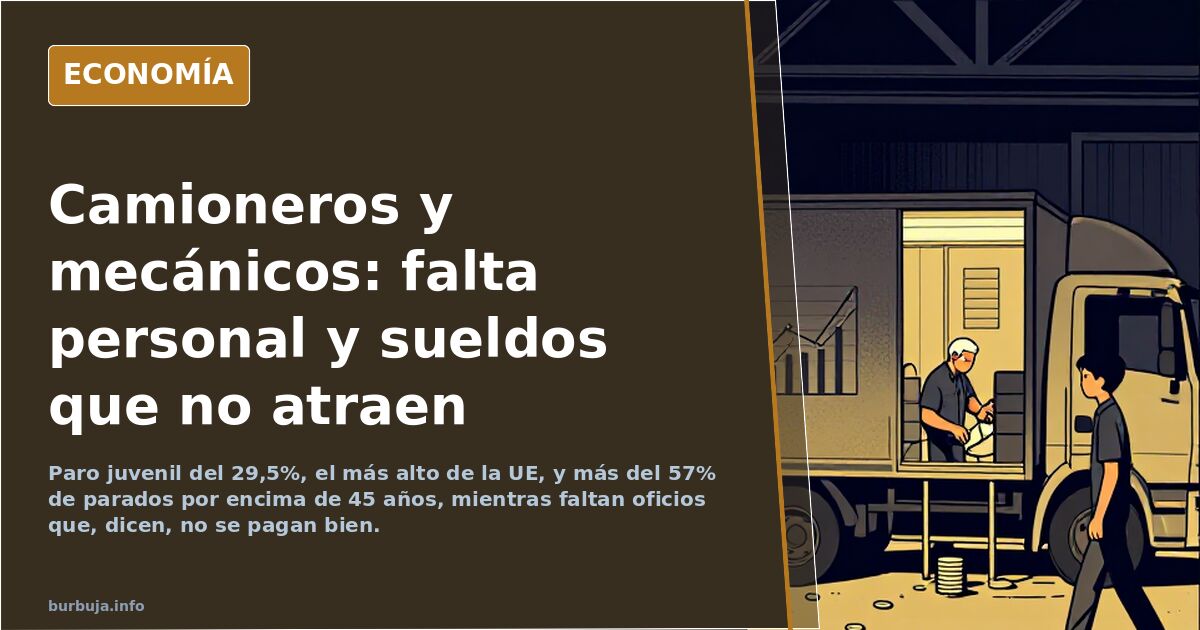
Spain Needs Trades It Doesn't Train and Pays as If They Were Abundant
There's no shortage of job openings. What's missing are people willing to accept €1,300 net for a job combining electronics, hydraulics, welding, diagnostics, and bodywork in a workshop, or €2,200 net for full weeks driving a trailer across Europe. This contradiction—that there's work but never the right kind—is framed against the stark figures of 2023: an employment rate below 51%, youth unemployment at 29.5% (the highest in the European Union), and over 57% of the unemployed aged over 45.
The Trades That Are Lacking and What They Pay
Mechanics, electricians, carpenters, plumbers. The list of supposedly deserted professions is long and repetitive. The problem, according to those who have surveyed the market, is that it demands a lot and pays little. A workshop won't hire anyone without experience; if they do, they offer an apprentice contract for €600 per month for a 40-hour week. And those already in the sector summarize the paradox: the job requires mastering mechanics, electronics, hydraulics, welding, diagnostics, and bodywork... to earn what a shelf stocker makes.
Meanwhile, no one is training. Vocational training takes two years—with the cost of being without income during that time—and upon completion, you face the closed door of requiring prior experience. There is work. What there isn't is anyone willing to pay for it as if it were a skilled trade.
The Truck Driver: €2,500 for National Routes, €2,200 for International
This is the only trade that the job seeker in this story eventually covers. Waiter, cook, ride-sharing driver, delivery person, packer, telemarketer, salesperson, cleaner... months of listings and closed doors. The job appears behind the wheel: international routes with a partner, one day in France, the next in Holland, then Germany. €2,200 net. And a phrase that says it all: 'When I return to Spain, I get depressed.'
Another driver, this one on national routes, earns €2,500 net and defends it, stating it's above average for an unskilled job. What he doesn't dispute is that the hours make it poorly paid. His rule is different: tachograph inviolable, mandatory card, holidays paid in advance. And, according to his explanation, the tachograph isn't tampered with: the car's speedometer lies downwards, which is why the trucks appear to be going 96 km/h when they are actually doing 90.
Ghost Offers on Job Portals
According to one of the participants, the problem isn't a lack of ads: it's the *kind* of ads. Major job portals are full of fake offers or processes that never close, because their business is selling recruitment. For specific profiles, the real channel remains the oldest: showing up at the door or frequenting places where goods are moved. The advertised scarcity doesn't always match the published vacancy.
The Unemployed Discarded by the System
Over 57% of the unemployed are over 45: the highest percentage recorded. In a market that insists on a labor shortage, this data points to the opposite. There are workers. Many. And they are not being considered. The narrative of a lack of willingness clashes with an obvious truth: 'No one works for passion everywhere, but for money,' as a forum user summarizes. People are paid what someone *wants* to pay, not what they *should*.
Pensions: 25 Years of Calculation and a 0.7% Solidarity Contribution
One guest is missing from the party: retirement. According to a forum user's account, the pension calculation base has been extended from the last 8 years to 25, with an intermediate stop at 15. And for those who still expect to collect it, a solidarity contribution of 0.7% is applied, which, they argue, does not count towards the benefit calculation later. Fewer reference years, a higher retirement age, and an extra tax. The math just doesn't add up.
In any given town, the answer is more pragmatic. A business owner closes their shop, transforms the space into a bar-shop, fires two permanent seasonal workers, stops accepting card payments, and saves over €4,000 in salaries and social security. They will invoice less. But they will make ends meet. They too.
With these ingredients, the scenario doesn't allow for many surprises. If salaries remain below the cost of living and the system demands more years of work without improving the offer, the trades advertised as scarce will continue to be the worst paid. Some of those looking for work are already planning to move abroad. The question isn't how many will endure: it's how many will do the same before someone notices.
There's no shortage of job openings. What's missing are people willing to accept €1,300 net for a job combining electronics, hydraulics, welding, diagnostics, and bodywork in a workshop, or €2,200 net for full weeks driving a trailer across Europe. This contradiction—that there's work but never the right kind—is framed against the stark figures of 2023: an employment rate below 51%, youth unemployment at 29.5% (the highest in the European Union), and over 57% of the unemployed aged over 45.
The Trades That Are Lacking and What They Pay
Mechanics, electricians, carpenters, plumbers. The list of supposedly deserted professions is long and repetitive. The problem, according to those who have surveyed the market, is that it demands a lot and pays little. A workshop won't hire anyone without experience; if they do, they offer an apprentice contract for €600 per month for a 40-hour week. And those already in the sector summarize the paradox: the job requires mastering mechanics, electronics, hydraulics, welding, diagnostics, and bodywork... to earn what a shelf stocker makes.
Meanwhile, no one is training. Vocational training takes two years—with the cost of being without income during that time—and upon completion, you face the closed door of requiring prior experience. There is work. What there isn't is anyone willing to pay for it as if it were a skilled trade.
The Truck Driver: €2,500 for National Routes, €2,200 for International
This is the only trade that the job seeker in this story eventually covers. Waiter, cook, ride-sharing driver, delivery person, packer, telemarketer, salesperson, cleaner... months of listings and closed doors. The job appears behind the wheel: international routes with a partner, one day in France, the next in Holland, then Germany. €2,200 net. And a phrase that says it all: 'When I return to Spain, I get depressed.'
Another driver, this one on national routes, earns €2,500 net and defends it, stating it's above average for an unskilled job. What he doesn't dispute is that the hours make it poorly paid. His rule is different: tachograph inviolable, mandatory card, holidays paid in advance. And, according to his explanation, the tachograph isn't tampered with: the car's speedometer lies downwards, which is why the trucks appear to be going 96 km/h when they are actually doing 90.
Ghost Offers on Job Portals
According to one of the participants, the problem isn't a lack of ads: it's the *kind* of ads. Major job portals are full of fake offers or processes that never close, because their business is selling recruitment. For specific profiles, the real channel remains the oldest: showing up at the door or frequenting places where goods are moved. The advertised scarcity doesn't always match the published vacancy.
The Unemployed Discarded by the System
Over 57% of the unemployed are over 45: the highest percentage recorded. In a market that insists on a labor shortage, this data points to the opposite. There are workers. Many. And they are not being considered. The narrative of a lack of willingness clashes with an obvious truth: 'No one works for passion everywhere, but for money,' as a forum user summarizes. People are paid what someone *wants* to pay, not what they *should*.
Pensions: 25 Years of Calculation and a 0.7% Solidarity Contribution
One guest is missing from the party: retirement. According to a forum user's account, the pension calculation base has been extended from the last 8 years to 25, with an intermediate stop at 15. And for those who still expect to collect it, a solidarity contribution of 0.7% is applied, which, they argue, does not count towards the benefit calculation later. Fewer reference years, a higher retirement age, and an extra tax. The math just doesn't add up.
In any given town, the answer is more pragmatic. A business owner closes their shop, transforms the space into a bar-shop, fires two permanent seasonal workers, stops accepting card payments, and saves over €4,000 in salaries and social security. They will invoice less. But they will make ends meet. They too.
With these ingredients, the scenario doesn't allow for many surprises. If salaries remain below the cost of living and the system demands more years of work without improving the offer, the trades advertised as scarce will continue to be the worst paid. Some of those looking for work are already planning to move abroad. The question isn't how many will endure: it's how many will do the same before someone notices.
Summary of a discussion on Burbuja.info - Foro de economía, actualidad y política., translated from Spanish and reviewed before publication. Read the full discussion (675 replies).
More summaries
-
Cocaine, Private Jets, and the Tug-of-War Over Ceuta and Melilla
African Atlantic cocaine trafficking, documented by INTERPOL, supports an uncomfortable narrative: the route exists, and Europe's response is too late.
-
Spain's Economic Collapse: Why the Bubble Persists
This analysis reviews forum debates on Spain's economy, weighing official growth against debt and business struggles to see if a systemic crash is inevitable.
-
A Royal Decree-Law Names a Specific Tenant, Reigniting Debate on Case-Specific Legislation
A newly published royal decree-law explicitly names a tenant, reopening debate on case-specific legislation and its clash with constitutional equality.
-
Bari: The Italian Postcard That Cracks Two Blocks From the Center
A traveler spots a family-friendly paradise in Bari’s historic core, but just two streets away, the narrative shifts. Italy vs. Spain compared.
-
Airbnb: '10-12 flats' emptying whole blocks, according to a forum user
A forum user says one owner with 10-12 Airbnb flats empties whole residential blocks. In Lugo or Teruel, prices also rise without mass tourism.
-
Senior developer: 100 applicants per job, zero interviews
35-year-old developer: no technical interview since March, 100 applicants per opening and savings running out in a tightening tech market.