
She holds 99% of power in Spanish homes, forum joke claims
The claim that women hold 99% of domestic power is a forum meme, not survey data, with the remaining 1% reserved for when she is absent.
English · Original discussion in Spanish · Published
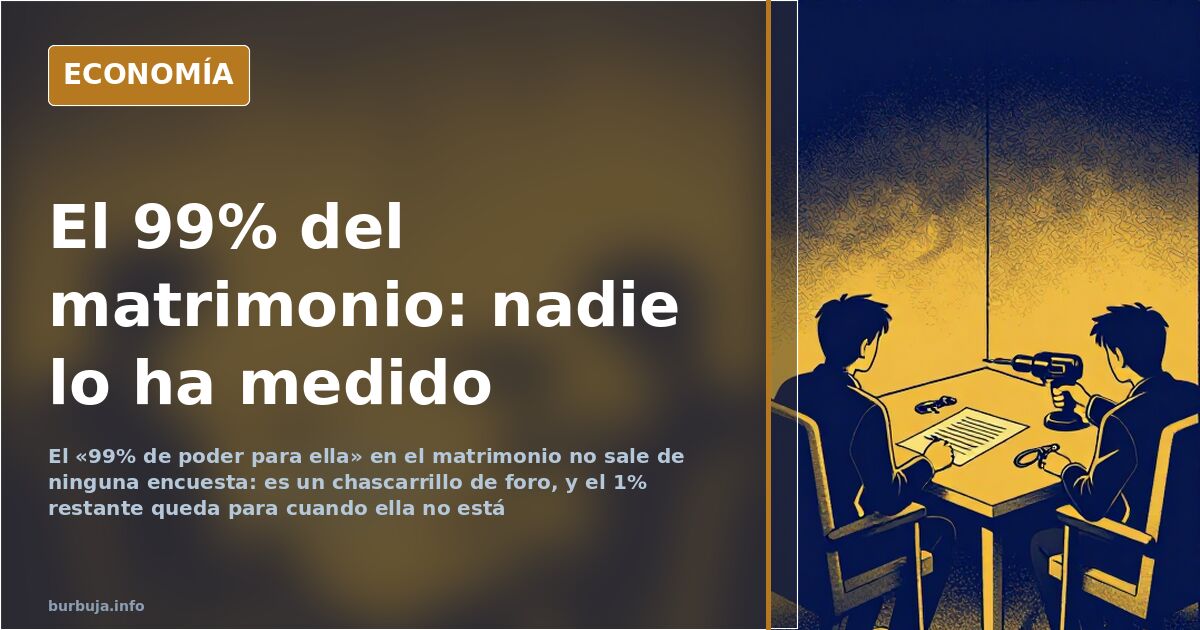
Power in marriage: who decides and who signs
Who runs the household is a question that stems from no survey yet has a popular answer: her. The repeated figure, caught between joke and accusation, is 99%, reserving the remaining 1% for moments when the vvife is not present. Where this asymmetry comes from, whether it is real, and who pays the bill is what is attempted to be explained afterwards, almost always based on anecdotes.
Who rules at home, her or him?
The most cynical description takes two sentences: the man makes all important decisions and the woman makes all others, because there is never anything important. It is repeated half-seriously, half-jokingly, settling the matter without providing a single piece of data. Another version even abandons the binary struggle: 50% power for the vvife and 50% for the mother-in-law. And a third, more resigned, argues that many are fine with how things are, as they say themselves upon leaving work: "I'm going home, because the boss gets angry."
What can be verified is the logic of the contract. Signing a marriage, it is argued, implies accepting broad and vague obligations while it lasts and an asset distribution that can be asymmetric when it ends. From this comes the thesis that it is a pact where one party wins and the other loses. It is a definitive statement, very repeated, and with very little statistics behind it: no one shows the distribution of rulings, pensions, or settlements that would support it.
Who pays the divorce bill?
The finer economic development points to domestic labor. If twenty years of washing dishes deserve remuneration, the same accounting requires valuing the twenty years of rent, food, clothing, and current expenses paid by the other. The complete breakdown, item by item, has its complexities and puts both sides in a bind: either marriage is understood as a partnership where each contribution is measured, or it is an institution where unpaid labor does not count until the judge appears.
On this basis, the underlying complaint is built, that of a legal framework that would treat spouses unequally and leave the woman better equipped after a breakup. As a counterexample, launched without much development, the case of female couples is cited: there, that distribution does not occur.
Who does repairs and who cleans the bathroom?
Here the conversation becomes concrete, which is when it contributes something. One side argues that maintenance tasks — welding a pergola, stripping a railing, solving voltage between neutral and ground — systematically fall on the man and that, moreover, they are sold to him as a hobby. The gift example condenses this: a drill as a gift because he likes building things, and a mop as an insult if the recipient is the other.
The objection is no worse: that thousands of channels exist about home repairs does not make internet a census. Cleaning the bathtub is also not a hobby, it is an obligation, and no one records it. The discussion does not resolve how many hours each partner assumes because there are no hours on the table; there are videos and anecdotes, which is something else.
She chooses the car and it's always an SUV
Even family consumption enters the portrait. The complaint is that buying a car has ceased to be male territory: now she decides and the result is a SUV, to the point of filling streets with that type of vehicle. The exception cited — a sedan bought with own money, without consulting, with a foreign vvife who thought the car looked like 'crushed poop' — confirms the rule via joke.
"So what?": the counterargument no one answers
Against all the above, there is a simple response: so what? If today she decides more in most couples, where is the problem? The question forces looking back. For generations, men ruled and no one was held accountable for it. And the past some long for was no paradise: infant mortality, poverty, and an infection from a rusty nail could end anyone before thirty. We have not left any Eden; we have left a world with fewer expectations for almost everyone.
That is the strongest point of the entire exchange and, curiously, the least answered. Because the real disagreement is not who chooses the sofa, but what is done with an asymmetry when the cost of leaving the relationship is different for each party.
Mental health and fatherhood: data thrown out without source
In one section, the hardest statistic appears: that 70% of suicides correspond to men. It is used as proof of male vulnerability and as a reply to the idea that asymmetry always harms the same side. It is convenient to separate planes: a mortality rate is not explained with anecdotes about who rules in the kitchen, and using it as a dinner-table argument is the opposite of analysis.
The other front peine and not closed is that of fatherhood. It is argued that a woman can decide to become a mother alone through artificial insemination while the man does not have an equivalent path that does not pass through marital commitment. The comparison is controversial, there are no figures, and it is far from settled: nor is there consensus on who bears the cost of single-parent families.
With these materials, the question left in the air is not whether he or she rules. It is whether an institution that distributes obligations throughout a lifetime and rights at its end can continue to be sold as a contract between equals. No one has put the survey on the table to prove it and, until it appears, the rest will remain strongly held opinion.
Summary of a discussion on Burbuja.info - Foro de economía, actualidad y política., translated from Spanish and reviewed before publication. Read the full discussion (205 replies).
More summaries
-
Nearly 100,000 Annual Separations: Spanish Marriage Crisis
Nearly 100,000 annual breakups in Spain, compared to 150,000-170,000 weddings. Madrid data shows over 70 divorces per 100 marriages.
-
Aznar reignites immigration debate over who fills rejected jobs
Who will do the work Spaniards reject? Aznar revives the debate with data: 13,500 Spaniards head to French harvests while IMV costs €500 million.
-
Divorce epidemic hits Spain: Is marriage the main cause?
Spain's divorce rate keeps rising, with women filing most breakups. We analyze the causes and economic consequences of this trend.
-
Global bank stocks fall 15-30% while indexes hit record highs
Bank stocks are down between 15% and 30% while major indexes keep trading near record highs, according to a post in the thread. Japanese bonds, the GCF Repo market and Ormuz…
-
Users demand removal of AI-generated auto summaries
Members of a popular online community are rebelling against AI summaries that take up more space than the original content and have removed key features.
-
Torrelodones: one dead in gang fight exposing social failure in Spain
A young Moroccan man was shot dead in Torrelodones, Spain, during a gang fight. Three arrested. The incident highlights the failure of integration in affluent areas.