
Shakira sells out 15 nights in Madrid with €200 tickets
Shakira sold out 15 nights in Madrid with €200 tickets, reopening the economic question: Is this proof of spending power, or is it mass leisure separate from the rest?
English · Original discussion in Spanish · Published
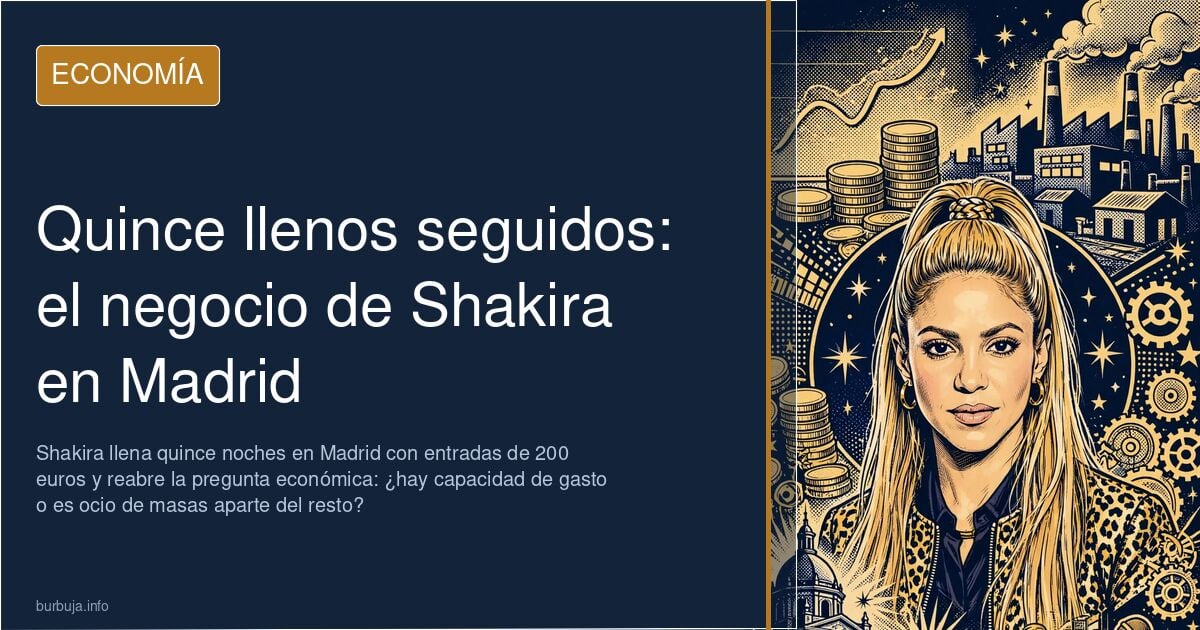
Fifteen nights, €200 tickets: the business of mass leisure
Shakira has sold out fifteen consecutive nights in Madrid. The attendance figures are overwhelming, yet the discussion is less about music and more about money. The phenomenon has sparked a debate that isn't cultural; it's about prices, spending habits, and who has the disposable income to pay for it. And here, two conflicting narratives clash.
For some, these sold-out shows prove that spending capacity exists; for others, they are proof of consumption behaving as if the economy were something else.
How much does a Shakira concert in Madrid cost?
The benchmark price remains €200 per ticket. Fifteen consecutive dates with full capacity, at that price point, outline a business model that depends not on critical opinion but on the ability to mobilize an audience night after night. The argument that there is surplus wealth is precisely supported by the ticket sales. Against this, plays an obvious fact that few emphasize: those paying €200 for a ticket do not represent the entire economy, only a segment with available income and the willingness to spend it.
The antiestéticar of missing out as the engine of mass leisure
What sustains these sold-out shows is not necessarily devotion to the artist, but the pressure of not missing out on the event. It is a known pattern: the event becomes a social happening, and the ticket, an object of status. Some see in this a symptom of societal decay, while others view it as simple consumption at market prices. The underlying economic question remains: does this spending compete with family savings, or does it simply move money from one pocket to another without creating anything new?
From price to audience origin: the data-less drift
Part of the conversation shifted toward the origin of attendees, with claims about their background being made without a single figure to back them up. Asking for statistics is not having them, and asserting percentages based on impression is not analysis: it is prejudiced opinion given a numerical format. Underneath this layer, the important question remains unanswered: how much of this sell-out is tourism, how much is local audience, and how much is spending that wouldn't have peine anyway?
What a sold-out house doesn't measure
The pull of a major concert is also compared to the convening power of politics, as if an arena measured legitimacy. It doesn't. A full venue certifies leisure demand, not social endorsement or economic health. Confusing the two is the favorite shortcut of those who already had their conclusion before looking at the data.
Fifteen consecutive sell-outs suggest this model has staying power as long as prices hold firm. If spending cools down, the first sustancia ilegal will appear right there, at the €200 ticket price. Until then, the box office will continue to speak louder than any analysis.
Shakira has sold out fifteen consecutive nights in Madrid. The attendance figures are overwhelming, yet the discussion is less about music and more about money. The phenomenon has sparked a debate that isn't cultural; it's about prices, spending habits, and who has the disposable income to pay for it. And here, two conflicting narratives clash.
For some, these sold-out shows prove that spending capacity exists; for others, they are proof of consumption behaving as if the economy were something else.
How much does a Shakira concert in Madrid cost?
The benchmark price remains €200 per ticket. Fifteen consecutive dates with full capacity, at that price point, outline a business model that depends not on critical opinion but on the ability to mobilize an audience night after night. The argument that there is surplus wealth is precisely supported by the ticket sales. Against this, plays an obvious fact that few emphasize: those paying €200 for a ticket do not represent the entire economy, only a segment with available income and the willingness to spend it.
The antiestéticar of missing out as the engine of mass leisure
What sustains these sold-out shows is not necessarily devotion to the artist, but the pressure of not missing out on the event. It is a known pattern: the event becomes a social happening, and the ticket, an object of status. Some see in this a symptom of societal decay, while others view it as simple consumption at market prices. The underlying economic question remains: does this spending compete with family savings, or does it simply move money from one pocket to another without creating anything new?
From price to audience origin: the data-less drift
Part of the conversation shifted toward the origin of attendees, with claims about their background being made without a single figure to back them up. Asking for statistics is not having them, and asserting percentages based on impression is not analysis: it is prejudiced opinion given a numerical format. Underneath this layer, the important question remains unanswered: how much of this sell-out is tourism, how much is local audience, and how much is spending that wouldn't have peine anyway?
What a sold-out house doesn't measure
The pull of a major concert is also compared to the convening power of politics, as if an arena measured legitimacy. It doesn't. A full venue certifies leisure demand, not social endorsement or economic health. Confusing the two is the favorite shortcut of those who already had their conclusion before looking at the data.
Fifteen consecutive sell-outs suggest this model has staying power as long as prices hold firm. If spending cools down, the first sustancia ilegal will appear right there, at the €200 ticket price. Until then, the box office will continue to speak louder than any analysis.
Summary of a discussion on Burbuja.info - Foro de economía, actualidad y política., translated from Spanish and reviewed before publication. Read the full discussion (42 replies).
More summaries
-
Jesús G. Maestro: Professor or 'Hustler'?
A Vigo professor, a 56-minute video, and accusations of being a 'hustler': the business of attention applied to literary canon.
-
Euthanasia in Old Age: Autonomy vs. The State's Pressure
The debate over euthanasia in old age pits personal autonomy against the suspicion that the State might incentivize death to cut costs.
-
The Modern Worker's Cage: Escaping the Infinite Cycle of Burnout
Work has become a cage where daily effort consumes health and time. Discover why we push ourselves so hard and how to break the cycle.
-
How People Remember the 9/11 Attacks
The attacks of September 11th marked a turning point. Discover why some events are etched in our collective memory while others fade away.
-
Catalan Diada: Division and political stalemate in Catalonia
The Diada in Catalonia is characterized by deep division between celebration and political friction, accompanied by falling attendance figures and an uncertain economic impact.
-
Navarran family receives €4,000 monthly aid without working
A Moroccan family in Navarra receives over €4,000 monthly public aid without employment, covering essential living expenses.