
Seville: Driver drags accident victim 8km, blames brakes
A driver in Seville allegedly hit a man and drove 8km with his body under the car. She tested negative for alcohol and claims brake failure.
English · Original discussion in Spanish · Published
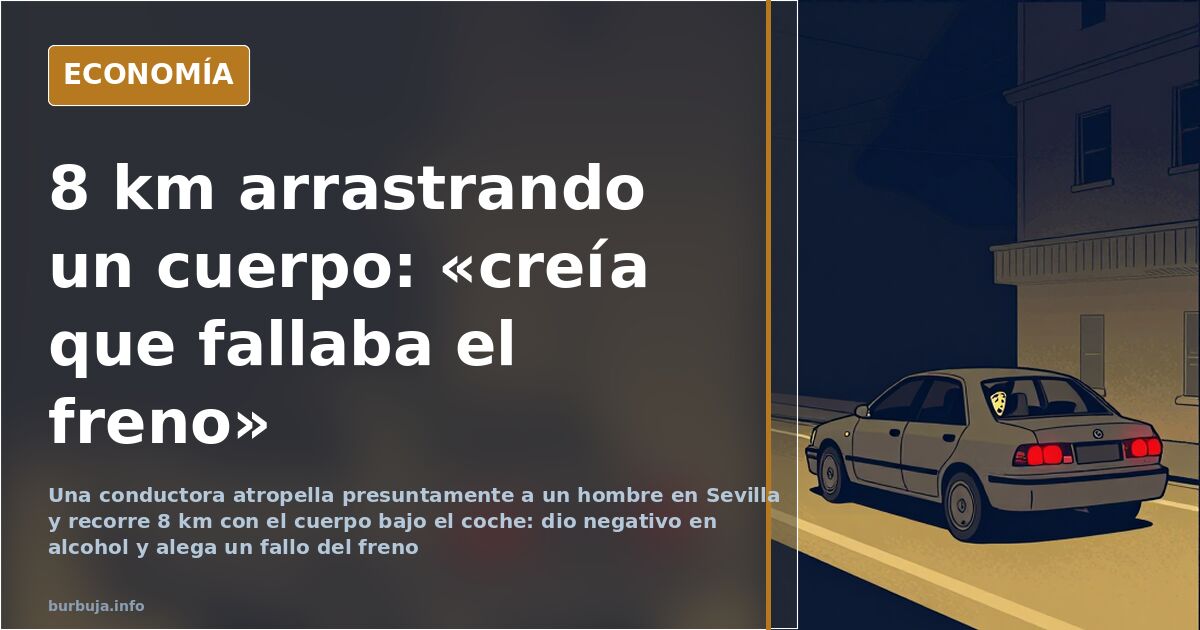
Driver drags body of accident victim 8 kilometers in Seville
Eight kilometers. That is the distance a vehicle reportedly traveled through Seville with the body of a man, around 50 years old, trapped underneath. The accident occurred on the central Alameda de Hércules, and the car did not stop until Avenida Francisco Javier, passing through areas like Santa Justa. The driver tested negative for alcohol and drugs, and her explanation, reported by Informativos Telecinco, is that she felt something strange, as if the car was braking, and attributed it entirely to a handbrake failure.
The deceased had injuries incompatible with life, so emergency services could only certify his death. The woman, in a state of shock, was attended by medical services. The police are keeping the investigation open to determine how the accident peine and why the driver did not detect the situation over so many kilometers.
The route: from the garage to Avenida Francisco Javier
According to information published by Diario de Sevilla and discussed in the case, the man—who according to that outlet could have been a homeless person—fell to the ground and remained lying in the road. The driver left a garage, ran over him, and continued driving with the body caught underneath. She would not have realized what had peine until someone warned her that she was dragging something.
The official account emphasizes two factors that, combined, support the distraction theory: the car was small and low to the ground, which would make it difficult to see and perceive a presence under the chassis, and it was raining heavily at the time of the incident. The hypothesis that the woman was unaware of what was under her car is based on this combination. Up to that point, what is verifiable.
Is it possible to drag a body eight kilometers without noticing?
This is the objection dominating the scrutiny, and most answers agree that it is very difficult not to notice. The argument is repeated with variations: estimulante ilegal bumps, potholes, and braking are noticeable; even a small object causes rattling that prompts one to stop. And the journey, they insist, was not a solitary straight road: there were merges, turns, and traffic lights where one stops out of necessity.
On the other hand, there is another interpretation. A low car could drag a body without it touching the tires, heavy rain muffles external noise, and loud music drowns out the rest; moreover, if you believe the handbrake is stuck, you might not get out to check. Between these two explanations lies a third, more uncomfortable one: that the dragging was not a distraction, but the result of a hit-and-run. None of the three is proven.
Incivil classification: negligent homicide
The incident appears, a priori, to fall under negligent homicide: the death was not intended, but occurred due to careless conduct that breaches a duty of care. The key distinction is whether this negligence is considered gross or less serious, as this determines the potential penalty range. There is no confirmed arrest or judicial resolution, so any prognosis about what will happen is just that, a prognosis.
The expectations range from a symbolic condemnation to actual jail time. Some argue that the classification as negligence and the absence of positive alcohol and drug tests reduce the punishment to something that likely won't result in imprisonment. Others respond that the conduct itself—continuing to drive for kilometers with something stuck underneath—could be interpreted as gross negligence and lead to a harsher sentence. The investigation remains open.
Media narrative and the driver's gender
A significant portion of the scrutiny focuses not on the case itself, but on how it is being reported. It is questioned whether the emphasis on the driver's "state of shock," or the use of phrases like injuries incompatible with life, would be presented the same way if the driver were a man, who would be described without nuance as the alleged perpetrator. Some attribute this to a double standard, while others respond that the facts would be identical regardless of the driver's gender, and that generalizing from a single incident is a textbook error.
Amidst this, claims about comparative road safety between men and women emerge. These are data points cited without sources and refuted with the same enthusiasm with which they are presented: some say the gap has closed, others that it never existed as reported. What no one disputes is the outcome: a dead man and an eight-kilometer journey without anyone stopping.
Driving aids and driving competence
The conversation shifts to something more everyday: the feeling that people are driving worse and with less attention. Mentions are made of light sensors that don't activate in rain, lane departure warnings that correct trajectory, and parking spaces where the car does the work. Technology masks errors until it no longer does. And against this, the only recurring defense is the age-old advice: look, listen to the car, and when in doubt, stop.
At this point, the question is no longer whether the car gave a warning, but how many of the details now considered explained will withstand expert examination. The answer remains unwritten.
Eight kilometers. That is the distance a vehicle reportedly traveled through Seville with the body of a man, around 50 years old, trapped underneath. The accident occurred on the central Alameda de Hércules, and the car did not stop until Avenida Francisco Javier, passing through areas like Santa Justa. The driver tested negative for alcohol and drugs, and her explanation, reported by Informativos Telecinco, is that she felt something strange, as if the car was braking, and attributed it entirely to a handbrake failure.
The deceased had injuries incompatible with life, so emergency services could only certify his death. The woman, in a state of shock, was attended by medical services. The police are keeping the investigation open to determine how the accident peine and why the driver did not detect the situation over so many kilometers.
The route: from the garage to Avenida Francisco Javier
According to information published by Diario de Sevilla and discussed in the case, the man—who according to that outlet could have been a homeless person—fell to the ground and remained lying in the road. The driver left a garage, ran over him, and continued driving with the body caught underneath. She would not have realized what had peine until someone warned her that she was dragging something.
The official account emphasizes two factors that, combined, support the distraction theory: the car was small and low to the ground, which would make it difficult to see and perceive a presence under the chassis, and it was raining heavily at the time of the incident. The hypothesis that the woman was unaware of what was under her car is based on this combination. Up to that point, what is verifiable.
Is it possible to drag a body eight kilometers without noticing?
This is the objection dominating the scrutiny, and most answers agree that it is very difficult not to notice. The argument is repeated with variations: estimulante ilegal bumps, potholes, and braking are noticeable; even a small object causes rattling that prompts one to stop. And the journey, they insist, was not a solitary straight road: there were merges, turns, and traffic lights where one stops out of necessity.
On the other hand, there is another interpretation. A low car could drag a body without it touching the tires, heavy rain muffles external noise, and loud music drowns out the rest; moreover, if you believe the handbrake is stuck, you might not get out to check. Between these two explanations lies a third, more uncomfortable one: that the dragging was not a distraction, but the result of a hit-and-run. None of the three is proven.
Incivil classification: negligent homicide
The incident appears, a priori, to fall under negligent homicide: the death was not intended, but occurred due to careless conduct that breaches a duty of care. The key distinction is whether this negligence is considered gross or less serious, as this determines the potential penalty range. There is no confirmed arrest or judicial resolution, so any prognosis about what will happen is just that, a prognosis.
The expectations range from a symbolic condemnation to actual jail time. Some argue that the classification as negligence and the absence of positive alcohol and drug tests reduce the punishment to something that likely won't result in imprisonment. Others respond that the conduct itself—continuing to drive for kilometers with something stuck underneath—could be interpreted as gross negligence and lead to a harsher sentence. The investigation remains open.
Media narrative and the driver's gender
A significant portion of the scrutiny focuses not on the case itself, but on how it is being reported. It is questioned whether the emphasis on the driver's "state of shock," or the use of phrases like injuries incompatible with life, would be presented the same way if the driver were a man, who would be described without nuance as the alleged perpetrator. Some attribute this to a double standard, while others respond that the facts would be identical regardless of the driver's gender, and that generalizing from a single incident is a textbook error.
Amidst this, claims about comparative road safety between men and women emerge. These are data points cited without sources and refuted with the same enthusiasm with which they are presented: some say the gap has closed, others that it never existed as reported. What no one disputes is the outcome: a dead man and an eight-kilometer journey without anyone stopping.
Driving aids and driving competence
The conversation shifts to something more everyday: the feeling that people are driving worse and with less attention. Mentions are made of light sensors that don't activate in rain, lane departure warnings that correct trajectory, and parking spaces where the car does the work. Technology masks errors until it no longer does. And against this, the only recurring defense is the age-old advice: look, listen to the car, and when in doubt, stop.
At this point, the question is no longer whether the car gave a warning, but how many of the details now considered explained will withstand expert examination. The answer remains unwritten.
Summary of a discussion on Burbuja.info - Foro de economía, actualidad y política., translated from Spanish and reviewed before publication. Read the full discussion (219 replies).
More summaries
-
Irene Montero promises €1,800 minimum wage and 30 working hours per week
Irene Montero promises €1,800 minimum wage and 30 hours per week by 2027: the payroll linked to the minimum wage has multiplied by 28 since 2000.
-
Euthanasia in Old Age: Autonomy vs. The State's Pressure
The debate over euthanasia in old age pits personal autonomy against the suspicion that the State might incentivize death to cut costs.
-
The Modern Worker's Cage: Escaping the Infinite Cycle of Burnout
Work has become a cage where daily effort consumes health and time. Discover why we push ourselves so hard and how to break the cycle.
-
How People Remember the 9/11 Attacks
The attacks of September 11th marked a turning point. Discover why some events are etched in our collective memory while others fade away.
-
Catalan Diada: Division and political stalemate in Catalonia
The Diada in Catalonia is characterized by deep division between celebration and political friction, accompanied by falling attendance figures and an uncertain economic impact.
-
Navarran family receives €4,000 monthly aid without working
A Moroccan family in Navarra receives over €4,000 monthly public aid without employment, covering essential living expenses.