
Severance: from Lumon's mystery to the season 2 fiasco
Severance's first season hooked viewers with an 8.2 on IMDb and its Lumon enigma. The second, released in January 2025, left audiences with the…
English · Original discussion in Spanish · Published
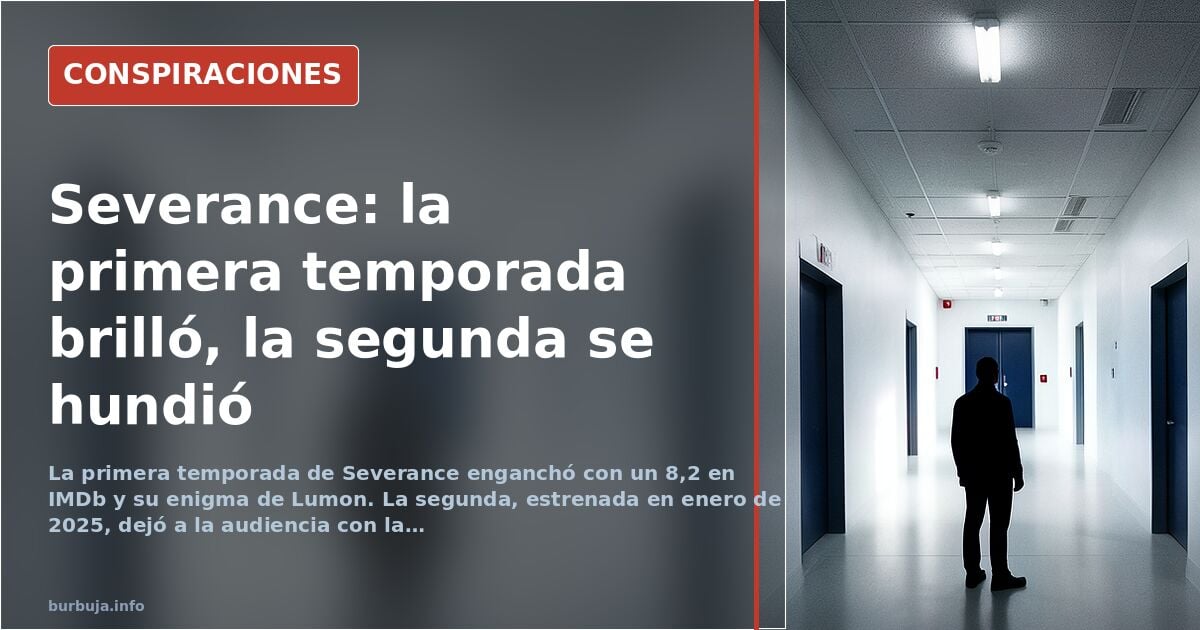
Severance: from Lumon's enigma to the collapse of season two
Nine episodes, two seasons, and a reversal of expectations that sums up the streaming era: a first installment that hooked audiences with its mystery and a second that, in the view of those who stuck with it to the end, squandered the original find. The series, directed by Ben Stiller and Aoife McArdle and written by Mohamad el Masri and Dan Erickson, began in 2022 with a surgical premise: employees of Lumon Industries undergo a procedure that separates their memories between work life and personal life. Mark Scout, played by Adam Scott, leads a team that begins to suspect the true nature of their work.
The starting point was well received. Comparisons with Eternal Sunshine of the Spotless Mind, Open Your Eyes, Cypher, The Prisoner, Dollhouse and a certain Westworld flavor circulated from day one. The show's subreddit filled up with theories and its IMDb score settled at **8.2**, a figure that on the TV scale counts as serious endorsement. Season 2 premiered on **January 17, 2025**.
What Lumon's confinement offers
The official synopsis describes a "bold experiment in work-life balance" that is called into question when Mark finds himself at the center of a mystery that forces him to confront the true nature of his job and of himself. Put in less flattering terms: workplace alienation in a lab coat. Some pointed this out immediately, recalling that the split between the productive self and the private self wasn't invented by fiction, but by one Karl Marx a good many years ago.
The opening of the plot includes scenes that were widely discussed. One of the first questions a protagonist receives when facing her orientation counselor is not where she is or who she is, but whether she is livestock. The counselor's answer —that they didn't create her, that they didn't give her consciousness or do her nails— works as the show's declaration of intent. Another: Mark's boss confesses that her mother was an atheist and that there was good news and bad news about hell. These are details that push viewers to read the show as a parable of compartmentalized consciousness.
The conspiratorial reading of the experiment
The forum where the series was discussed didn't stop at TV criticism. Several commenters read Lumon's procedure as an analogy for the compartmentalization of consciousness attributed to mind-control programs, while others took it into spiritual territory: the idea that the self that enters this world forgets what lies on the other side. The discussion drifted toward whether the audiovisual industry produces transformative content or mere inconsequential entertainment, and toward the suspicion that products designed as vehicles for control messages inevitably end up carrying the opposite message.
That leap from the screen to the system is nothing new. Westworld itself served as an example: there are shows that hint at certain truths, wrapped in multiple demoralizing lies, and then stretch the gum until it becomes an endless loop. The comparison with Lost appeared early on, and with reason: after the island fiasco, trust in the writers took a hit.
The collapse of the second season
Consensus soured with the new episodes. The first season worked like a solid Black Mirror; the second, in the view of the harshest critics, seemed like an attempt to play at being Twin Peaks or to repeat Lost and ended up as an indigestible mush. The accusations are harsh: writers who are no longer around, a bunch of lunatics dropping ALUCINÓGENO ILEGAL with pretensions of doing something cool, viewers itching to throw bottles at the screen. The final scene took its share of the blame, including a mention of a goat.
Not everything was outright rejection. Some praised specific audiovisual finds —a man running for ten minutes through endless white corridors— and others tried to decipher the symbolism of the ending: the numbers the employees sort into boxes would be building the mind of a character, a kind of hive mind based on all of their experiences, read as a plan for the evolution of the founding demiurge's soul. The exegesis exists. The problem is that a series can't survive on exegesis alone.
Viewing habits changed too
The conversation drifted toward the way we watch television. There used to be a week's wait between episodes, ads at the worst possible moment, and the burden of the video game to endure. Today, if playback stalls for three seconds, all seven plagues come pouring in. The trade-off is continuity: before, if you missed an episode, you missed it forever; now you can watch the whole season in two or three sittings without losing the thread.
The problem is when the complete binge reveals there was no thread. The first season of Severance was built on mystery; the second, according to the most repeated verdict, stopped at the attempt. And that's where the analysis gets stuck: if the enigma was the show, revealing it badly is worse than not revealing it at all.
Summary of a discussion on Burbuja.info - Foro de economía, actualidad y política., translated from Spanish and reviewed before publication. Read the full discussion (65 replies).
More summaries
-
Mel Gibson Falsely Accused of Calling for Ellen DeGeneres' Execution
Mel Gibson and Ellen DeGeneres: a disreputable outlet claims the actor sought the death penalty for the presenter over cannibalism, without any evidence.
-
Bill Murray: the riddle nobody can solve
An anonymous thread promised two explosive stories about Bill Murray and a mysterious hipster director. Jazz, sketches and off-kilter synchronicities. They never surfaced.
-
Ashtar Sheran: the intergalactic fleet said to be cooling the Atlantic
A conspiracy theory claims an alien fleet beneath the Atlantic is causing a cooling anomaly, while science attributes it to Greenland's melting ice. Manipulation?
-
Terraces as human energy farms: conspiracy theory or paranoia?
A traveler claims that terraces are human farms for energy extraction. The theory, with no evidence, drifts into quantum synchronicity.
-
Alcohol: the modern opium of the people?
Alcohol consumption as a tool of social control, from teenage indoctrination to the theory that the elites don't drink. A sober analysis.
-
Fomenko and Chronology 2.0: the Old World Order under suspicion
Fomenko and Chronology 2.0 challenge official history: Tartaria, giants, free energy and professor Huang Heqing. Are they lying about the past?