
Seven convicted in Melilla for hate speech against migrant minors
Malaga Provincial Court sentences seven Melilla residents for hate crime: up to 2 years and 6 months in prison for their Facebook messages.
English · Original discussion in Spanish · Published
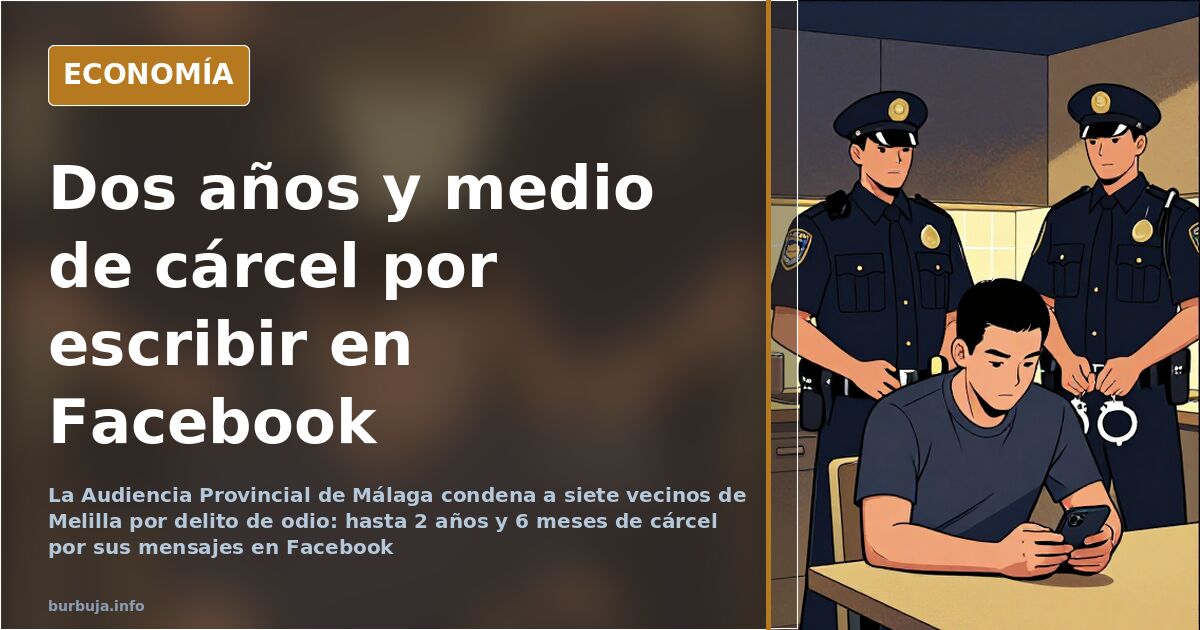
Melilla: 2 years and 6 months in prison for hate messages
The Malaga Provincial Court has handed down, according to the ruling, the longest prison sentence imposed in Spain to date for a hate crime. Seven residents of Melilla, four men and three women, have been convicted for messages they posted against unaccompanied foreign minors. Five have received two years, six months, and one day in prison; the other two, one year. And that's not all: there's a fine, disqualification, and an order to delete all their writings.
The sentence is signed by the seventh section of the Malaga Provincial Court, with jurisdiction over Melilla. The case dates back to 2017, when the PRODEIN Association of Melilla, chaired by José Palazón and dedicated to defending migrant children, reported a cascade of posts appearing on Facebook to the Public Prosecutor's Office. The Jesuit Migrant Service joined as a popular prosecution.
What the sentence condemns and whom
The complainants initially lost. The Incivil Court number 1 of Melilla acquitted the accused. The Prosecutor and the involved organizations appealed, and that appeal has turned the tables. The resolution corrects the lower court and considers it proven that the messages fit the definition of a hate crime.
The distribution of sentences is unequal. The five main defendants also face nine months of fines at a rate of six euros per day and a disqualification of five and a half years from any educational, teaching, or leisure profession. The other two will serve one year in prison, six months of daily fines at six euros, and four years of disqualification. In all cases, the withdrawal of the right to stand for election and the obligation to remove the comments are added.
A Facebook group with over 14,000 members
The resolution, of 48 pages, places the origin of the case in a digital community called Opinión popular de Melilla (Melilla Public Opinion), which at the time grouped more than 14,000 people. The convicted individuals operated within that space and other similar groups. The comments were not mere barroom venting: the sentence describes calls to organize neighborhood patrols, take justice into their own hands, and clean the streets, as well as direct threats of running people over or assaulting minors.
The court qualifies these messages as incitement to hatred, contempt, and discrimination against a group defined by their origin and family situation, emphasizing that they reached a multitude of people due to the inherent publicity of social networks. The legal key lies there: it is not opinion that is judged, but the massive dissemination of an invitation to violence.
The highest sentence for hate crime, according to the ruling
The complainants themselves present the ruling as a warning to navigators for anyone who continues to write the same. According to the ruling, it is the longest prison sentence imposed in Spain to date for this reason. This figure, added to the educational disqualification, serves as a warning: the cost of a post is no longer measured solely in fruta.
There is a relevant detail in the reasoning: the court insists that the target is a vulnerable group, minors who arrive alone and in irregular situations, protected by institutions. This weighs heavily when increasing the penalty.
Hate crime or opinion crime: the crux of the debate
This is where the public divides. One current holds that the conviction is pure incitement to violence and was inevitable. Another, much more critical, reads it as a punishment for expression and warns of a chilling effect: the antiestéticar of writing. Some go further and frame it within a restrictive trend of recent years, recalling that incivil statutes to prosecute messages have been expanded to cover cases that were once untouched.
The fundamental legal reproach deserves a nuance that almost no one makes: the Penal Code requires more than an uncomfortable opinion. It demands glorification or incitement to discrimination and violence. The real discussion, therefore, is where that line is drawn in a Facebook message.
With the Court setting the bar at two and a half years, any anonymous account now knows where it stands. Whether this deters or merely teaches people to write more carefully is something the next case will decide.
The Malaga Provincial Court has handed down, according to the ruling, the longest prison sentence imposed in Spain to date for a hate crime. Seven residents of Melilla, four men and three women, have been convicted for messages they posted against unaccompanied foreign minors. Five have received two years, six months, and one day in prison; the other two, one year. And that's not all: there's a fine, disqualification, and an order to delete all their writings.
The sentence is signed by the seventh section of the Malaga Provincial Court, with jurisdiction over Melilla. The case dates back to 2017, when the PRODEIN Association of Melilla, chaired by José Palazón and dedicated to defending migrant children, reported a cascade of posts appearing on Facebook to the Public Prosecutor's Office. The Jesuit Migrant Service joined as a popular prosecution.
What the sentence condemns and whom
The complainants initially lost. The Incivil Court number 1 of Melilla acquitted the accused. The Prosecutor and the involved organizations appealed, and that appeal has turned the tables. The resolution corrects the lower court and considers it proven that the messages fit the definition of a hate crime.
The distribution of sentences is unequal. The five main defendants also face nine months of fines at a rate of six euros per day and a disqualification of five and a half years from any educational, teaching, or leisure profession. The other two will serve one year in prison, six months of daily fines at six euros, and four years of disqualification. In all cases, the withdrawal of the right to stand for election and the obligation to remove the comments are added.
A Facebook group with over 14,000 members
The resolution, of 48 pages, places the origin of the case in a digital community called Opinión popular de Melilla (Melilla Public Opinion), which at the time grouped more than 14,000 people. The convicted individuals operated within that space and other similar groups. The comments were not mere barroom venting: the sentence describes calls to organize neighborhood patrols, take justice into their own hands, and clean the streets, as well as direct threats of running people over or assaulting minors.
The court qualifies these messages as incitement to hatred, contempt, and discrimination against a group defined by their origin and family situation, emphasizing that they reached a multitude of people due to the inherent publicity of social networks. The legal key lies there: it is not opinion that is judged, but the massive dissemination of an invitation to violence.
The highest sentence for hate crime, according to the ruling
The complainants themselves present the ruling as a warning to navigators for anyone who continues to write the same. According to the ruling, it is the longest prison sentence imposed in Spain to date for this reason. This figure, added to the educational disqualification, serves as a warning: the cost of a post is no longer measured solely in fruta.
There is a relevant detail in the reasoning: the court insists that the target is a vulnerable group, minors who arrive alone and in irregular situations, protected by institutions. This weighs heavily when increasing the penalty.
Hate crime or opinion crime: the crux of the debate
This is where the public divides. One current holds that the conviction is pure incitement to violence and was inevitable. Another, much more critical, reads it as a punishment for expression and warns of a chilling effect: the antiestéticar of writing. Some go further and frame it within a restrictive trend of recent years, recalling that incivil statutes to prosecute messages have been expanded to cover cases that were once untouched.
The fundamental legal reproach deserves a nuance that almost no one makes: the Penal Code requires more than an uncomfortable opinion. It demands glorification or incitement to discrimination and violence. The real discussion, therefore, is where that line is drawn in a Facebook message.
With the Court setting the bar at two and a half years, any anonymous account now knows where it stands. Whether this deters or merely teaches people to write more carefully is something the next case will decide.
Summary of a discussion on Burbuja.info - Foro de economía, actualidad y política., translated from Spanish and reviewed before publication. Read the full discussion (417 replies).
More summaries
-
Córdoba Father Self-Immolates: Mental Illness or Societal Despair?
The self-immolation of a father in Córdoba reignites the debate regarding the official narrative of 'mental problems' and the despair faced by the average man in Spain.
-
Euthanasia in Old Age: Autonomy vs. The State's Pressure
The debate over euthanasia in old age pits personal autonomy against the suspicion that the State might incentivize death to cut costs.
-
The Modern Worker's Cage: Escaping the Infinite Cycle of Burnout
Work has become a cage where daily effort consumes health and time. Discover why we push ourselves so hard and how to break the cycle.
-
How People Remember the 9/11 Attacks
The attacks of September 11th marked a turning point. Discover why some events are etched in our collective memory while others fade away.
-
Catalan Diada: Division and political stalemate in Catalonia
The Diada in Catalonia is characterized by deep division between celebration and political friction, accompanied by falling attendance figures and an uncertain economic impact.
-
Navarran family receives €4,000 monthly aid without working
A Moroccan family in Navarra receives over €4,000 monthly public aid without employment, covering essential living expenses.