
SEUR’s Minimalist Christmas Basket: Water, Cake, and Cured Meat
A viral video reveals SEUR’s Christmas basket contains only water, a cake, and meat slices, sparking debate over employee treatment.
English · Original discussion in Spanish · Published
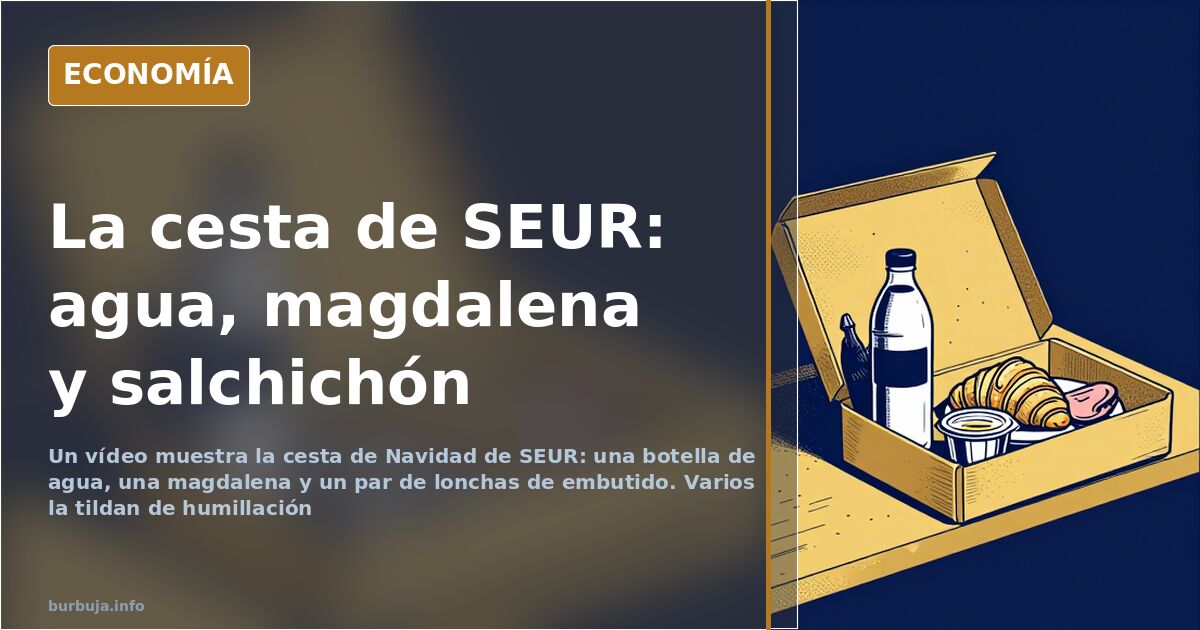
Water, cake, and three slices: SEUR’s Christmas basket
A bottle of water, a cake, and two slices of cured meat. That is all that can be seen inside the cardboard box a worker opens in a video circulating these days, presented as SEUR’s Christmas basket for its staff. The man’s expression while pulling out the items, a mix of bewilderment and forced smile, has done the rest: the matter has sparked a long thread of comments filled with indignation, humor, and comparisons to what everyone else receives at their company.
Before forming an opinion, it is important to establish the facts. There is a video, a small box, and contents that do not even amount to a full breakfast. The question hovering over everything else is simple: Is this a Christmas basket or a poorly understood office treat?
What was in SEUR’s basket?
The identifiable elements are three: a bottle of Bezoya mineral water, a packaged cake, and what several descriptions estimate as two slices of chorizo or salami. No turron, no wine, nothing to save for the holidays. Some call it a "survival basket."
The water is not a minor detail. Bezoya is a brand known for its low dry residue—28 mg per liter, according to the water comparison reproduced in the responses—and is recommended for children's diets or those who need to monitor sodium. The bottle is good. A good bottle is still just a bottle. Each piece stands on its own; together, they do not support any narrative.
Was it delivered only to external staff?
One circulating version suggests this is not the basket for the core staff, but the one reserved for external or subcontracted workers. There is no official confirmation of this distinction, and the video does not clarify it. The nuance, however, changes the framework: if the box is the year-end bonus for external delivery personnel, the disdain has a different scale than if it applies to office staff.
Some argue that an external worker is "lucky to get something." And others respond that this reasoning is precisely what degrades working conditions, as it turns the absence of a right into a favor.
How much does that basket cost, and how much does a real one cost
The estimates circulating place the video’s content below 5 euros. And place around 20 euros the baskets seen walking down the street in December: three turrons, cheap wine, a chorizo, a small loin. Something shabby, admits more than one, but still something that can be consumed without worry.
One of the formulas cited is the gift ticket: one hundred euros to spend where each person wishes, thirty more for birthdays, around 150 euros per year per employee in total, according to the calculation exposed by a participant. Less than a company dinner and significantly less than the fruta cost of a viral video. A request that appears, however, is another: that this money goes into the paycheck and each person buys what they like.
The basket is replaced by a card
According to a participant, some companies have liquidated the tradition years ago: goodbye to the cardboard box with the printed name, hello to a gift card redeemable at a large supermarket. Easy and aseptic. The argument is twofold: it eliminates the spectacle of seeing workers carrying boxes on public transport and sidesteps the problem of guessing tastes. The downside is the usual one: a detail that becomes a accounting entry ceases to be a detail.
Tax authorities also take a share
A flank often overlooked: several messages in the thread argue that the Christmas basket counts as income in kind and that its value must be declared, even if it is just two pieces of turron, a chorizo, and a bottle of wine. With this framework, a shrinking basket is not just a budget problem: it is the consequence of gifting via remuneration being more expensive than gifting in cash, and of the company finding it more beneficial to give nothing.
From "something is something" to the company restaurant
At the other end are those who recall that some companies no longer distribute anything and that a treat, however poor, is always better than zero. The comparison quickly fills with names: those who receive packages from coffee firms or large department stores praise the service when the company pays for quality; those who work daily with logistics operators direct reproaches elsewhere. And a joke runs through the conversation: salaries will end up being paid in lots like this.
The only indicator that went well
There remains one detail, perhaps the most disconcerting. The box arrived. The first time, without incidents, without the notice of "we passed by and no one was home" and without forcing anyone to cross half the city to a pickup point. In a delivery operation, that is the only number that comes out clean. What was inside is another conversation.
A bottle of water, a cake, and two slices of cured meat. That is all that can be seen inside the cardboard box a worker opens in a video circulating these days, presented as SEUR’s Christmas basket for its staff. The man’s expression while pulling out the items, a mix of bewilderment and forced smile, has done the rest: the matter has sparked a long thread of comments filled with indignation, humor, and comparisons to what everyone else receives at their company.
Before forming an opinion, it is important to establish the facts. There is a video, a small box, and contents that do not even amount to a full breakfast. The question hovering over everything else is simple: Is this a Christmas basket or a poorly understood office treat?
What was in SEUR’s basket?
The identifiable elements are three: a bottle of Bezoya mineral water, a packaged cake, and what several descriptions estimate as two slices of chorizo or salami. No turron, no wine, nothing to save for the holidays. Some call it a "survival basket."
The water is not a minor detail. Bezoya is a brand known for its low dry residue—28 mg per liter, according to the water comparison reproduced in the responses—and is recommended for children's diets or those who need to monitor sodium. The bottle is good. A good bottle is still just a bottle. Each piece stands on its own; together, they do not support any narrative.
Was it delivered only to external staff?
One circulating version suggests this is not the basket for the core staff, but the one reserved for external or subcontracted workers. There is no official confirmation of this distinction, and the video does not clarify it. The nuance, however, changes the framework: if the box is the year-end bonus for external delivery personnel, the disdain has a different scale than if it applies to office staff.
Some argue that an external worker is "lucky to get something." And others respond that this reasoning is precisely what degrades working conditions, as it turns the absence of a right into a favor.
How much does that basket cost, and how much does a real one cost
The estimates circulating place the video’s content below 5 euros. And place around 20 euros the baskets seen walking down the street in December: three turrons, cheap wine, a chorizo, a small loin. Something shabby, admits more than one, but still something that can be consumed without worry.
One of the formulas cited is the gift ticket: one hundred euros to spend where each person wishes, thirty more for birthdays, around 150 euros per year per employee in total, according to the calculation exposed by a participant. Less than a company dinner and significantly less than the fruta cost of a viral video. A request that appears, however, is another: that this money goes into the paycheck and each person buys what they like.
The basket is replaced by a card
According to a participant, some companies have liquidated the tradition years ago: goodbye to the cardboard box with the printed name, hello to a gift card redeemable at a large supermarket. Easy and aseptic. The argument is twofold: it eliminates the spectacle of seeing workers carrying boxes on public transport and sidesteps the problem of guessing tastes. The downside is the usual one: a detail that becomes a accounting entry ceases to be a detail.
Tax authorities also take a share
A flank often overlooked: several messages in the thread argue that the Christmas basket counts as income in kind and that its value must be declared, even if it is just two pieces of turron, a chorizo, and a bottle of wine. With this framework, a shrinking basket is not just a budget problem: it is the consequence of gifting via remuneration being more expensive than gifting in cash, and of the company finding it more beneficial to give nothing.
From "something is something" to the company restaurant
At the other end are those who recall that some companies no longer distribute anything and that a treat, however poor, is always better than zero. The comparison quickly fills with names: those who receive packages from coffee firms or large department stores praise the service when the company pays for quality; those who work daily with logistics operators direct reproaches elsewhere. And a joke runs through the conversation: salaries will end up being paid in lots like this.
The only indicator that went well
There remains one detail, perhaps the most disconcerting. The box arrived. The first time, without incidents, without the notice of "we passed by and no one was home" and without forcing anyone to cross half the city to a pickup point. In a delivery operation, that is the only number that comes out clean. What was inside is another conversation.
Summary of a discussion on Burbuja.info - Foro de economía, actualidad y política., translated from Spanish and reviewed before publication. Read the full discussion (363 replies).
More summaries
-
El Corte Inglés posts best profit since 2009 despite aging customer base
El Corte Inglés achieves its best ordinary result since 2009 with 359 million euros, while its customer base ages and younger shoppers migrate to the internet.
-
Complaint over 'Cara al Sol' played in El Corte Inglés in Albacete
A customer claims an employee played the 'Cara al Sol' over the loudspeakers at El Corte Inglés in Albacete and asks the company to investigate.
-
Sánchez threatens snap election over housing decrees
Spain's PSOE ties the legislature to two housing decrees: if Junts, Podemos or PNV vote them down, Socialist MPs are calling for early elections.
-
Coliving in Madrid: €475 room on Gran Vía for over-50s
Adriana, over 50, pays €475 for a coliving room on Gran Vía shared with nine people aged 20 to 30.
-
University of La Rioja opens probe over private chat
Spain's University of La Rioja investigates students for vulgar comments in a private WhatsApp group, facing potential expulsion.
-
Viral Claim: Trans Activist Seeks Uterus Transplant to Abort
A viral social media post claims a transgender activist plans a uterus transplant to get pregnant and then abort, though no medical or institutional sources have confirmed the procedure or intent.