
Serbia-Kosovo Tension Peaks After Gazivode Plant Seizure
Kosovo special forces seize Gazivode hydroelectric plant as Belgrade warns of a 'point of no return' amid rising tensions in the north.
English · Original discussion in Spanish · Published
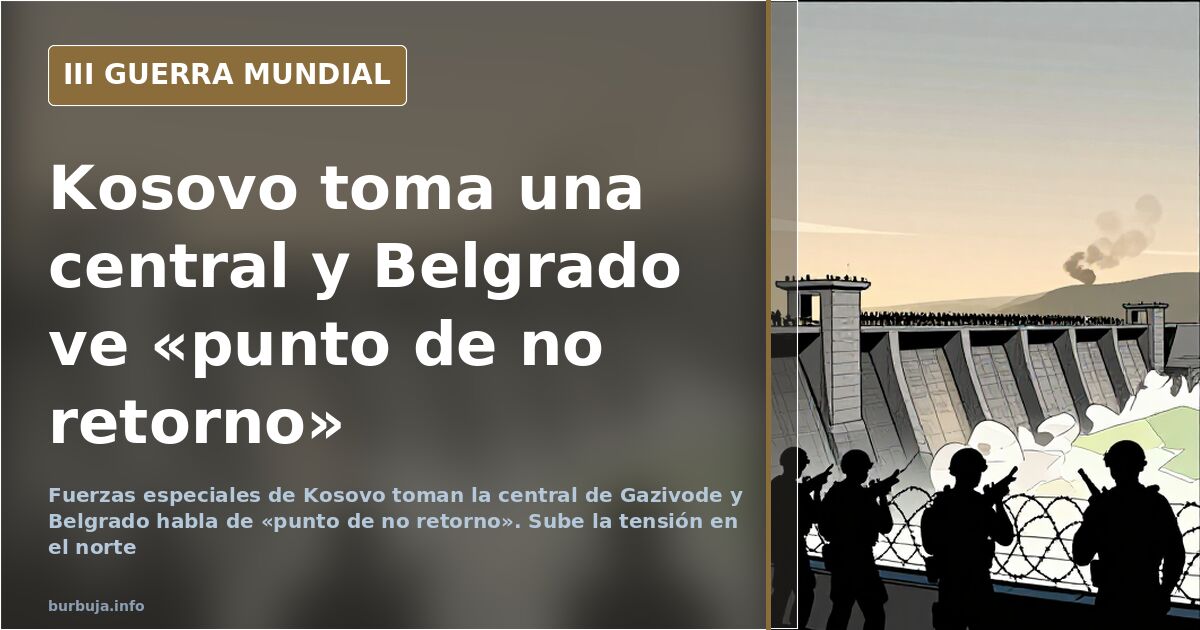
Serbia and Kosovo on the brink: Plant seized and 'point of no return'
Kosovo’s special forces took control of the Gazivode hydroelectric power plant, removed Serbian flags and, according to reports, evicted a Serbian employee. From Belgrade came a statement summarizing the situation’s severity, attributed to the State Secretary of the Serbian Ministry of Foreign Affairs: “We are approaching the point of no return tonight.” The paradox is textbook—each side claims to want peace while the other prepares contingency plans—returning the Balkans to the center of the geopolitical board.
On the public stage, Kosovar Prime Minister Albin Kurti described Kosovo as a “European, democratic, and pro-American state,” contrasting it with Serbian leadership he labeled “autocratic, pro-Asian, and warmongering.” Serbian President Aleksandar Vučić spoke of the “most difficult” day of his mandate and an even worse night ahead. Serbia convened an emergency meeting of its National Security Council.
What seizing the Gazivode plant means
Control of Gazivode is not a minor detail. The operation was publicized alongside reports of removed flags and an expelled worker, a script that in the Balkans is often read as a prelude to something larger.
On the Serbian side, they refer to the administrative line—the de facto border—and state that the army is positioned along the entire perimeter. Broadcaster B92 described the situation in Kosovo and Metohija directly as a “point of no return,” accusing Pristina authorities of “preparing total chaos.” The most circulated phrase, attributed to the State Secretary of the Serbian Ministry of Foreign Affairs, asserts that Kurti is preparing his militarized police to “ravage the north.”
Barricades and the ultimatum nobody confirms
The immediate origin of the tension spike is a Kosovar ultimatum regarding Serbian barricades, which some Serbian media present as a decision to start a war. That framing is not verifiable with what is on the table, but the effect is: the organization of veterans from the Kosovo Liberation Army announced, after learning Belgrade considered sending up to 1,000 security force members, that it would respond with war. Explosions in Mitrovica completed the picture of a heavy day.
Vučić, meanwhile, offered the counterpoint he usually seeks in each crisis: KFOR guarantees that there will be no violent actions. The detail matters because it places the international force in the role of arbiter—and umbrella—while the Serbian political class builds a narrative of a besieged nation.
International reaction: Baerbock and NATO
German Foreign Minister Annalena Baerbock accused Serbia of deliberately fueling tensions in Kosovo and deemed Belgrade’s proposal to send troops to the province “totally unacceptable.” It is the stance of part of Europe that, according to this analysis, already knows who to blame.
The underlying question is what strength remains to sustain that narrative. Some argue that, after wear and tear in Afghanistan and Ukraine, NATO needs an apparent success and that Serbia is the most convenient candidate to pay for it. Against this weighs an argument of pure military arithmetic: Kosovo holds all the cards today, Serbia cannot confront the Alliance, and Russia, the usual balance focus, is far away.
Why Serbia won’t give up Kosovo
The historical background is what turns any incident into drama. For much of Serbian analysis, Kosovo functions as the point where “everything begins” and where Ottoman expansion was halted, a founding myth of the same weight as other sacred territories in Europe. On that basis, ethnic composition is debated: some argue the region was Serbia’s poorest, prompting many Serbs to emigrate, while Albanians arrived from a more impoverished Albania, with higher birth rates, reaching a demographic majority claiming the territory in less than a century.
Comparison with other territorial conflicts—including domestic parallels some sketch—is quickly dismissed: the terms are not equivalent, and here nobody is going to divide the Balkans among neighbors, however much the notion circulates as comic relief.
How much of this pulse responds to electoral calculation, a pressure operation with KFOR as witness, or a misunderstanding escalated in real time is what neither side clarifies. The next question is obvious and nobody signs it: Who lowers the tone first?
Kosovo’s special forces took control of the Gazivode hydroelectric power plant, removed Serbian flags and, according to reports, evicted a Serbian employee. From Belgrade came a statement summarizing the situation’s severity, attributed to the State Secretary of the Serbian Ministry of Foreign Affairs: “We are approaching the point of no return tonight.” The paradox is textbook—each side claims to want peace while the other prepares contingency plans—returning the Balkans to the center of the geopolitical board.
On the public stage, Kosovar Prime Minister Albin Kurti described Kosovo as a “European, democratic, and pro-American state,” contrasting it with Serbian leadership he labeled “autocratic, pro-Asian, and warmongering.” Serbian President Aleksandar Vučić spoke of the “most difficult” day of his mandate and an even worse night ahead. Serbia convened an emergency meeting of its National Security Council.
What seizing the Gazivode plant means
Control of Gazivode is not a minor detail. The operation was publicized alongside reports of removed flags and an expelled worker, a script that in the Balkans is often read as a prelude to something larger.
On the Serbian side, they refer to the administrative line—the de facto border—and state that the army is positioned along the entire perimeter. Broadcaster B92 described the situation in Kosovo and Metohija directly as a “point of no return,” accusing Pristina authorities of “preparing total chaos.” The most circulated phrase, attributed to the State Secretary of the Serbian Ministry of Foreign Affairs, asserts that Kurti is preparing his militarized police to “ravage the north.”
Barricades and the ultimatum nobody confirms
The immediate origin of the tension spike is a Kosovar ultimatum regarding Serbian barricades, which some Serbian media present as a decision to start a war. That framing is not verifiable with what is on the table, but the effect is: the organization of veterans from the Kosovo Liberation Army announced, after learning Belgrade considered sending up to 1,000 security force members, that it would respond with war. Explosions in Mitrovica completed the picture of a heavy day.
Vučić, meanwhile, offered the counterpoint he usually seeks in each crisis: KFOR guarantees that there will be no violent actions. The detail matters because it places the international force in the role of arbiter—and umbrella—while the Serbian political class builds a narrative of a besieged nation.
International reaction: Baerbock and NATO
German Foreign Minister Annalena Baerbock accused Serbia of deliberately fueling tensions in Kosovo and deemed Belgrade’s proposal to send troops to the province “totally unacceptable.” It is the stance of part of Europe that, according to this analysis, already knows who to blame.
The underlying question is what strength remains to sustain that narrative. Some argue that, after wear and tear in Afghanistan and Ukraine, NATO needs an apparent success and that Serbia is the most convenient candidate to pay for it. Against this weighs an argument of pure military arithmetic: Kosovo holds all the cards today, Serbia cannot confront the Alliance, and Russia, the usual balance focus, is far away.
Why Serbia won’t give up Kosovo
The historical background is what turns any incident into drama. For much of Serbian analysis, Kosovo functions as the point where “everything begins” and where Ottoman expansion was halted, a founding myth of the same weight as other sacred territories in Europe. On that basis, ethnic composition is debated: some argue the region was Serbia’s poorest, prompting many Serbs to emigrate, while Albanians arrived from a more impoverished Albania, with higher birth rates, reaching a demographic majority claiming the territory in less than a century.
Comparison with other territorial conflicts—including domestic parallels some sketch—is quickly dismissed: the terms are not equivalent, and here nobody is going to divide the Balkans among neighbors, however much the notion circulates as comic relief.
How much of this pulse responds to electoral calculation, a pressure operation with KFOR as witness, or a misunderstanding escalated in real time is what neither side clarifies. The next question is obvious and nobody signs it: Who lowers the tone first?
Summary of a discussion on Burbuja.info - Foro de economía, actualidad y política., translated from Spanish and reviewed before publication. Read the full discussion (178 replies).
More summaries
-
Balkans tensions: Border blockades between Serbia and Kosovo
Tensions in the Balkans: Border blockades between Serbia and Kosovo and US intervention.
-
Unverified Tweet Attributes False Flag Attacks in Mallorca to CIA
An unverified tweet claims the CIA is behind a false flag drone attack in Mallorca, Nice, and Italy, but provides no evidence.
-
NATO: "The casting changes if you have to go to the front," according to a tweet
According to a message circulated online, NATO drops the diversity in its ads: "Inclusion disappears when you have to die on the front line."
-
Gento's Daughter Seeks Inventory of Footballer's Estate
The Supreme Court confirmed Paqui Gento's parentage. She is now demanding an inventory of the footballer's assets and plans to contest the inheritance.
-
Missile hits Poland: two dead, Article 4 triggered
Two killed in Przewodów after a missile strike on Polish soil. Warsaw invokes NATO's Article 4 and convenes its National Security Council.
-
Flat Earth Paradox: Elite Power vs. Free Speech
A forum user argues that a global flat-Earth conspiracy requires an omnipotent elite unable to silence dissenters, sparking debate.