
September CPI: Inflation Soars to 4.9%
Inflation rose 4.9% in September, its highest level since February 2023, with deposits at 0.05% and income tax not adjusted for inflation.
English · Original discussion in Spanish · Published
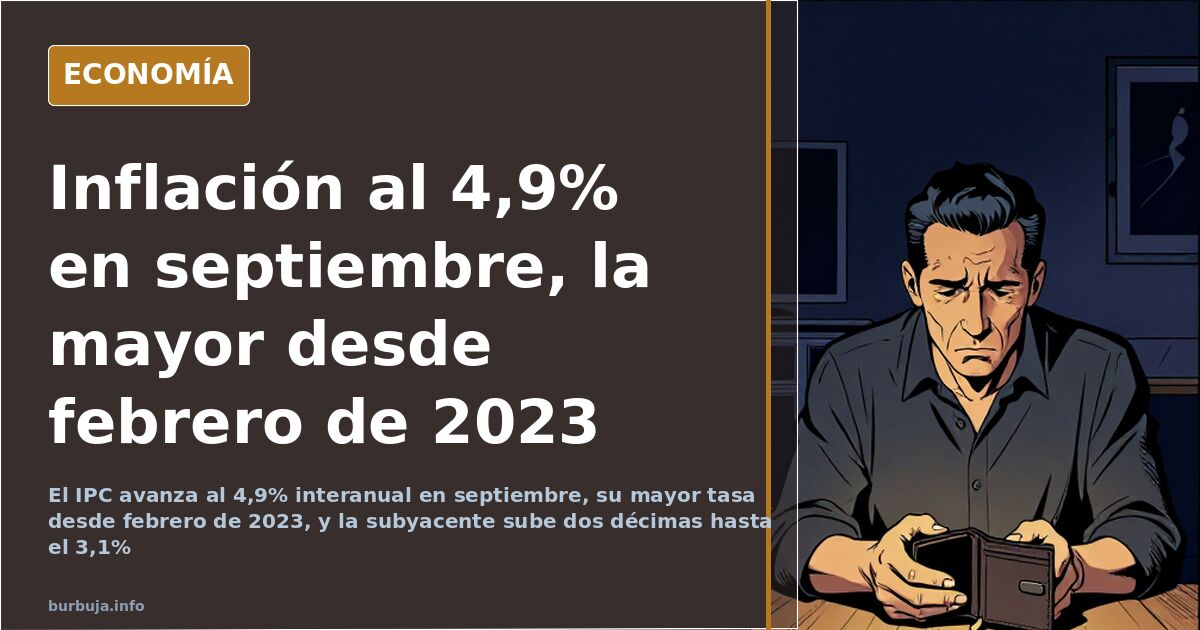
CPI Soars to 4.9% While Savings Earn 0.05%
Put your money in fixed-term deposits and ask how much you get. That's the acid test for this September. Savers who do everything right — don't spend what they don't have, don't sign up for strange products, don't get into trouble — earn a 0.05% annual rate if they park their money in a large bank, and 1% if they go to one of the banks the industry calls shady with a sneer. In that same month, the Consumer Price Index (CPI) rose 4.9% year-on-year. The difference is undeniable.
Why September's CPI Rose to 4.9%
The provisional data published by the National Statistics Institute (INE) shows inflation six tenths higher than in July and at its highest level since February 2023. The main driver is fuel, but there's a statistical trick: a year ago, gasoline prices fell, and that base effect inflates the comparison. Add to this the tourist packages, which fell less this September than the previous one.
The fine print is the core inflation — which excludes energy and fresh food — which is up two tenths to 3.1%, its highest level since March 2024. It remains 1.8 points below the general index, so the argument of structural relief still holds. Barely. In monthly terms, the CPI rose 0.3% over August, marking eight consecutive months of increases. The definitive data will be released on October 14.
The Anti-Crisis Shield Arrives Amid Middle East Conflict
The Council of Ministers approved a new package to cushion the price escalation, especially for energy, just before previous aid expires. The Executive is extending aid to the agri-food sector — including compensation for the increased cost of agricultural diesel — presumably until December 31, and keeping an eye on electrification and decarbonization. The Ministry of Economy justifies this by stating that containing the contagion of the energy shock to other prices avoids what are technically called second-round effects. They also recall that between March and August, food prices fell by 0.6%.
Why Does Money in the Bank Lose Purchasing Power?
Because interest rates are rising, but not enough. The ten-year Spanish bond is around 4%, and no bank pays that for a deposit except for occasional promotional offers that last a few months. With inflation at 4.9%, the math is negative by definition. The conclusion repeated at any financial discussion is that savers have no choice but to gamble their money in equities or accept losses.
The Income Tax That Takes Half the Increase
Here's the trap almost no one looks at. If pensions and public salaries are updated with the CPI, but the government doesn't adjust income tax for inflation, a good portion of the increase goes directly into the Treasury's coffers: the taxpayer moves into a higher tax bracket without becoming richer. It is argued that the agreed-upon increase for public employees remains at 2%, well below the index, and that the accumulated loss of purchasing power is around 25% over sixteen years.
The Uncomfortable Question: Indexing Pensions and Salaries to CPI
Every tenth of a percent of inflation automatically increases public spending if everything is tied to the index. Some warn that this chain update could be precisely what unbalances the accounts, and others anticipate another crisis, similar to 2008 (for different reasons), where the adjustment would eventually come from this very mechanism. A figure has been put on the table for this update: 6%.
And the unsettling data: with inflation marking eight consecutive months of monthly increases, the new anti-crisis shield is being introduced with core inflation at its highest level since March 2024.
Put your money in fixed-term deposits and ask how much you get. That's the acid test for this September. Savers who do everything right — don't spend what they don't have, don't sign up for strange products, don't get into trouble — earn a 0.05% annual rate if they park their money in a large bank, and 1% if they go to one of the banks the industry calls shady with a sneer. In that same month, the Consumer Price Index (CPI) rose 4.9% year-on-year. The difference is undeniable.
Why September's CPI Rose to 4.9%
The provisional data published by the National Statistics Institute (INE) shows inflation six tenths higher than in July and at its highest level since February 2023. The main driver is fuel, but there's a statistical trick: a year ago, gasoline prices fell, and that base effect inflates the comparison. Add to this the tourist packages, which fell less this September than the previous one.
The fine print is the core inflation — which excludes energy and fresh food — which is up two tenths to 3.1%, its highest level since March 2024. It remains 1.8 points below the general index, so the argument of structural relief still holds. Barely. In monthly terms, the CPI rose 0.3% over August, marking eight consecutive months of increases. The definitive data will be released on October 14.
The Anti-Crisis Shield Arrives Amid Middle East Conflict
The Council of Ministers approved a new package to cushion the price escalation, especially for energy, just before previous aid expires. The Executive is extending aid to the agri-food sector — including compensation for the increased cost of agricultural diesel — presumably until December 31, and keeping an eye on electrification and decarbonization. The Ministry of Economy justifies this by stating that containing the contagion of the energy shock to other prices avoids what are technically called second-round effects. They also recall that between March and August, food prices fell by 0.6%.
Why Does Money in the Bank Lose Purchasing Power?
Because interest rates are rising, but not enough. The ten-year Spanish bond is around 4%, and no bank pays that for a deposit except for occasional promotional offers that last a few months. With inflation at 4.9%, the math is negative by definition. The conclusion repeated at any financial discussion is that savers have no choice but to gamble their money in equities or accept losses.
The Income Tax That Takes Half the Increase
Here's the trap almost no one looks at. If pensions and public salaries are updated with the CPI, but the government doesn't adjust income tax for inflation, a good portion of the increase goes directly into the Treasury's coffers: the taxpayer moves into a higher tax bracket without becoming richer. It is argued that the agreed-upon increase for public employees remains at 2%, well below the index, and that the accumulated loss of purchasing power is around 25% over sixteen years.
The Uncomfortable Question: Indexing Pensions and Salaries to CPI
Every tenth of a percent of inflation automatically increases public spending if everything is tied to the index. Some warn that this chain update could be precisely what unbalances the accounts, and others anticipate another crisis, similar to 2008 (for different reasons), where the adjustment would eventually come from this very mechanism. A figure has been put on the table for this update: 6%.
And the unsettling data: with inflation marking eight consecutive months of monthly increases, the new anti-crisis shield is being introduced with core inflation at its highest level since March 2024.
Summary of a discussion on Burbuja.info - Foro de economía, actualidad y política., translated from Spanish and reviewed before publication. Read the full discussion (52 replies).
More summaries
-
September CPI 4.9%: the official figure and the IRPF (Spain's income tax) left untouched
Official CPI is 4.9%, but real price rises feel far higher: an unindexed IRPF and capped rates eat the increase
-
Córdoba Father Self-Immolates: Mental Illness or Societal Despair?
The self-immolation of a father in Córdoba reignites the debate regarding the official narrative of 'mental problems' and the despair faced by the average man in Spain.
-
Euthanasia in Old Age: Autonomy vs. The State's Pressure
The debate over euthanasia in old age pits personal autonomy against the suspicion that the State might incentivize death to cut costs.
-
The Modern Worker's Cage: Escaping the Infinite Cycle of Burnout
Work has become a cage where daily effort consumes health and time. Discover why we push ourselves so hard and how to break the cycle.
-
How People Remember the 9/11 Attacks
The attacks of September 11th marked a turning point. Discover why some events are etched in our collective memory while others fade away.
-
Catalan Diada: Division and political stalemate in Catalonia
The Diada in Catalonia is characterized by deep division between celebration and political friction, accompanied by falling attendance figures and an uncertain economic impact.