
Selling your share of a co-owned property in Spain when your ex refuses to sell
How to sell your 50% stake in a Spanish property when your ex-partner won't cooperate: abstract share, court auction, and the 25% that funds offer for an undivided share.
English · Original discussion in Spanish · Published
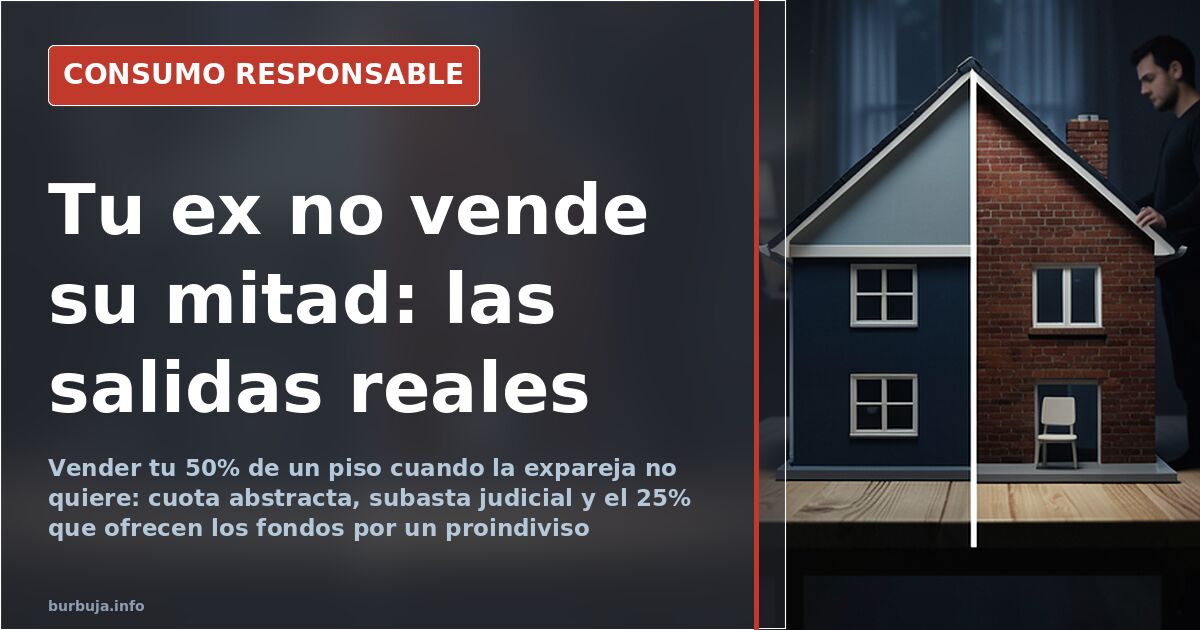
Selling your half of the property when your ex refuses: what it costs to get out
You own 50% of a property, you no longer live there, and the other co-owner doesn't want to sell. Can you do anything without going to court? Yes, but almost every route involves losing money. The first legal certainty is that your abstract share of the property belongs to you and you can sell it to a third party without anyone's permission: Article 399 of the Spanish Civil Code supports this route. The second is that nobody is going to pay you market value for co-owning with a stranger who occupies the home.
Companies that buy undivided shares outright rarely offer more than 25% of market value, according to the estimates used by those who have explored that market. It's the fastest route and the most expensive: you swap a problem for a financial loss. The professional buyer knows they're purchasing a share with an awkward occupant inside and discounts the risk with arithmetical ruthlessness.
What the law says about selling your share without permission
The general rules of ordinary co-ownership allow you to dispose of your share without the consent of the others. Use of the property is another matter: if she occupies 100% of the home while you pay the mortgage, community fees, insurance and utilities, there are grounds to claim rent from her for exclusive use. Several lawyers consulted in the sector point out that this is the most profitable argument in the short term: turning the other party's passivity into a documented monthly debt.
The problem arises when the property was bought without clear paperwork. If the couple was not married under Spain's community property regime (sociedad de gananciales), the co-ownership is by shares and the Civil Code regime applies without restrictions. If there was a community property regime, the property doesn't belong to the two of you: it belongs to a common marital estate, and the picture changes. Confusion over the marital property regime is why many of these conflicts drag on for years.
The court auction: when it's worth it and what you lose
Judicial dissolution of the co-ownership is the classic way out. Before admitting the claim, the judge requires proof that an agreement was attempted: a burofax (a certified fax-style notice) offering to buy or sell, a formal written proposal, a documented refusal. Without that paper trail, the proceedings stall. With it, the ruling takes roughly a year to recognise that the co-ownership can be dissolved.
Then comes the auction, and that's where the maths gets tight. At the first auction the property cannot be awarded for less than 75% of the valuation; at the second there is no minimum. Anyone with liquidity can bid and take full ownership at a bargain price, provided they can endure the strain of the process. Co-owners also have a right of first refusal, though its scope varies by autonomous region and is worth reviewing with a lawyer before taking the plunge.
The rental bluff and the limits of pressure
The temptation to move a third party into the property to force a sale comes up in every conversation on the subject. Legally it's murky ground: if those wanting to rent it out don't hold a majority, they can sign the contract, but the judge can void it if the other co-owner challenges it. And if the tenant moves into an occupied home, the complaint may land on them. The bluff works in conversation; in court, it backfires.
Psychological pressure has an even clearer limit: any verbal threat, with no witnesses, becomes a harassment complaint with her word against yours. Anyone who has trinc these disputes knows the ground is tilted. That's why lawyers insist on the burofax and written messages: what isn't documented doesn't exist.
The cross-offer: buying her half or selling yours at the same price
There's a move that appears at almost every negotiating table: offer to buy her 50% and, if she says no, tell her you accept the same offer for your half. If she accepts, you keep the whole property and decide later. If she rejects both, her unwillingness to reach an agreement is on record, which is exactly what the judge will want to see.
The underlying problem isn't legal, it's about incentives. She enjoys an asset she only half owns and pays no rent. As long as that situation continues, she has no economic reason to move. The only way to change the calculation is to make passivity cost her money, and that's achieved with receipts, not arguments.
The cleanest way out remains a bad deal: sell at a discounted price, split the proceeds and close. Anyone who has been through one of these proceedings knows the emotional toll and years of waiting rarely make up the difference. But nobody signs up to that until they're in the thick of it.
Summary of a discussion on Burbuja.info - Foro de economía, actualidad y política., translated from Spanish and reviewed before publication. Read the full discussion (75 replies).
More summaries
-
Unlocking a phone by IMEI: why the free code almost never arrives
The free IMEI unlock code almost never shows up: the Galaxy Trend Plus wasn't listed in the service consulted, and the real route involves rooting or paying.
-
Megane radio code: 25 euros at the dealer or free at home
The four-digit code for a Megane radio costs 25 euros at the dealership or nothing at all, by extracting the pre-code from the unit and using a calculator.
-
Skimping on your property manager is the worst move a homeowners association can make
A cheap or absent property manager drives up repair costs: a leak from a broken gutter joint can end up requiring full cornice waterproofing. Here's why.
-
Total Renting: Is car leasing for individuals a financial trap?
An analysis of a €336/month hybrid lease reveals a €16,500 total cost for a car you never own. Is leasing worthwhile for private individuals in Spain?
-
Your house loses 3 degrees overnight and it's not the windows
Turning the heating off at 20.7º and waking up to 17.6º with 0º outside: why the cold comes in through the roller shutter box, not the glass of your brand-new windows
-
Miele at €1,500: spare parts exist, but has quality gone?
A 30-year-old washing machine got a spare part; another burns out a sensor every three or four years. The debate: does €1,500 for a Miele buy durability or nostalgia?