
Selling second-hand from home: when Spain's tax agency sees you as self-employed
There is no legal euro cap for selling as a private individual, but regularity and a banking trail can turn your second-hand sales into a business activity.
English · Original discussion in Spanish · Published
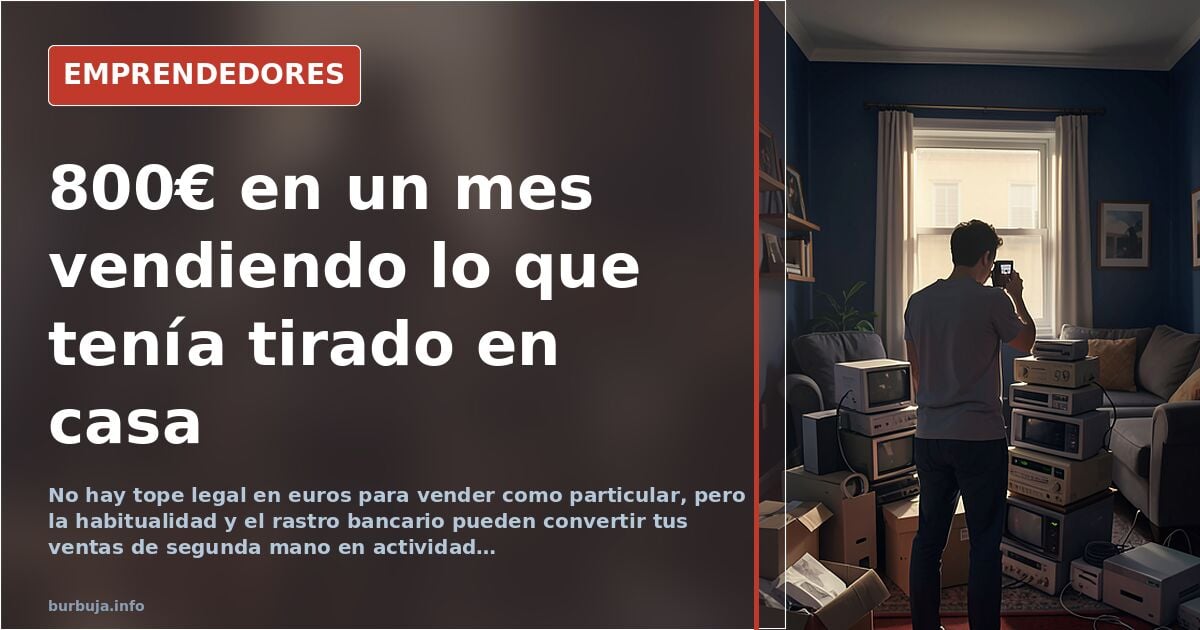
Selling what's lying around your home: the blurry line between private seller and self-employed
An unemployed man, recovering from surgery and without work for years, decides to take what he no longer uses out of the closet. He used to buy products for 100 to 150 euros and sells them for 30 or 50. In one month, more than 800 euros in orders. The question gnawing at him is not whether he sells cheap, but whether selling like this, as a private individual, has a legal cap. The short answer: there is no euro limit, but there is a red line almost nobody knows how to draw.
Is there a euro limit for selling as a private individual?
No. No rule sets a magic annual sales figure after which you stop being a private seller. What determines legality is not the amount, but the regularity of the activity. Selling four loose items you already owned is one thing; setting up a resale channel with recurring stock is another. The authorities don't look at the total in euros, they look at the pattern: if you buy to sell, if you repeat, if there is ongoing profit-seeking.
That's where the confusion starts. Some claim that up to 3,000 euros a year count as private sales and don't need to be declared. That threshold circulates as revealed truth, but it is not written in any law in those words. Others argue that from the very first cent you should register as self-employed and invoice. The reality is greyer: the obligation arises from habitual activity, not from a round number.
The shipping agency trap and accumulated money
The specific case has a detail that complicates everything: the money doesn't go through his account. The shipping agency charges the recipient, keeps it, and he withdraws it whenever he wants. That system leaves a banking trail that the tax agency can trinc. This is not cash under the mattress. Every transfer is a footprint.
The volume is starting to be significant: more than 800 euros in one month, with pending material that could add up to several thousand. If the pace continues, the question stops being theoretical. Spain's tax agency (Agencia Tributaria) doesn't go after someone selling a used bike, but it can cross-check data if it detects a constant flow of income without declared activity.
PayPal, Luxembourg and the myth of invisible money
There's an idea going around that getting paid via PayPal and not moving the money to a bank account keeps sales off the radar. PayPal is in Luxembourg, doesn't share information with the tax authorities, and if you spend within the platform, the money never touches Spain. Sounds good. It's a half-myth: PayPal has reporting obligations under the European framework, and a high, sustained flow in a personal account can trigger alerts. It is not a fiscal cave.
The full calculation of how much you can sell without problems, broken down between occasional sales and habitual activity, is the point where the matter becomes really murky. The line between one thing and the other is not in an official gazette, it's in the facts.
The question nobody answers with a figure
The underlying debate is uncomfortable: the law gives no number, and without a number, the citizen navigates blind. A private individual selling their second-hand things shouldn't antiestéticar a fine, but if the volume and repetition sketch a commercial activity, the authorities can reinterpret what began as a closet clean-out. And then the penalty arrives.
The unsettling figure: in one month he has sold more than 800 euros of products he bought for 100 or 150. If he keeps this up, in a year he'll exceed 9,000. Nobody has told him yet where the limit is, because the limit doesn't exist. Regularity exists. And that is decided by an inspector.
Summary of a discussion on Burbuja.info - Foro de economía, actualidad y política., translated from Spanish and reviewed before publication. Read the full discussion (9 replies).
More summaries
-
Self-employed and importing from China: what Spain's tax office requires
A self-employed worker can import from China to resell without forming an S.L., but must declare the activity and pay duties and VAT, according to the debate.
-
Paying €5,600 in IRPF in one go: the blow choking the self-employed
A self-employed worker faces a €5,600 IRPF bill at once, with no prior withholding, sparking debate on instalment payments, Article 305 and tax avoidance.
-
Spain's self-employed vs bureaucracy: from VAT to Verifactu, how much longer?
The bureaucratic burden of VAT, income tax and Verifactu is pushing Spain's self-employed to the limit. Is the paperwork worth it?
-
Mechatronics vocational training: high demand in northern Spain and €26,000 job offer
A supermarket maintenance job pays €26,000, but workers warn of bosses who ignore rules, travel and broken schedules.
-
VOX pulls out of Senate races in six Spanish provinces, leaving PP unopposed on the right
VOX will not run for the Senate in Valencia, Castellón, Cádiz, the Balearics and both Canary Islands constituencies. It will still stand in Lleida, Tarragona and Gipuzkoa.
-
Sports betting: why a 72% win rate doesn't guarantee profit
A record of 15 wins and 5 losses with +966.9 units doesn't prove profitability: at odds of 1.55 you need to win more than 64.5% of bets just to break even.