
Selling lockpicks is legal in Spain, but breaking in is a crime
In Spain, selling and owning lockpicking tools like topolinos is legal. However, using them to enter another person's property constitutes burglary.
English · Original discussion in Spanish · Published
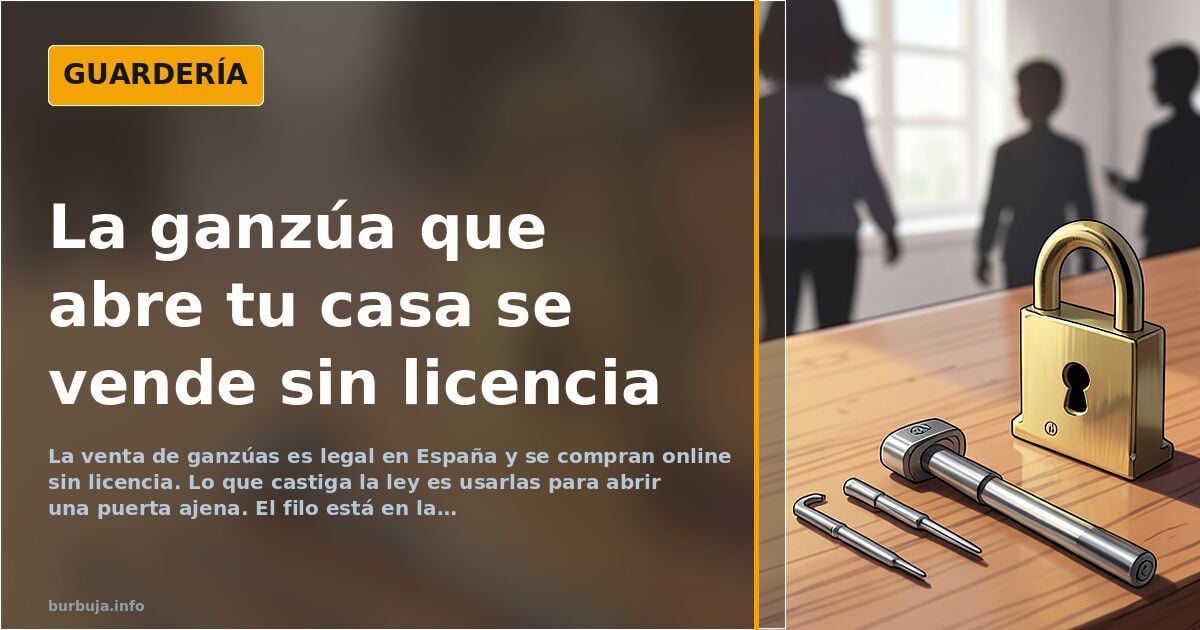
Lockpicking tools are legal; using them on someone else's home is a crime
A YouTube ad promises to open locks "without damage" and without paying a locksmith. The website selling it appears AI-generated and hastily translated from Chinese to English. This raises an uncomfortable question: if anyone can buy the device, what prevents opening other people's doors? The short answer is that nothing physically prevents it; what stops it is the Penal Code.
Possession and sale of lockpicks, tension wrenches, and opening kits are not prohibited in Spain. They are sold on Amazon, in Chinese stores, and on locksmithing websites without requiring a license or prior registration. What is a crime is using these tools to break into another person's property or steal. The legal line separates the object from the act, not the object from the intent.
What you can buy and for how much
The market is broad and cheap. There are lockpick kits for transparent padlocks used for practice at home, professional picks, and the so-called topolino, a tool that, according to online discussions, opens "almost any" security lock without breaking anything. It is easily found on AliExpress and Alibaba. The price of the gadget advertised on YouTube that opens locks without damage: 500 euros, as mentioned when seeing it.
Training is also free. YouTube has tutorials on lockpicking, brand recommendations, and kit comparisons. Those who practice it as a hobby describe it as something "really simple once you feel the picks," recommending starting with transparent padlocks. None of this is illegal.
The lock as an illusion of security
The conversation quickly derives towards an uncomfortable conclusion: the lock is not an insurmountable barrier, it is a delay. Old cylinders fall with a paperclip and a thin-blade knife in less than five minutes, as recalled regarding Yale locks from the seventies. Modern ones hold up longer, but they are not invulnerable.
The emerging technical consensus is clear: a good cylinder, with movable pieces in the key, and a well-mounted protective shield force the intruder to make noise or directly smash it. "With a good cylinder, no topolino, impression, or anything. You have to break it or nothing," summarizes one message. The shield is the piece many do not know about and which changes the game: without it, even the most expensive cylinder remains exposed.
The weak link is digital
Distrust shifts towards connected locks. If everything going through WiFi is hackable, a lock peine with a mobile phone adds an attack surface that a physical key does not have. Listening to conversations, recording schedules, and knowing when no one is home is a pattern that a connected device can leak. The practical conclusion: electronics do not replace the cylinder, they complement it or worsen it.
The open question
No one in the conversation proposes banning sales, and several recall that the criterion is the same as with knives: the object is legal, the use against third parties is not. The floating question is not whether there should be a possession registry like for weapons, but why there isn't one and if it would serve any purpose. Because whoever wants to open someone else's door does not need the 500-euro kit: a screwdriver and a hairpin are enough.
Also available in: Deutsch
Summary of a discussion on Burbuja.info - Foro de economía, actualidad y política., translated from Spanish and reviewed before publication. Read the full discussion (43 replies).
More summaries
-
Filming a police officer in Spain: when the right to record is no shield
A private security student films a police officer in Spain and the video reopens the question: does the law protect those who record, or does it only document the abuse?
-
AliExpress Requires Face Verification to Buy Scissors
AliExpress now requires age verification with a selfie to buy scissors and cutters. Is it legal? Who benefits from this erratic data control?
-
The addiction to 'expert' YouTubers: the miracle additive case
The sound of a pssst when opening a Coca-Cola live on air is the trademark of a YouTuber who calls himself an engineer and sells miracle additives. A channel dedicated to analysis exposed…
-
Online Death of Known Figure Cesard Sparks Debate
The passing of internet personality Cesard triggers polarized reactions, sparking a debate about his complex legacy, controversial reputation, and digital footprint.
-
Spanish Rock That Truly Competes With Anglo-Saxon Standards
Barón Rojo recorded at Iron Maiden’s studio and Héroes del Silencio reached Lindemann. A look at Spanish rock that stands toe-to-toe with its Anglo-Saxon counterparts.
-
Modern Horror in 2026: 'Obsession' Shines Amid Genre Fatigue
In a lackluster 2026, 'Obsession' stands out as the year's best horror film, while reviews warn of disappointing sequels and mediocre releases.