
Self-service laundromats: the math that debunks the savings
A user calculates that a family with three children spends €1,600 a year on self-service laundry. A washing machine costs €300 and lasts five years. The math that…
English · Original discussion in Spanish · Published
Self-service laundromats: the math that debunks the savings
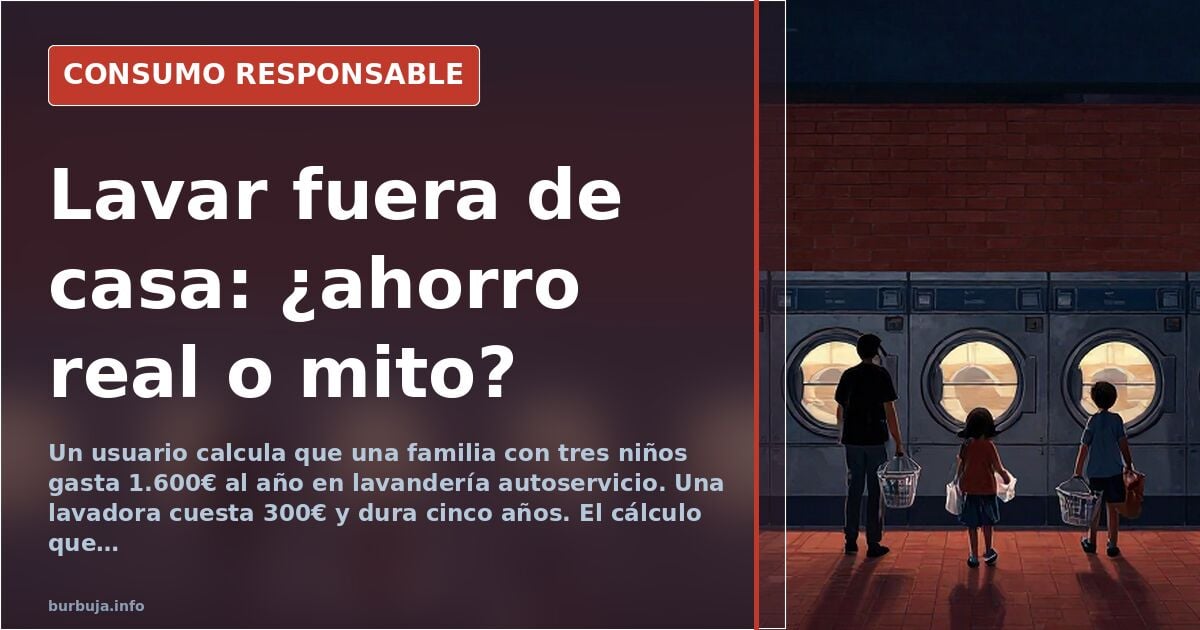
A user calculates that a family with three young children does around 400 loads of laundry a year. At four euros a wash at a self-service laundromat —no dryer— that comes to €1,600 a year, plus an hour a day hauling bags down the street. A decent washing machine costs €300 and lasts five years. A father wrote out the math with a calculator in hand, and it sums up the core of a debate that has been going on for years: does washing your clothes outside the home actually pay off?
The original question is a domestic one: in many households the washing machine is reserved for duvets, sofa covers and large loads. The anecdote that sets everything off is simple. A woman goes to wash the sofa covers and finds a man using four machines at once. "What a rip-off," she comments on getting back. Her husband's reply is the crux of the matter: between detergent, fabric softener, electricity, water and possible breakdowns, it might work out cheaper than at home.
What a load of laundry at a laundromat really costs
Prices reported by those who have used the service range from four to five euros per wash, with detergent and fabric softener on the customer in many places. One user worked out five euros per weekly load between washer and dryer: about €260 a year. Another ran the numbers with two washes a month at four euros: €96 a year, no dryer. In two years, you've nearly paid off a new washing machine.
The problem appears when the frequency goes up. A household doing three washes a week —regular clothes, work clothes, bedding— pushes the figure above €600 a year. With young children, it climbs to 400 loads a year and €1,600. At that point there's no debate left: the fixed cost of having a machine at home pays for itself.
The hidden cost: time, logistics and travel
Money isn't the only variable. You have to load the laundry, wait, move it from washer to dryer and come back to collect it. Three trips per load. Anyone who has done it with small children describes it as one of the most serious hassles of domestic life. A participant who lived in apartments without a washing machine sums it up: no amount of money buys the convenience of having one at home.
Against that, there are cases where self-service wins. Rental flats with no space or hookups, summer apartments, students, singles who move often. Also for one-off loads that won't fit in a domestic machine: a giant blanket, thirty kilos of laundry after renovation work, a holiday motorhome. There, time is worth more than money.
The hygiene suspicion nobody has proven
Part of the discussion goes down the hygiene drain. Some argue that putting your clothes in a shared machine is little short of an act of faith, while others reply with the obvious comparison: if you sit at a table in a bar, you're already using something that has passed through thousands of hands. Industrial washing machines run with very hot water and harsh products, but there is no visible disinfection protocol between customers.
One user found out at his own expense: he washed workshop clothes in a machine and confirmed it didn't self-clean between cycles. He left a note for the next customer. The data doesn't confirm a health risk, but it does debunk the idea that the laundromat is a sterile environment.
Who actually uses these laundromats
The typical user is not the average Spanish family. It's people in cities where housing is small and expensive —New York, Paris, much of Italy and Germany— where the laundromat has been part of the urban landscape for decades. In Spain, the phenomenon has arrived with expensive rents, tiny flats and a certain aesthetic imported from American movies.
There's the detail that throws everything off: the self-service laundromat doesn't compete with the home washing machine on price. It competes with not having room for one.
Also available in: Deutsch
Summary of a discussion on Burbuja.info - Foro de economía, actualidad y política., translated from Spanish and reviewed before publication. Read the full discussion (31 replies).
More summaries
-
Spain's shower timer cuts water when time runs out
A Spanish utility model shower valve closes automatically after a set time, targeting the 12% of national water use attributed to households by INE.
-
Indoor LED Grow: €38 Electricity for 200g Yield
A 120W LED lamp adds €38 to electricity bills per cycle, yielding 200g of dry flower quarterly, according to amateur calculations.
-
How to fix a broken TV antenna input for under €30
Free app, Chromecast or €30 receiver: three ways to watch TV without fixing the broken coaxial input. The cheapest costs zero euros.
-
Beef at €18/kg at Carrefour in Spain: are food prices really deflating?
A kilo of beef at 18 euros at Carrefour in Spain sparks the debate: real deflation or a mirage? A price comparison, meat quality and the gap with official CPI figures.
-
Penny-pinching on tyres: savings or danger?
Replace tyres every 5 years or only when worn? Extreme budgeting on wheels divides opinion. Prices, risks and brands to help you decide without putting yourself at
-
Energy-saving light bulbs: a guide to avoiding watts confusion
How to choose energy-saving light bulbs: real equivalences, colour temperature, recommended brands and the debate over mercury and radiation. A data-backed guide.