
Scrapping the SMI (Spain's national minimum wage), pensions and public healthcare: the bill for refunding your contributions
The scenario of scrapping the SMI, pensions and public healthcare gets an accounting answer: refund the million I paid in plus the interest I never earned.
English · Original discussion in Spanish · Published
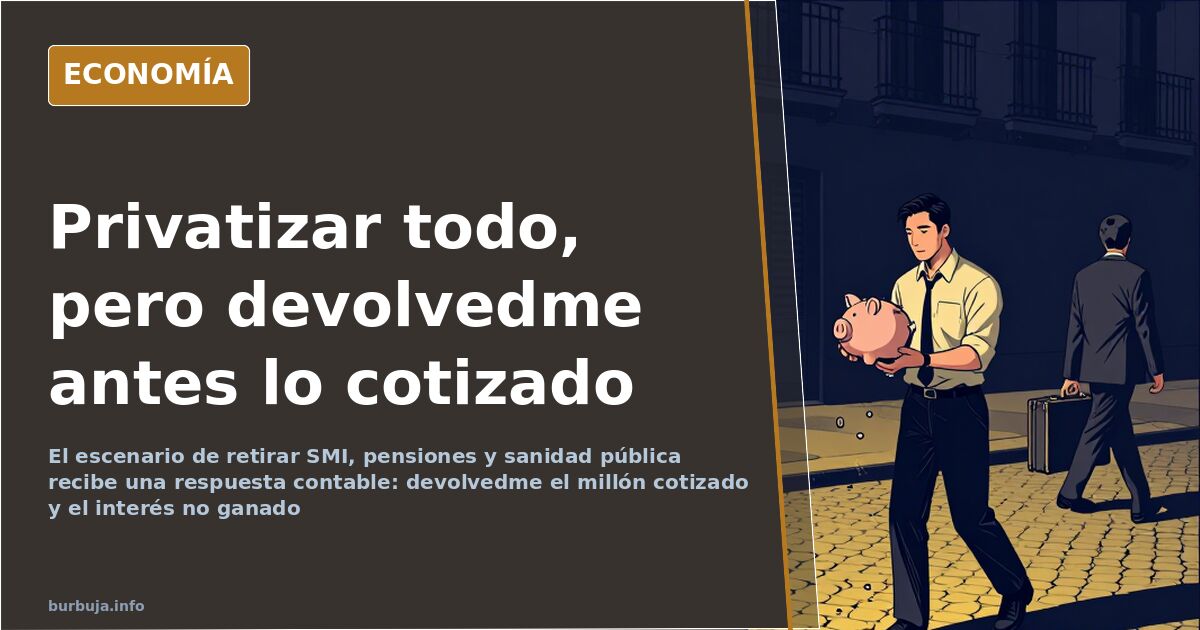
Dismantling the welfare state: the refund no one calculates
Dismantling the welfare state from top to bottom has a technical defense. Presenting it as a deserved punishment for voters is another matter. The starting scenario lists a dozen measures —withdrawal of the SMI (Spain's national minimum wage), abolition of public pensions and subsidies, exit from the public healthcare system, sweeping privatization, a free-for-all in urban planning and labor regulations, a return to imported fossil fuels— and presents them as the inevitable fate of those who supposedly would have asked for them. The strongest reply did not come from outrage. It came from accounting.
What the proposed scenario includes
The proposal does not stop at budget theory. On the table are the disappearance of the minimum wage, the end of contributory pensions, the withdrawal of subsidies, the shift to paying for healthcare use, and the sale of what is still considered strategic. Add to that the dismantling of urban planning regulations, to the point of legalizing settlements without planning, and an energy U-turn that redraws the map of renewables.
The text also includes a massive arrival of population, put at twenty million people with no source to support it, and describes a loosening of controls on food and drinking water. These are the passages where the argument loses its tone and resorts to broad brushstrokes; they are also the easiest to dismantle.
Privatize, yes, but with the account settled
The response that shapes the argument is that of a taxpayer who accepts the framework as long as what they paid in is returned to them. The minimum wage is eliminated: they do not receive it and argue their pay is negotiated above that threshold. Pensions are abolished: they first demand the return of the one million euros paid in contributions over their working life plus the stock-market returns they would have earned from their first contribution onward. Subsidies disappear: they claim back the portion of their IRPF (Spain's personal income tax) that funds them. Healthcare is privatized: they say they pay for their own when they use it and add that their obligation to pay for someone else's ends the same day.
The reasoning is symmetrical and, for that very reason, uncomfortable. It also has an obvious hole: no one quantifies what the system has already returned to that same taxpayer —healthcare, education, infrastructure— nor how the balance changes by cohort, sens or income bracket. The million-euro figure is a personal estimate without verification; the interest demanded, a counterfactual that admits no exact rebuttal.
From calculation to personal attack
The exchange broke down before it reached arithmetic. From accounting it moved to the question of whether the interlocutor deserved cancer, settled by another with a no one deserves it and the reminder that both of their healthcare had already been paid for in advance. In between appear references to Ukraine, the defunct Soviet Union, and the other person's medication.
The most curious passage has nothing to do with money: someone asks whether they would rule out a partner because of their political profile. The question went unanswered, like almost everything that does not add up on a spreadsheet.
With the breakdown on the table, the real balance of a dismantling would change depending on who looks at it, and neither side has put forward the figure. What is foreseeable is that the scenario will continue to be sold as punishment rather than calculation. Until someone adds up contributions and subtracts benefits, the give me back what's mine will remain the hardest reply to refute.
Key data
Dismantling the welfare state from top to bottom has a technical defense. Presenting it as a deserved punishment for voters is another matter. The starting scenario lists a dozen measures —withdrawal of the SMI (Spain's national minimum wage), abolition of public pensions and subsidies, exit from the public healthcare system, sweeping privatization, a free-for-all in urban planning and labor regulations, a return to imported fossil fuels— and presents them as the inevitable fate of those who supposedly would have asked for them. The strongest reply did not come from outrage. It came from accounting.
What the proposed scenario includes
The proposal does not stop at budget theory. On the table are the disappearance of the minimum wage, the end of contributory pensions, the withdrawal of subsidies, the shift to paying for healthcare use, and the sale of what is still considered strategic. Add to that the dismantling of urban planning regulations, to the point of legalizing settlements without planning, and an energy U-turn that redraws the map of renewables.
The text also includes a massive arrival of population, put at twenty million people with no source to support it, and describes a loosening of controls on food and drinking water. These are the passages where the argument loses its tone and resorts to broad brushstrokes; they are also the easiest to dismantle.
Privatize, yes, but with the account settled
The response that shapes the argument is that of a taxpayer who accepts the framework as long as what they paid in is returned to them. The minimum wage is eliminated: they do not receive it and argue their pay is negotiated above that threshold. Pensions are abolished: they first demand the return of the one million euros paid in contributions over their working life plus the stock-market returns they would have earned from their first contribution onward. Subsidies disappear: they claim back the portion of their IRPF (Spain's personal income tax) that funds them. Healthcare is privatized: they say they pay for their own when they use it and add that their obligation to pay for someone else's ends the same day.
The reasoning is symmetrical and, for that very reason, uncomfortable. It also has an obvious hole: no one quantifies what the system has already returned to that same taxpayer —healthcare, education, infrastructure— nor how the balance changes by cohort, sens or income bracket. The million-euro figure is a personal estimate without verification; the interest demanded, a counterfactual that admits no exact rebuttal.
From calculation to personal attack
The exchange broke down before it reached arithmetic. From accounting it moved to the question of whether the interlocutor deserved cancer, settled by another with a no one deserves it and the reminder that both of their healthcare had already been paid for in advance. In between appear references to Ukraine, the defunct Soviet Union, and the other person's medication.
The most curious passage has nothing to do with money: someone asks whether they would rule out a partner because of their political profile. The question went unanswered, like almost everything that does not add up on a spreadsheet.
With the breakdown on the table, the real balance of a dismantling would change depending on who looks at it, and neither side has put forward the figure. What is foreseeable is that the scenario will continue to be sold as punishment rather than calculation. Until someone adds up contributions and subtracts benefits, the give me back what's mine will remain the hardest reply to refute.
Key data
- The scenario puts at twenty million the number of people who would arrive in the country, with no source to back it up
- One reply claims a million euros paid in contributions over their working life
- The proposal brings together a dozen dismantling measures
Summary of a discussion on Burbuja.info - Foro de economía, actualidad y política., translated from Spanish and reviewed before publication. Read the full discussion (19 replies).
More summaries
-
Portugal to deny free public healthcare to non-resident or undocumented foreigners
Portugal's PSD proposes that foreigners without legal residence pay for public healthcare or prove they have insurance. Emergency care would be exempt.
-
Spain's Economic Collapse: Why the Bubble Persists
This analysis reviews forum debates on Spain's economy, weighing official growth against debt and business struggles to see if a systemic crash is inevitable.
-
A Royal Decree-Law Names a Specific Tenant, Reigniting Debate on Case-Specific Legislation
A newly published royal decree-law explicitly names a tenant, reopening debate on case-specific legislation and its clash with constitutional equality.
-
Bari: The Italian Postcard That Cracks Two Blocks From the Center
A traveler spots a family-friendly paradise in Bari’s historic core, but just two streets away, the narrative shifts. Italy vs. Spain compared.
-
Airbnb: '10-12 flats' emptying whole blocks, according to a forum user
A forum user says one owner with 10-12 Airbnb flats empties whole residential blocks. In Lugo or Teruel, prices also rise without mass tourism.
-
Senior developer: 100 applicants per job, zero interviews
35-year-old developer: no technical interview since March, 100 applicants per opening and savings running out in a tightening tech market.