
Schools ignore bullying until victim fights back
Witnesses say a bullied minor finally hit back after enduring abuse, triggering a late and inadequate reaction from the school environment.
English · Original discussion in Spanish · Published
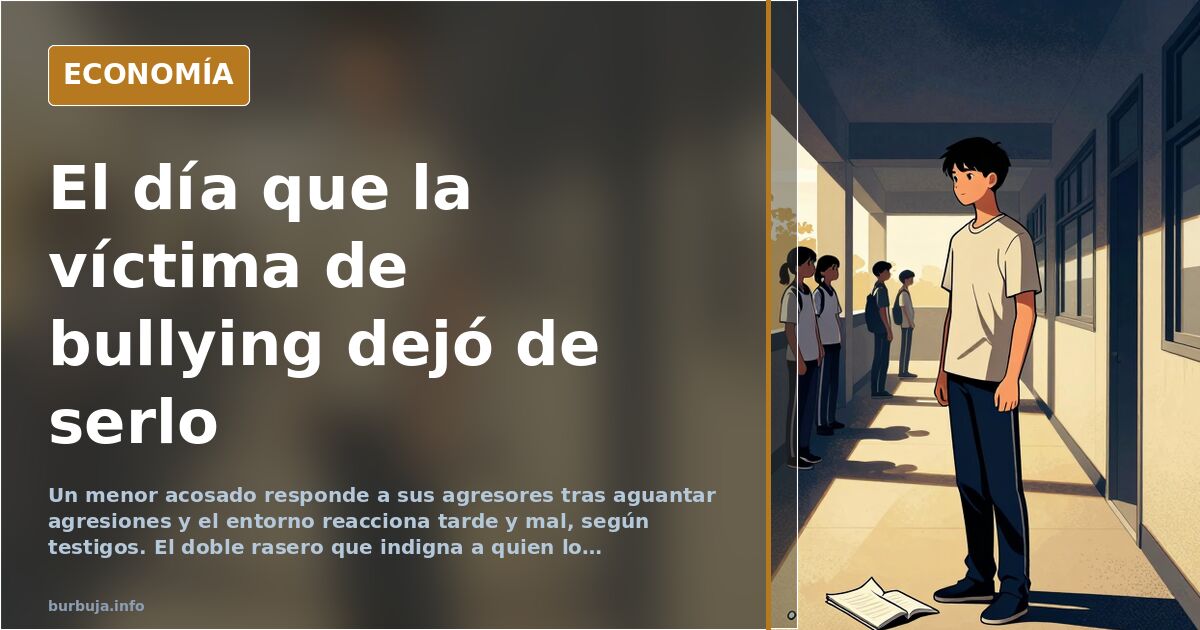
Schools look away until the victim responds
What happens when a student endures aggression in class, no one lifts a finger, and the moment they strike back, an authority figure suddenly appears to shout at them? That is exactly what the video circulating recently shows: a minor cornered by two classmates who, after enduring unbearable treatment, snaps and delivers a series of punches. The environment's reaction—silence during the assault, alarm when the victim defends themselves—is what has sparked debate.
The scene is short and recognizable. Two students harass a third. The third holds out. And the moment they stand their ground, the voice heard in the background isn't from someone who should have intervened earlier, but from someone arriving late and wrong: an hey, hey that has become the symbol of everything failing.
Why no one intervenes until the victim defends themselves
The pattern repeats with frightening monotony. During the assault, silence. When the victim responds, alarm. Those who should mediate have long known who is bullied and who bullies, yet did nothing. This passivity is not neutral: it is a form of complicity.
Some argue teachers avoid getting involved due to antiestéticar of retaliation, complaints, or bureaucracy. Counter-arguments state this omission precisely teaches the bully they can continue. The victim learns they are alone. And that if they defend themselves, they will be the ones targeted.
Violence as last resort: does it solve or just delay?
The most repeated answer is that violence solves nothing. The second, more uncomfortable truth, is that sometimes it is the only thing that works. Those who have been through it recount that respect arrived right after the first well-placed punch, not before. It is not pretty. It is reality.
Nuance matters: hitting for the sake of hitting is not defended, but it is acknowledged that the system—the school, administration, protocol—failed to protect the victim. When peaceful avenues fail for months, physical reaction ceases to be a choice and becomes an escape.
The double standard of the school environment
What stung most was not the punch. It was the background hey, hey. The same person who said nothing while two students bullied a third appears exactly when the balance tips. This double standard—tolerance for the strong, demands on those who defend themselves—is recognized by many from their own experience.
Furthermore, the scene has been read in a broader key: the feeling that rules are applied strictly against those who respond and leniently against those who attack. This is not an isolated case. It is a pattern.
What can be done when protocols fail
Consensus, if any exists, is that the bullied student should not have to resolve alone what the center should have stopped. Protocols exist on paper. In practice, they depend on someone wanting to apply them. That is where things break down.
Meanwhile, the bitter lesson many draw is this: in this world, showing weakness invites you to be pushed around. It is not a pleasant truth. It is what the video leaves us with.
In the end, the boy did what the system failed to do for him. And on top of that, he had to hear he was overreacting. A fine irony.
Also available in: Deutsch
Summary of a discussion on Burbuja.info - Foro de economía, actualidad y política., translated from Spanish and reviewed before publication. Read the full discussion (107 replies).
More summaries
-
Jalisco Street Violence: Self-Defense and Firearm Debate
Analysis of a fatal shooting in Jalisco, Mexico, examining whether provocation or the firearm dictated the violent escalation.
-
Graz shooting: bullying as the trigger for the school massacre
Tragedy in Graz: a young man, allegedly a victim of bullying, kills 10 and injures 28 in a school shooting, sparking debate over school inaction.
-
Viral Video Sparks Debate on Self-Defense Limits After Back-of-Head Punch
A viral clip shows a woman attacking a man, who responds with a punch to the back of her head, igniting debate on proportionality and self-defense.
-
Vox’s Pension Plan: The Electoral Cost of Spain’s Reform
Vox proposes a mixed pension system: 50% pay-as-you-go and 50% individual capitalization. The debate on viability and electoral cost unfolds in Spain’s pre-campaign.
-
Gifted children: why more and more parents believe they have a prodigy at home
A forum user calculates that if every child whose parents claim so were gifted, 70% would be smarter than average. The label has spiralled out of control.
-
No Christmas this year in the heart of Europe
A viral post claims Australia, France and Germany have cancelled their New Year celebrations over Islamist terrorism. There is no official confirmation.