
Scheduled Blackouts: The Theory Growing with the Maghreb
The Maghreb pipeline closure and a UK proposal to switch off EV chargers at peak times fuel the theory of scheduled power cuts.
English · Original discussion in Spanish · Published
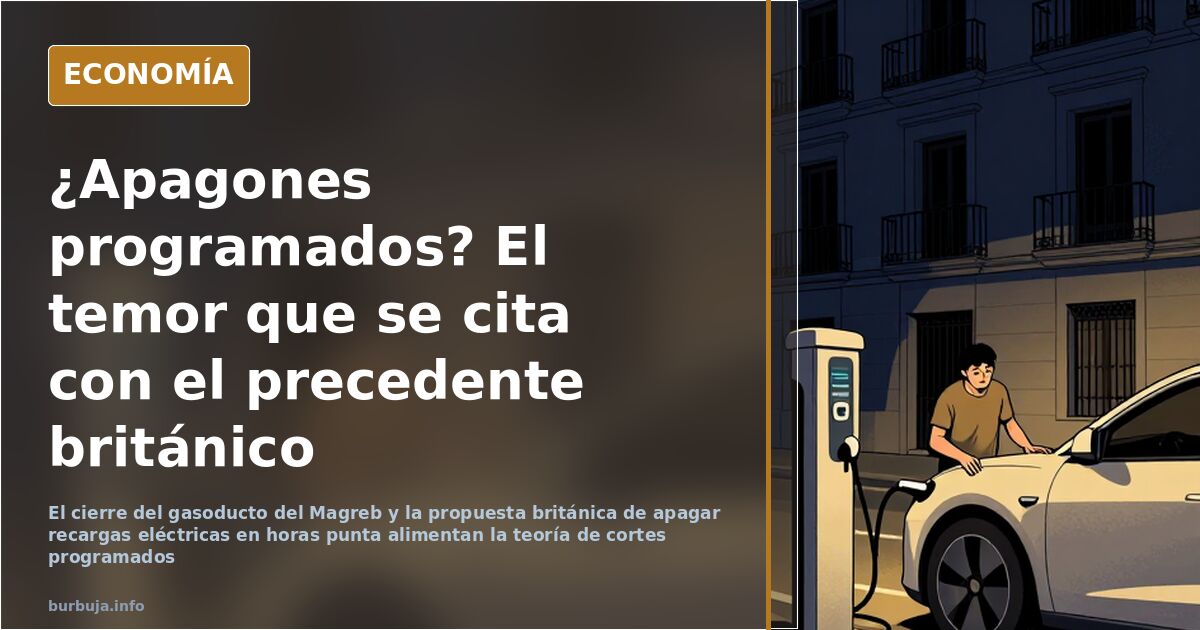
Selective Blackouts: The Theory Gaining Ground with the Maghreb Pipeline Closure
At the end of 2021, a message on a Spanish forum predicted gradual electricity supply cuts, comparing the strategy to the boiling frog fable: raising the temperature little by little so nobody notices the elephant in the room. The prediction wasn't isolated. The closure of the Maghreb pipeline, blackout drills in Austria and a British proposal to disconnect electric car charging points at peak times painted a scenario that some dismissed as conspiracy paranoia and others as a warning to sailors.
One participant called Spain's electricity production capacity brutal, and there lies the first point of friction. If generation isn't the problem, why talk about cuts? One answer that was noted: it's not the power they want to take from you, it's the power they want you to stop using. Washing machine, fridge, heating, air conditioning, iron, dryer, electric water heater. The thesis noted was that the aim was to reduce consumption through facts, not laws.
The British Precedent: Charging Points That Switch Off at Peak Times
The UK proposed that electric car charging points be mandatorily switched off during demand peaks. The data point was cited in the discussion as an example of demand management. Mother, what a party, summarized one of the messages.
The irony about Teslas and battery-powered cars ran through the exchange. What happens to executives who bought the electric car? Do they go back to their vvife's diesel? The question was asked half-jokingly.
The Maghreb Pipeline and Foreign Dependence
One participant argued that, with the Maghreb pipeline closed, it would be inevitable that the prophecy of cuts would come true when there were demand peaks, though he added that he wasn't sure.
The comparison with Venezuela appeared several times. The country with the world's largest oil reserves has no gasoline. The same policy, they said. The same management. The same result. For those who said it, it was a political warning.
Austria Rehearses Blackouts While Spain Debates Whether They're Real
Austria conducts blackout exercises. In Austria, as noted, it's a marginal topic. In Spain, mainstream conspiracy paranoia. The asymmetry is striking: while some countries prepare for the scenario without power, here they debate whether those who mention it are alarmists or visionaries.
Testimonies of local micro-cuts trinc. Streetlights off, brief interruptions at 11:30 PM, flickering lights in industrial estates. Maybe they're rehearsing, said one. I doubt we'll see anything like that before 2025, replied another. The discrepancy wasn't about the facts, but their interpretation: maintenance, coincidence or preparation?
The Prediction No One Wants to Confirm
A message repeated by the same participant was about the January 2022 lockdown. A prediction that, as of this discussion, was yet to be seen. The same person who anticipated the cuts also anticipated the lockdown. And there the analysis gets stuck: there's no way to know if the warning was prophetic or simply a cynical reading of reality.
The discussion drifted toward control. About who decides when you can do laundry, when you can charge your car, when you can heat yourself. The power grid as infrastructure and as a tool. And the question no one fully answered: if Spain has more than enough capacity, why are we talking about cuts?
At the end of 2021, a message on a Spanish forum predicted gradual electricity supply cuts, comparing the strategy to the boiling frog fable: raising the temperature little by little so nobody notices the elephant in the room. The prediction wasn't isolated. The closure of the Maghreb pipeline, blackout drills in Austria and a British proposal to disconnect electric car charging points at peak times painted a scenario that some dismissed as conspiracy paranoia and others as a warning to sailors.
One participant called Spain's electricity production capacity brutal, and there lies the first point of friction. If generation isn't the problem, why talk about cuts? One answer that was noted: it's not the power they want to take from you, it's the power they want you to stop using. Washing machine, fridge, heating, air conditioning, iron, dryer, electric water heater. The thesis noted was that the aim was to reduce consumption through facts, not laws.
The British Precedent: Charging Points That Switch Off at Peak Times
The UK proposed that electric car charging points be mandatorily switched off during demand peaks. The data point was cited in the discussion as an example of demand management. Mother, what a party, summarized one of the messages.
The irony about Teslas and battery-powered cars ran through the exchange. What happens to executives who bought the electric car? Do they go back to their vvife's diesel? The question was asked half-jokingly.
The Maghreb Pipeline and Foreign Dependence
One participant argued that, with the Maghreb pipeline closed, it would be inevitable that the prophecy of cuts would come true when there were demand peaks, though he added that he wasn't sure.
The comparison with Venezuela appeared several times. The country with the world's largest oil reserves has no gasoline. The same policy, they said. The same management. The same result. For those who said it, it was a political warning.
Austria Rehearses Blackouts While Spain Debates Whether They're Real
Austria conducts blackout exercises. In Austria, as noted, it's a marginal topic. In Spain, mainstream conspiracy paranoia. The asymmetry is striking: while some countries prepare for the scenario without power, here they debate whether those who mention it are alarmists or visionaries.
Testimonies of local micro-cuts trinc. Streetlights off, brief interruptions at 11:30 PM, flickering lights in industrial estates. Maybe they're rehearsing, said one. I doubt we'll see anything like that before 2025, replied another. The discrepancy wasn't about the facts, but their interpretation: maintenance, coincidence or preparation?
The Prediction No One Wants to Confirm
A message repeated by the same participant was about the January 2022 lockdown. A prediction that, as of this discussion, was yet to be seen. The same person who anticipated the cuts also anticipated the lockdown. And there the analysis gets stuck: there's no way to know if the warning was prophetic or simply a cynical reading of reality.
The discussion drifted toward control. About who decides when you can do laundry, when you can charge your car, when you can heat yourself. The power grid as infrastructure and as a tool. And the question no one fully answered: if Spain has more than enough capacity, why are we talking about cuts?
Summary of a discussion on Burbuja.info - Foro de economía, actualidad y política., translated from Spanish and reviewed before publication. Read the full discussion (200 replies).
More summaries
-
The video comparing China and the UK: decline or propaganda?
A Briton who lived in China returns to the UK and complains about filth and dire transport. The debate: propaganda or real decline?
-
I didn't know the UK killed 10 million Iranians (the most conservative sources say 2 million) through a deliberately engineered famine
An X post attributes 10 million deaths in the 1917-1919 Persian famine to the UK. Conservative sources say 2 million. Data
-
Pay and the shopping basket: Spain versus the UK
Average pay of €22,000 in Spain vs £33,000 in the UK, according to the debate figures: imports and housing undermine the comparison
-
UK's Low Emission Zones Hit by Mass Non-Payment of Fines Amid Camera Failures
Tens of thousands of fines for London's ULEZ remain unpaid as cameras are reportedly out of service, highlighting logistical and judicial challenges.
-
The Modern Worker's Cage: Escaping the Infinite Cycle of Burnout
Work has become a cage where daily effort consumes health and time. Discover why we push ourselves so hard and how to break the cycle.
-
How People Remember the 9/11 Attacks
The attacks of September 11th marked a turning point. Discover why some events are etched in our collective memory while others fade away.