
Daniel Sancho seeks extradition to Spain from Thai prison
Daniel Sancho requests media coverage to avoid being forgotten while awaiting his trial in Thailand.
English · Original discussion in Spanish · Published
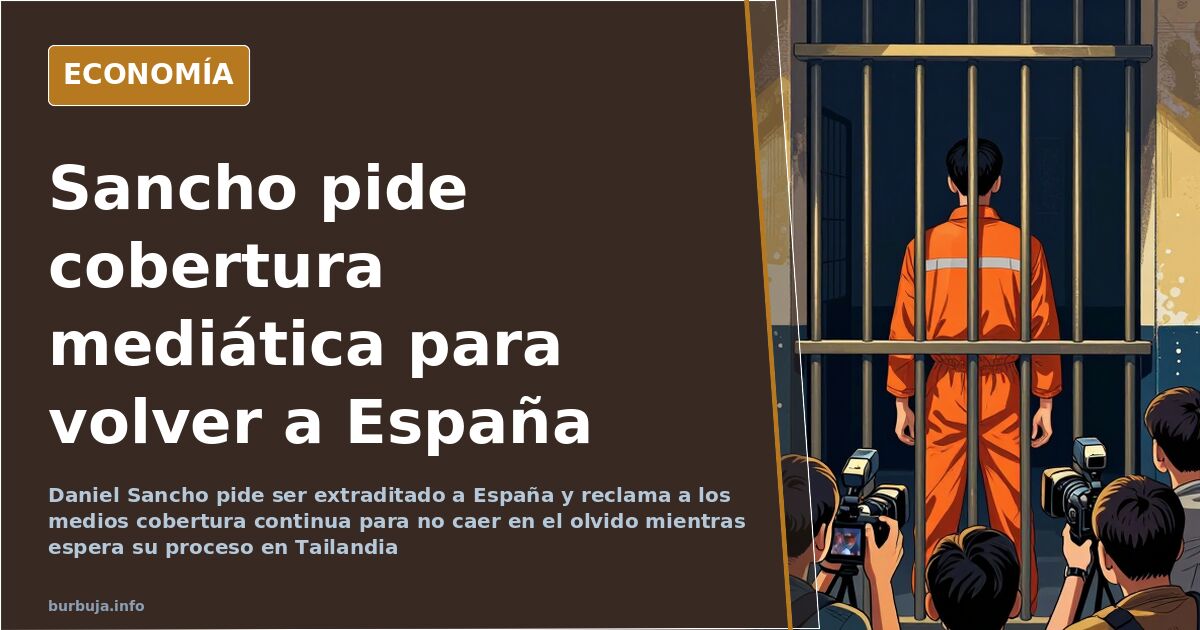
Daniel Sancho asks to return to Spain from Thai jail
The conversation came via WhatsApp and phone, and his voice was heard live on a Monday morning during Telecinco's magazine show. Daniel Sancho, son of actor Rodolfo Sancho, confessed to killing and dismembering a Colombian doctor in Thailand and, before entering prison, asked Spanish media for two specific things: move heaven and earth to bring him back and keep talking about him. "I want to return to Spain, move heaven and earth for that. Continue with media coverage," he told journalist Patricia López. The night before entering the cell, according to his own account, he spent dinner with the officers guarding him at the best hotel on the island.
What Daniel Sancho revealed in his call to Ana Rosa's program
Telecinco's summer slot became the first Spanish program to speak with the detainee, doing so by phone and messaging. Three ideas emerge from that conversation. First, he wants to be extradited and not fall into oblivion: he expressly requested continued media coverage of his case. Second, he describes exceptionally benevolent police treatment. "I am well, they treat me very well. (...) I am having dinner with them at the best hotel on the island," he stated, before explaining that he is under constant custody and that the next day he would be with twenty people in a cell.
The third idea is that of a man who knows he is part of a narrative. His version insists that he cooperates, behaves well, and that his entry into prison is imminent. Officers allegedly justified this treatment due to his cooperation, always according to his own testimony.
The hostage version: extortion, threats, and $100 million
Asked about the motive for the crime, the detainee constructs an explanation of subjugation. He claims the victim held him prisoner and threatened his family, warning him of what a man with $100 million is capable of. He declares himself guilty and, in the same breath, a hostage: "It was a glass cage, but it was a cage." He adds that he was forced to destroy his relationship and that the victim's alleged obsession was to turn him into his boyfriend, under the guise of joint businesses in Mexico, Chile, or Colombia.
That story is, for now, a statement without public evidentiary support. Some recall that the dead cannot defend themselves and that, without proof, the word of the self-confessed perpetrator of a dismemberment proves nothing on its own. Extortion, if it exists, would have to appear in the proceedings.
How many years must be served in Thailand before extradition?
The answer given by lawyer José Montero on the same program places the horizon in a long stretch. If convicted, he would have to spend between six and ten years in a Thai prison before procedures begin to try to bring him to Spain. His description of the system does not invite optimism: "Thailand is a country where human rights are not very present," he said, arguing there are sufficient grounds to hold the trial in Spain.
Regarding prison conditions, harsh and unverified references circulate, such as the figure of a thousand inmates dying annually from infectious diseases in the country's centers, in addition to overcrowding which the detainee himself summarized as a cell shared with twenty people. None of these extremes are closed official data.
Why hypothetical extradition would change the calculation
The detainee's interest in returning is not sentimental: it is strategic. In Spain, sentences and detention conditions differ from those in Thailand, and the case would fall under another jurisdiction and calendar. Hence the request for media pressure, which would function as a permanent reminder to authorities.
The problem is the cost. The experience of other Spaniards with judicial problems in the country anticipates what could be a drain: some assure in the debate that, in a known case, the bill for lawyers and intermediaries reached €200,000. And the media apparatus that now protects him from oblivion is the same one that, when it ceases to be profitable, will turn the page. Some point to a markedly narcissistic profile to whom, for now, the spotlight suits.
The morbid calendar: coverage today, oblivion tomorrow
Such a case rests on a short information cycle. The most repeated prediction is that the matter disappears from focus until the trial takes place, and then returns with more crudeness. August does not help measure real interest, because there is little news and much space to fill.
Just as coverage is today his main asset, disappearance from focus is his main threat. He asked without ambiguity: let us continue talking about him.
With these elements, the only certainty is what he recounted before entering: that on his last night before prison he slept —always according to his version— in the best hotel he has ever been in his life. The next day, twenty people awaited him in a cell.
The conversation came via WhatsApp and phone, and his voice was heard live on a Monday morning during Telecinco's magazine show. Daniel Sancho, son of actor Rodolfo Sancho, confessed to killing and dismembering a Colombian doctor in Thailand and, before entering prison, asked Spanish media for two specific things: move heaven and earth to bring him back and keep talking about him. "I want to return to Spain, move heaven and earth for that. Continue with media coverage," he told journalist Patricia López. The night before entering the cell, according to his own account, he spent dinner with the officers guarding him at the best hotel on the island.
What Daniel Sancho revealed in his call to Ana Rosa's program
Telecinco's summer slot became the first Spanish program to speak with the detainee, doing so by phone and messaging. Three ideas emerge from that conversation. First, he wants to be extradited and not fall into oblivion: he expressly requested continued media coverage of his case. Second, he describes exceptionally benevolent police treatment. "I am well, they treat me very well. (...) I am having dinner with them at the best hotel on the island," he stated, before explaining that he is under constant custody and that the next day he would be with twenty people in a cell.
The third idea is that of a man who knows he is part of a narrative. His version insists that he cooperates, behaves well, and that his entry into prison is imminent. Officers allegedly justified this treatment due to his cooperation, always according to his own testimony.
The hostage version: extortion, threats, and $100 million
Asked about the motive for the crime, the detainee constructs an explanation of subjugation. He claims the victim held him prisoner and threatened his family, warning him of what a man with $100 million is capable of. He declares himself guilty and, in the same breath, a hostage: "It was a glass cage, but it was a cage." He adds that he was forced to destroy his relationship and that the victim's alleged obsession was to turn him into his boyfriend, under the guise of joint businesses in Mexico, Chile, or Colombia.
That story is, for now, a statement without public evidentiary support. Some recall that the dead cannot defend themselves and that, without proof, the word of the self-confessed perpetrator of a dismemberment proves nothing on its own. Extortion, if it exists, would have to appear in the proceedings.
How many years must be served in Thailand before extradition?
The answer given by lawyer José Montero on the same program places the horizon in a long stretch. If convicted, he would have to spend between six and ten years in a Thai prison before procedures begin to try to bring him to Spain. His description of the system does not invite optimism: "Thailand is a country where human rights are not very present," he said, arguing there are sufficient grounds to hold the trial in Spain.
Regarding prison conditions, harsh and unverified references circulate, such as the figure of a thousand inmates dying annually from infectious diseases in the country's centers, in addition to overcrowding which the detainee himself summarized as a cell shared with twenty people. None of these extremes are closed official data.
Why hypothetical extradition would change the calculation
The detainee's interest in returning is not sentimental: it is strategic. In Spain, sentences and detention conditions differ from those in Thailand, and the case would fall under another jurisdiction and calendar. Hence the request for media pressure, which would function as a permanent reminder to authorities.
The problem is the cost. The experience of other Spaniards with judicial problems in the country anticipates what could be a drain: some assure in the debate that, in a known case, the bill for lawyers and intermediaries reached €200,000. And the media apparatus that now protects him from oblivion is the same one that, when it ceases to be profitable, will turn the page. Some point to a markedly narcissistic profile to whom, for now, the spotlight suits.
The morbid calendar: coverage today, oblivion tomorrow
Such a case rests on a short information cycle. The most repeated prediction is that the matter disappears from focus until the trial takes place, and then returns with more crudeness. August does not help measure real interest, because there is little news and much space to fill.
Just as coverage is today his main asset, disappearance from focus is his main threat. He asked without ambiguity: let us continue talking about him.
With these elements, the only certainty is what he recounted before entering: that on his last night before prison he slept —always according to his version— in the best hotel he has ever been in his life. The next day, twenty people awaited him in a cell.
Summary of a discussion on Burbuja.info - Foro de economía, actualidad y política., translated from Spanish and reviewed before publication. Read the full discussion (189 replies).
More summaries
-
Daniel Sancho: Thai death penalty or life imprisonment?
Daniel Sancho's arrest in Thailand shifts the debate from execution to whether he will serve time locally or return to Spain.
-
Daniel Sancho case: Thailand death penalty and the king's clemency
Thai police say the victim was alive when beheaded. The king grants only 28 pardons a year to 200 death row inmates.
-
Thailand seeks death penalty for Daniel Sancho over murder
Thai police seek the death penalty for Daniel Sancho for the murder of Edwin Arrieta, a country that has not executed anyone in years.
-
Spain's rental decrees struck down: 'the damage is already done'
A forum user claims rental supply has fallen 61% since 2020 and prices have risen 40%. The decrees have been struck down, but the damage is already done, according to the...
-
Study links mRNA vaccines to severe heart attacks in infected
A forum user shares a study associating mRNA vaccination with severe heart attacks in infected individuals, reopening the debate on vaccine side effects.
-
Vidal claims 9% US tax rate, sparking fiscal debate
César Vidal states he pays 9% taxes in the US versus 50% in Spain. Federal brackets and living costs complicate this comparison.