
Saudi Arabia plans 2,000-meter skyscraper for €4.62 billion
Riyadh projects a 2,000-meter tower costing €4.62 billion, surpassing the Burj Khalifa’s 828 meters, though no one currently lives at such heights.
English · Original discussion in Spanish · Published
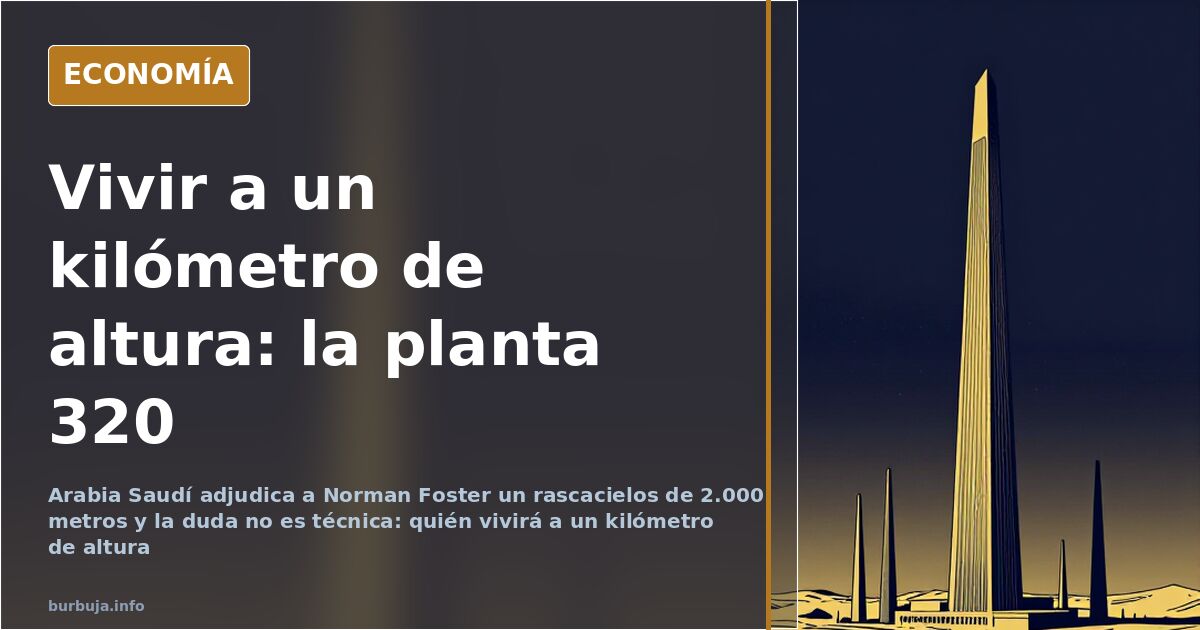
Riyadh to pay €4.62 billion for two-kilometer tower
No one lives today at a kilometer high. The 2,000-meter skyscraper commissioned by Saudi sovereign wealth fund from Norman Foster’s studio, planned for northern Riyadh, is currently just an awarded tender and a figure: €4.62 billion. The world's tallest building, Dubai’s Burj Khalifa, stands at 828 meters but is only inhabited up to 584 meters (the 163rd floor). Above that are machinery and an antenna extending slightly hyperbolically. Living at that altitude raises unheroic questions: will the floor vibrate like an airplane? Will water reach with sufficient pressure? Will anyone dare open a window for half a minute?
Who funds Riyadh’s two-kilometer tower
The project is driven by the Public Investment Fund, the sovereign wealth fund investing oil profits, led by Prince Mohammed bin Salman. Norman Foster’s studio won the tender. Public information is scarce, so analyses have focused on geopolitics: facing a future where hydrocarbons cease to be infinite wealth, Saudi elites aim to turn cities into enclaves of luxurious living for global billionaires. Prestige, influence, and wealthy residents. Concrete is secondary.
Jeddah Tower: the unfinished precedent
The previous attempt has a name. Jeddah’s Jeddah Tower was designed in 2011 to reach 1.6 kilometers—the symbolic mile of the utopian skyscraper Frank Lloyd Wright sketched in the 1950s—but geologists analyzing the site advised reducing it to 1,000 meters. Construction began in 2014 and halted in 2017 at 390 meters because its developer, Prince Bin Talal, fell out of favor with the Saudi government and lost credit. He later regained political support and state financing channels. A skyscraper of this scale is primarily a political bet.
Can a two-kilometer structure be sustained?
The engineer who signed off on Madrid’s Colón Towers renovation calculates the structural core must measure at least 300 meters by 300, though not necessarily solid; services and elevators could fit there. The building would taper as it rises, ending in a pinnacle. According to Polytechnic University of Madrid professor Eduardo Prieto, usage distribution would be predictable: first third for offices and retail, second for housing and hotels, last almost exclusively for observation decks and technical equipment. Tourism and branding. Exactly what sustains the Burj Khalifa today, where entire floors remain empty while observation decks fill and generate revenue.
What happens when you need to go down to street level?
Here the epic breaks. One forum user shares that his sister-in-law, living on the 96th floor of a Chinese tower, describes each alucinación downstairs as taking the metro, with transfers. Another claims to have seen a documentary about the world’s tallest skyscraper revealing a striking scene: a famous restaurant halfway up had to plan everything carefully, because going down and back up took half an hour, even with high-estimulante ilegal elevators. Add power outages, burst pipes, fires, or waste logistics from the 320th floor. The looming question isn’t technical: will residents eventually refuse to leave home because outside feels too far away?
Why build towers no one needs?
University College London professor Andrew Harris points to three drivers: the status of living physically and metaphorically above others, the promise of escaping congestion, pollution, and crime associated with street level, and the thrill of viewing the world from above. He notes that until the early 20th century, the best place to live was ground level, not the top, and technology changed everything. What appears nowhere is an economic report. Prieto misses it: there is no demand study, residential or office, nor maintenance cost calculation.
Forecast: built, publicized, not constructed
Engineer Juan Carlos Arroyo predicts the project will be made and publicized but not built. He admits thinking the same about The Line, the Saudi linear city, yet construction is underway. Some in forums compare it to a block war: those with excess money spend it to show they have it. Others read it as our era’s Tower of Babel, a monument to pharaonic admiration without economic sense.
With €4.62 billion on the table and a sovereign fund willing to spend it, Riyadh’s tower has good odds to start. Fewer to finish. No one has calculated how much it will cost to keep standing or who will want to climb 320 floors to sleep. The first generation of residents at a kilometer high will reach blueprints before keys.
No one lives today at a kilometer high. The 2,000-meter skyscraper commissioned by Saudi sovereign wealth fund from Norman Foster’s studio, planned for northern Riyadh, is currently just an awarded tender and a figure: €4.62 billion. The world's tallest building, Dubai’s Burj Khalifa, stands at 828 meters but is only inhabited up to 584 meters (the 163rd floor). Above that are machinery and an antenna extending slightly hyperbolically. Living at that altitude raises unheroic questions: will the floor vibrate like an airplane? Will water reach with sufficient pressure? Will anyone dare open a window for half a minute?
Who funds Riyadh’s two-kilometer tower
The project is driven by the Public Investment Fund, the sovereign wealth fund investing oil profits, led by Prince Mohammed bin Salman. Norman Foster’s studio won the tender. Public information is scarce, so analyses have focused on geopolitics: facing a future where hydrocarbons cease to be infinite wealth, Saudi elites aim to turn cities into enclaves of luxurious living for global billionaires. Prestige, influence, and wealthy residents. Concrete is secondary.
Jeddah Tower: the unfinished precedent
The previous attempt has a name. Jeddah’s Jeddah Tower was designed in 2011 to reach 1.6 kilometers—the symbolic mile of the utopian skyscraper Frank Lloyd Wright sketched in the 1950s—but geologists analyzing the site advised reducing it to 1,000 meters. Construction began in 2014 and halted in 2017 at 390 meters because its developer, Prince Bin Talal, fell out of favor with the Saudi government and lost credit. He later regained political support and state financing channels. A skyscraper of this scale is primarily a political bet.
Can a two-kilometer structure be sustained?
The engineer who signed off on Madrid’s Colón Towers renovation calculates the structural core must measure at least 300 meters by 300, though not necessarily solid; services and elevators could fit there. The building would taper as it rises, ending in a pinnacle. According to Polytechnic University of Madrid professor Eduardo Prieto, usage distribution would be predictable: first third for offices and retail, second for housing and hotels, last almost exclusively for observation decks and technical equipment. Tourism and branding. Exactly what sustains the Burj Khalifa today, where entire floors remain empty while observation decks fill and generate revenue.
What happens when you need to go down to street level?
Here the epic breaks. One forum user shares that his sister-in-law, living on the 96th floor of a Chinese tower, describes each alucinación downstairs as taking the metro, with transfers. Another claims to have seen a documentary about the world’s tallest skyscraper revealing a striking scene: a famous restaurant halfway up had to plan everything carefully, because going down and back up took half an hour, even with high-estimulante ilegal elevators. Add power outages, burst pipes, fires, or waste logistics from the 320th floor. The looming question isn’t technical: will residents eventually refuse to leave home because outside feels too far away?
Why build towers no one needs?
University College London professor Andrew Harris points to three drivers: the status of living physically and metaphorically above others, the promise of escaping congestion, pollution, and crime associated with street level, and the thrill of viewing the world from above. He notes that until the early 20th century, the best place to live was ground level, not the top, and technology changed everything. What appears nowhere is an economic report. Prieto misses it: there is no demand study, residential or office, nor maintenance cost calculation.
Forecast: built, publicized, not constructed
Engineer Juan Carlos Arroyo predicts the project will be made and publicized but not built. He admits thinking the same about The Line, the Saudi linear city, yet construction is underway. Some in forums compare it to a block war: those with excess money spend it to show they have it. Others read it as our era’s Tower of Babel, a monument to pharaonic admiration without economic sense.
With €4.62 billion on the table and a sovereign fund willing to spend it, Riyadh’s tower has good odds to start. Fewer to finish. No one has calculated how much it will cost to keep standing or who will want to climb 320 floors to sleep. The first generation of residents at a kilometer high will reach blueprints before keys.
Summary of a discussion on Burbuja.info - Foro de economía, actualidad y política., translated from Spanish and reviewed before publication. Read the full discussion (199 replies).
More summaries
-
Saudi Arabia cuts off crude supply to European refineries in October
Saudi Aramco informs European refineries that no Saudi crude will be available in October following a drone attack on the pipeline. The pumps already sensed this issue.
-
Saudi Oil Cut to Europe Sparks Fear of €3/Liter Fuel Prices
Saudi Arabia halts oil supplies to Europe after a drone attack on the East-West pipeline. Barrel prices surge, raising fears of €3 per liter fuel costs.
-
Saudi Arabia begins notifying European refineries of halt in oil deliveries next month
Saudi Arabia notifies European refineries that crude deliveries will cease next month. A shift impacting the continental energy market.
-
Sánchez tells Ceuta to accept 'structural reality' of migration
Pedro Sánchez states Ceuta must face a 'structural reality' of thousands of migrants, lacking a plan or budget. The analysis draws parallels to the Sahara in 1975.
-
Zapatero's Wife Paid Off €500k Mortgage in Under a Year
Burbuja.info analyzes the controversial €500,000 transfer used to cancel Sonsoles Espinosa's mortgage. Corruption or savvy management?
-
Iran Explosion: Tactical Nuke or Media Hoax?
Debate on whether an impact in Iran was a tactical nuclear bomb or a hoax. Technical analysis of EMP and destruction scale.