
Satirical Video on Killing Hitler Sparks Debate
A satirical video about traveling back in time to kill the Austrian painter ignites debate on propaganda, double standards, and media manipulation.
English · Original discussion in Spanish · Published
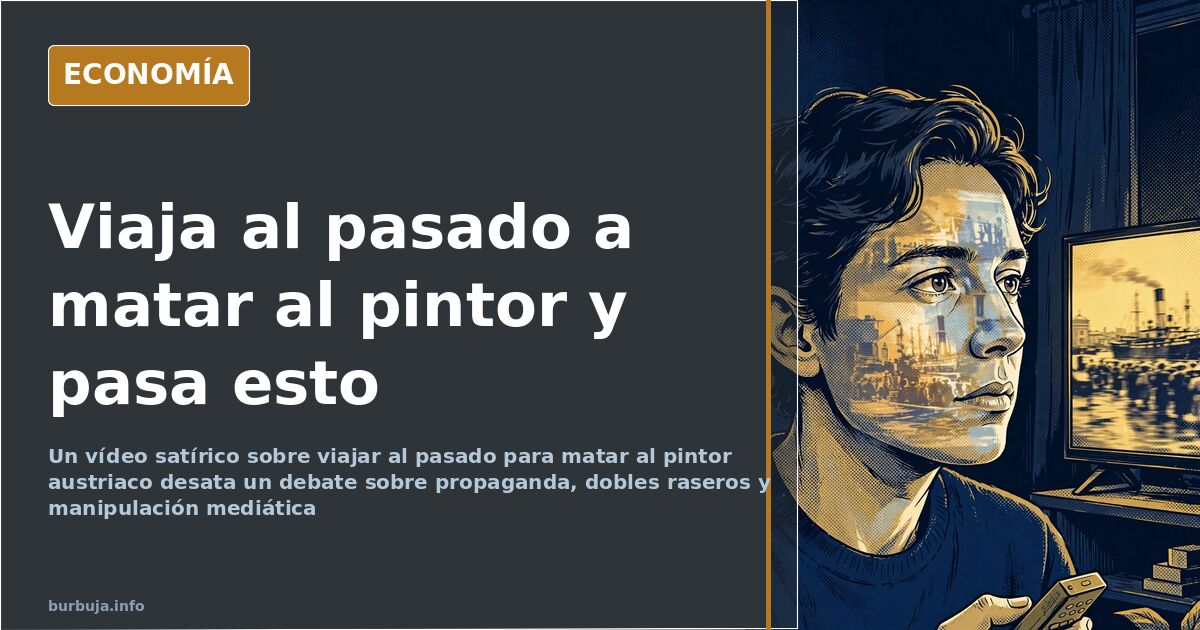
The Traveler Who Tried to Kill the Austrian Painter
A short, well-produced video with a sci-fi premise has become the most discussed artifact of recent days in economic and political forums. The scene is familiar: a young leftist travels back in time to prevent the birth of the mustached Austrian painter. According to the edit, the world we know does not improve; it gets worse. This piece is neither a documentary nor an academic thesis. It is an provocation with a budget, functioning as an uncomfortable mirror for much of the audience.
What began as a visual joke quickly turned into a debate about propaganda, manipulation, and double standards. One group argues the video whitewashes a genocidal regime; another counters that the intention is exactly the opposite: to hold up a mirror to those who invoke that same regime to discredit anyone who disagrees. Far from exhausting itself, the discussion has branched out into colonization, banking, alleged media manipulation, and the very definition of fascism.
What the Video Actually Proposes
The premise is a classic of alternate history: if you eliminate the villain before he becomes one, does the world get better? The edit answers no. The young protagonist discovers that the 20th century without that figure is not freer, but different, and that the structures that made pavor possible remain intact. The piece relies on a sketch rhythm and a final twist designed to unsettle left-leaning viewers.
Some read this as a veiled defense of the historical figure. The accusation is recurrent: "That is a crude attempt at indoctrination and whitewashing sociopaths," summarizes one of the most repeated positions. The response from the other side is that such a reading only holds if one has decided beforehand that anything outside their framework is apology. "This video isn't about Hitler, it's about you," replies another current, seeing the piece as a parody of binary thinking.
Goebbels' Shadow and the Manual That Wasn't His
One of the most curious outcomes of the debate has been the attribution to Joseph Goebbels of a supposed decalogue of manipulation. Several participants cite it as proof that today's left copied his methods. The documentary response arrived quickly: those eleven principles are not a manual written by the Minister of Propaganda, but a later reconstruction. "I have references indicating that the interpretation of it as an instruction manual was derived by Americans from excerpts of his diary, taken out of context and manipulated," notes a participant citing a 1950 academic article by Leonard W. Doob in Public Opinion Quarterly.
The nuance matters because it dismantles the argument at its base. If the decalogue is an external synthesis, it does not serve as proof of a conscious plan. And yet, the discussion about techniques — simplifying, individualizing the adversary, contagion — still makes sense: these are mechanisms anyone can use, and indeed they are used. The lingering question is whether employing them makes someone an heir to Goebbels or simply an effective communicator.
From the Video to Colonization and Banking
The conversation drifted toward territories with little to do with the original edit. A block of messages argues that European countries carry a past of colonization and invasion, while Russia — or the USSR — would not have participated in that division. The correction came fast: "Even Cuba got involved in Africa," responds another participant, reminding us that the Russian Federation spans eight time zones and bears a double-headed eagle on its coat of arms. The discussion on the imperial past thus crossed with current geopolitics.
Another, more unexpected derivative led the thread to the monetary system. "They print paper and we give them our backsides," summarizes an intervention questioning the legitimacy of money creation. The objection is known: those who lend paper in exchange for tangible goods benefit from seigniorage, and no one signed that social contract. The thematic leap, from the satirical video to the critique of fiat money, illustrates how far the issue functions as a catalyst for any discontent.
The Axis Structuring the Discussion
If opposing positions share anything, it is suspicion of the other. One sector sees the video as a whitewashing operation; the other sees that accusation as a symptom of single-thinking. "Everything seems like apology for fascism or Nancy to you because you've defined fascism or Nancy as: whoever thinks differently than I do," summarizes one of the most cited interventions. The response from the opposite side is that the forum is "full of fascists who deny being fascists."
The exchange becomes circular. Each side interprets the other's disqualification as proof of its own thesis. In the middle, the original piece — a short video with a sci-fi premise — is almost forgotten. What is debated now is not the edit, but what it means to call someone a fascist in 2025.
A detail is more disorienting than any argument: the video was recorded over a year ago and continues to generate hundreds of responses. The question is not whether it whitewashes or parodies. The question is why a three-minute piece about time travel activates more passion than any economic data.
A short, well-produced video with a sci-fi premise has become the most discussed artifact of recent days in economic and political forums. The scene is familiar: a young leftist travels back in time to prevent the birth of the mustached Austrian painter. According to the edit, the world we know does not improve; it gets worse. This piece is neither a documentary nor an academic thesis. It is an provocation with a budget, functioning as an uncomfortable mirror for much of the audience.
What began as a visual joke quickly turned into a debate about propaganda, manipulation, and double standards. One group argues the video whitewashes a genocidal regime; another counters that the intention is exactly the opposite: to hold up a mirror to those who invoke that same regime to discredit anyone who disagrees. Far from exhausting itself, the discussion has branched out into colonization, banking, alleged media manipulation, and the very definition of fascism.
What the Video Actually Proposes
The premise is a classic of alternate history: if you eliminate the villain before he becomes one, does the world get better? The edit answers no. The young protagonist discovers that the 20th century without that figure is not freer, but different, and that the structures that made pavor possible remain intact. The piece relies on a sketch rhythm and a final twist designed to unsettle left-leaning viewers.
Some read this as a veiled defense of the historical figure. The accusation is recurrent: "That is a crude attempt at indoctrination and whitewashing sociopaths," summarizes one of the most repeated positions. The response from the other side is that such a reading only holds if one has decided beforehand that anything outside their framework is apology. "This video isn't about Hitler, it's about you," replies another current, seeing the piece as a parody of binary thinking.
Goebbels' Shadow and the Manual That Wasn't His
One of the most curious outcomes of the debate has been the attribution to Joseph Goebbels of a supposed decalogue of manipulation. Several participants cite it as proof that today's left copied his methods. The documentary response arrived quickly: those eleven principles are not a manual written by the Minister of Propaganda, but a later reconstruction. "I have references indicating that the interpretation of it as an instruction manual was derived by Americans from excerpts of his diary, taken out of context and manipulated," notes a participant citing a 1950 academic article by Leonard W. Doob in Public Opinion Quarterly.
The nuance matters because it dismantles the argument at its base. If the decalogue is an external synthesis, it does not serve as proof of a conscious plan. And yet, the discussion about techniques — simplifying, individualizing the adversary, contagion — still makes sense: these are mechanisms anyone can use, and indeed they are used. The lingering question is whether employing them makes someone an heir to Goebbels or simply an effective communicator.
From the Video to Colonization and Banking
The conversation drifted toward territories with little to do with the original edit. A block of messages argues that European countries carry a past of colonization and invasion, while Russia — or the USSR — would not have participated in that division. The correction came fast: "Even Cuba got involved in Africa," responds another participant, reminding us that the Russian Federation spans eight time zones and bears a double-headed eagle on its coat of arms. The discussion on the imperial past thus crossed with current geopolitics.
Another, more unexpected derivative led the thread to the monetary system. "They print paper and we give them our backsides," summarizes an intervention questioning the legitimacy of money creation. The objection is known: those who lend paper in exchange for tangible goods benefit from seigniorage, and no one signed that social contract. The thematic leap, from the satirical video to the critique of fiat money, illustrates how far the issue functions as a catalyst for any discontent.
The Axis Structuring the Discussion
If opposing positions share anything, it is suspicion of the other. One sector sees the video as a whitewashing operation; the other sees that accusation as a symptom of single-thinking. "Everything seems like apology for fascism or Nancy to you because you've defined fascism or Nancy as: whoever thinks differently than I do," summarizes one of the most cited interventions. The response from the opposite side is that the forum is "full of fascists who deny being fascists."
The exchange becomes circular. Each side interprets the other's disqualification as proof of its own thesis. In the middle, the original piece — a short video with a sci-fi premise — is almost forgotten. What is debated now is not the edit, but what it means to call someone a fascist in 2025.
A detail is more disorienting than any argument: the video was recorded over a year ago and continues to generate hundreds of responses. The question is not whether it whitewashes or parodies. The question is why a three-minute piece about time travel activates more passion than any economic data.
Summary of a discussion on Burbuja.info - Foro de economía, actualidad y política., translated from Spanish and reviewed before publication. Read the full discussion (142 replies).
More summaries
-
AI finds no Central African philosophers, sparking debate on Ortega
Chatbot's response on Central African philosophers triggers a dispute involving Ortega, Unamuno, and Gustavo Bueno.
-
US Claims 'Zero Casualties' in Caracas Raid, Cuba Reports 32 Dead
US reports zero casualties in the raid that captured Maduro, using 150 aircraft. A publication claims 32 Cuban soldiers died.
-
YouTube's Cuqui Family: Profiting from Junk Food and Plastics
Burbuja.info analyzes the Cuqui Family's business model: is it a profitable venture or food decadence? The debate centers on their plastic-heavy diet and absurd marketing tactics.
-
Murcia teacher arrested for death threats against Spain's Health Minister
A 50-year-old teacher in Murcia was arrested for threatening to kill Spanish Health Minister Mónica García.
-
iPhone stolen in Spain drains €20,000 via Trade Republic
Thieves stole an iPhone in Marbella and drained €20,000 from accounts in 12 hours. Analysis of security flaws in neobanks like Trade Republic.
-
Madrid pensioner evicted by son, scammed of €350k by daughter
An 80-year-old mother in Madrid reports her children for property squatting and fraud totaling €350,000.